

Read The Times Australia

Daily Bulletin

Sharks come in many different shapes and sizes. But they all follow a centuries-old mathematical rule

  • Written by: Jodie L. Rummer, Professor of Marine Biology, James Cook University
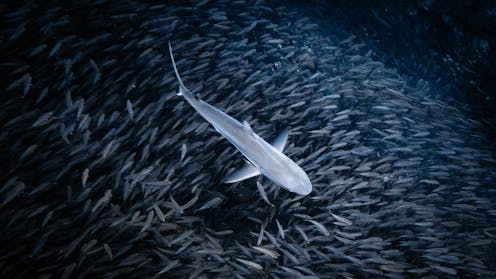
Sharks come in many different shapes and sizes. But they all follow a centuries-old mathematical rule

From hand-sized lantern sharks that glow in the deep sea to bus-sized whale sharks gliding through tropical waters, sharks come in all shapes and sizes.

Despite these differences, they all face the same fundamental challenge: how to get oxygen, heat and nutrients to every part of their bodies efficiently.

Our new study, published today in Royal Society Open Science, shows that sharks follow a centuries-old mathematical rule – the two-thirds scaling law – that predicts how body shape changes with size. This tells us something profound about how evolution works – and why size really does matter.

What is the two-thirds scaling law?

The basic idea is mathematical: surface area increases with the square of body length, while volume increases with the cube. That means surface area increases more slowly than volume, and the ratio between the two – crucial for many biological functions – decreases with size.

This matters because many essential life processes happen at the surface: gas exchange in the lungs or gills, such as to take in oxygen or release carbon dioxide, but also heat loss through skin and nutrient uptake in the gut.

These processes depend on surface area, while the demands they must meet – such as the crucial task of keeping the body supplied with oxygen – depend on volume. So, the surface area-to-volume ratio shapes how animals function.

A small shark held in a human hand.
Whale sharks are as big as buses, while dwarf lanternsharks (pictured here) are as small as a human hand. Chip Clark/Smithsonian Institution

Despite its central role in biology, this rule has only ever been rigorously tested in cells, tissues and small organisms such as insects.

Until now.

Why sharks?

Sharks might seem like an unlikely group for testing an old mathematical theory, but they’re actually ideal.

For starters, they span a huge range of sizes, from the tiny dwarf lantern shark (about 20 centimetres long) to the whale shark (which can exceed 20 metres). They also have diverse shapes and lifestyles – hammerheads, reef-dwellers, deep-sea hunters – each posing different challenges for physiology and movement.

Plus, sharks are charismatic, ecologically important and increasingly under threat. Understanding their biology is both scientifically valuable and important for conservation.

A school of sharks swimming through a coral reef.
Sharks are ecologically important but are increasingly under threat. Rachel Moore

How did we test the rule?

We used high-resolution 3D models to digitally measure surface area and volume in 54 species of sharks. These models were created using open-source CT scans and photogrammetry, which involves using photographs to approximate a 3D structure. Until recently, these techniques were the domain of video game designers and special effects artists, not biologists.

We refined the models in Blender, a powerful 3D software tool, and extracted surface and volume data for each species.

Then we applied phylogenetic regression – a statistical method that accounts for shared evolutionary history – to see how closely shark shapes follow the predictions of the two-thirds rule.

3D models of various kinds of sharks.
Sharks follow the two-thirds scaling rule almost perfectly, as seen in this 3D representation. Joel Gayford et al

What did we find?

The results were striking: sharks follow the two-thirds scaling rule almost perfectly, with surface area scaling to body volume raised to the power of 0.64 – just a 3% difference from the theoretical 0.67.

This suggests something deeper is going on. Despite their wide range of forms and habitats, sharks seem to converge on the same basic body plan when it comes to surface area and volume. Why?

One explanation is that what are known as “developmental constraints” – limits imposed by how animals grow and form in early life – make it difficult, or too costly, for sharks to deviate from this fundamental pattern.

Changing surface area-to-volume ratios might require rewiring how tissues are allocated during embryonic development, something that evolution appears to avoid unless absolutely necessary.

But why does it matter?

This isn’t just academic. Many equations in biology, physiology and climate science rely on assumptions about surface area-to-volume ratios.

These equations are used to model how animals regulate temperature, use oxygen, and respond to environmental stress. Until now, we haven’t had accurate data from large animals to test those assumptions. Our findings give researchers more confidence in using these models – not just for sharks, but potentially for other groups too.

As we face accelerating climate change and biodiversity loss, understanding how animals of all sizes interact with their environments has never been more urgent.

This study, powered by modern imaging tech and some old-school curiosity, brings us one step closer to that goal.

Authors: Jodie L. Rummer, Professor of Marine Biology, James Cook University

Read more https://theconversation.com/sharks-come-in-many-different-shapes-and-sizes-but-they-all-follow-a-centuries-old-mathematical-rule-259050

Business News

How Telematics Helps Australian Companies Improve Productivity

Operating a commercial fleet in Australia is a uniquely demanding endeavour. Between the sprawling urban sprawl of cities like Sydney and Melbourne and the immense, unforgiving stretches of the Outb...

Daily Bulletin - avatar Daily Bulletin

Inside the Icon: The BridgeMuseum Officially Opens at the Sydney Harbour Bridge

A bold new way to experience one of Australia’s most recognisable landmarks has arrived, with BridgeClimb Sydney officially opening the all-new BridgeMuseum.  Located inside the Sydney Harbour Brid...

Daily Bulletin - avatar Daily Bulletin

Is Your Brand Showing Up in AI Search? Most Melbourne Brands Aren't.

The New Front Door Nobody Told You About Something changed. Quietly. Without a press release. The way buyers find businesses in Australia has been rewired. Not replaced, rewired. Google isn't dead...

Daily Bulletin - avatar Daily Bulletin

How Australian Businesses Can Measure SEO ROI

SEO can feel vague when you are staring at a dashboard full of numbers that do not clearly connect to revenue. The key is to measure the right signals in the right order, then tie them back to outcome...

Daily Bulletin - avatar Daily Bulletin

How Commercial Roller Shutters Improve Site Security Without Slowing Operations

Security upgrades can be frustrating when they make everyday work harder. A door that takes too long to open, creates bottlenecks at shift change, or fails at the worst time can turn “better protectio...

Daily Bulletin - avatar Daily Bulletin

Why a Document Destruction Service Still Matters for Modern Businesses

Businesses generate large volumes of information every day, from staff records and contracts to invoices, reports and customer files. While attention often focuses on how documents are stored, the way...

Daily Bulletin - avatar Daily Bulletin

Bicycle Rack Safety and Space-Smart Storage

Bike storage problems usually show up as small annoyances first: tangled handlebars, scratched frames, and bikes that topple when you pull one out. Over time, those issues become safety risks, especia...

Daily Bulletin - avatar Daily Bulletin

How to Tell if a Childcare Centre Is a Good Fit for Your Child

Choosing childcare can feel like you’re making a huge decision with limited information. Tours are short, centres are often on their best behaviour, and your child might act differently in a new space...

Daily Bulletin - avatar Daily Bulletin

Car Import Timeline: What Usually Happens at Each Stage

Importing a car into Australia can feel confusing because multiple agencies and checkpoints are involved, and the timeline is shaped as much by paperwork quality as it is by shipping speed. The most u...

Daily Bulletin - avatar Daily Bulletin

The Daily Magazine

Gold Migration Lawyers in Liquidation: How the Closure Affects Your ART Appeal

If your appeal was with Gold Migration Lawyers, a recent change to how the Tribunal decides cases ...

The pressure cooker: life in urban Australia in 2026

Australian cities have always been demanding. Long commutes, rising housing costs, busy schedules a...

What Actually Makes a Good Criminal Lawyer in Melbourne

Most people only think about this question once. That is usually too late. Most people charged wi...

Why Working With A Chatswood Tutor Can Improve Academic Performance

Academic expectations continue increasing for students across primary school, high school, and senio...

Is It Worth Getting Solar Panels in Melbourne?

The real question is not whether solar works in Melbourne. It works. The question is what it is co...

How A Diploma Of Project Management Builds Practical Skills For Modern Work Environments

Developing the ability to plan, execute, and deliver outcomes efficiently is a key requirement in to...

How to Choose the Right Football for Every Level

Choosing a football may seem straightforward, but the right option depends on who will be using it a...

What to Ask a Wedding Photographer Before You Book

Booking a wedding photographer can feel deceptively simple: you like the photos, you like the vibe...

Why Stress Relief For Dogs Is Essential For Emotional Balance And Long-Term Wellbeing

Managing emotional health is just as important as physical care when it comes to pets, which is why ...