

‘There are too many unpleasant things in life without creating more’: why Impressionism is the world’s favourite art movement
- Written by: Sasha Grishin, Adjunct Professor of Art History, Australian National University
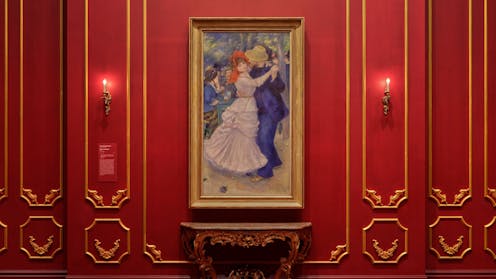
Impressionism is the world’s favourite art movement.
Impressionist paintings create an oasis of beauty into which a viewer can escape from a sometimes dark and troubling world, or simply from the mundane boredom of urban living.
The Impressionist master, Pierre-Auguste Renoir, once famously observed:
To my mind, a picture should be something pleasant, cheerful, and pretty. Yes, pretty! There are too many unpleasant things in life as it is without creating still more of them.
The new Impressionism exhibition at the National Gallery of Victoria brings together over a 100 of these pleasant, cheerful and pretty paintings and graphics. It features some of the greatest names in French Impressionism, including Claude Monet, Pierre-Auguste Renoir, Edgar Degas, Camille Pissarro, Édouard Manet, Mary Cassatt, Berthe Morisot, Paul Signac and Alfred Sisley.

For the first time in Australia
Initially, the Impressionist painters had difficulty in selling their work amid the torrent of negative criticism.
But then their Parisian art dealer Paul Durand-Ruel established a gallery in New York City, and the American artist Mary Cassatt – who worked with the Impressionists in Paris – found increasing popularity. By the 1880s and 1890s, American collectors started to buy Impressionist paintings by many of the top French artists.
This explains why the Museum of Fine Arts in Boston possesses such an outstanding collection of Impressionist paintings. Yet, unlike the museums in New York, the Boston museum is less well known and Australians are seeing many of these paintings for the first time.

To say that most works in this exhibition have never been previously seen in Australia is only partially true. Four years ago, just before Melbourne was locked down for COVID, the NGV launched a similar show. Apart from a handful of art lovers posing as media, that show expired under lockdown and was packed up and returned to Boston without being widely exposed to Australian audiences.
The new reiteration is supplemented with six additional paintings, including the early and deeply moving painting by Degas of Degas’s Father Listening to Lorenzo Pagans Playing the Guitar (1869–72).
 Edgar Degas, French, 1834–1917, Degas’s Father Listening to Lorenzo Pagans Playing the Guitar, about 1869–72.
Museum of Fine Arts Boston
Edgar Degas, French, 1834–1917, Degas’s Father Listening to Lorenzo Pagans Playing the Guitar, about 1869–72.
Museum of Fine Arts Boston
The whole exhibition has been totally reimagined as part of an immersive interior design. It moves far away from the clinical white cube of a modern exhibition space and closer to the 19th century posh domestic interiors in which the paintings first appeared.
An extensive and in-depth exhibition
Chronologically, the exhibition charts the development of French Impressionism from the mid-19th century and the so-called Barbizon school and realism, through to late Impressionism in the early 20th century.
It includes the great paintings by Cézanne and Manet, and memorable paintings from early to late Impressionism. There is an abundance of important works by the main Impressionist masters including Monet (16 of his canvases in one room), Degas, Sisley, Renoir, Pissarro, Cassatt and Morisot, and a few unexpected gems by van Gogh and Signac.
 Installation view of French Impressionism from the Museum of Fine Arts, Boston on display from June 6 to October 5, at NGV International, Melbourne.
Photo: Sean Fennessy
Installation view of French Impressionism from the Museum of Fine Arts, Boston on display from June 6 to October 5, at NGV International, Melbourne.
Photo: Sean Fennessy
It is an extensive and in-depth exhibition.
The depth of the Boston collection enables rare insights. For example, when we see Édouard Manet’s Street Singer (1862), we may be aware that he employed his favourite model Victorine Meurent. Apart from being a model, Meurent was also an artist in her own right and in the same exhibition there is a self-portrait of her from 1876.
 Left: Edouard Manet, French, 1832–1883. Street singer, c. 1862. Oil on canvas. 171.1 x 105.8 cm Museum of Fine Arts, Boston Bequest of Sarah Choate Sears in memory of her husband, Joshua Montgomery Sears. Right: Victorine Meurent, French, 1844–1927. Self-portrait c. 1876. Oil on canvas 35 × 27 cm. Museum of Fine Arts, Boston Arthur Gordon Tompkins Fund.
Photography © Museum of Fine Arts, Boston. All Rights Reserved.
Left: Edouard Manet, French, 1832–1883. Street singer, c. 1862. Oil on canvas. 171.1 x 105.8 cm Museum of Fine Arts, Boston Bequest of Sarah Choate Sears in memory of her husband, Joshua Montgomery Sears. Right: Victorine Meurent, French, 1844–1927. Self-portrait c. 1876. Oil on canvas 35 × 27 cm. Museum of Fine Arts, Boston Arthur Gordon Tompkins Fund.
Photography © Museum of Fine Arts, Boston. All Rights Reserved.
Strictly speaking, perhaps neither painting can be described as “Impressionist”. But it is a wonderful encounter of a woman being observed and, in the same exhibition, this woman looking out of the picture space and doing the observing. The self-portrait is one of those additions that was not in the original show.
If we glance at a handful of some of the outstanding paintings in the show – including Monet’s Grainstack (snow effect) (1891), The water lily pond (1900), or Water lilies (1905); Renoir’s Dance at Bougival (1883) or The Seine at Chatou (1881); Pissarro’s Spring pasture (1889); Degas’s Racehorses at Longchamp (1871/1874); and Morisot’s Embroidery (1889) – we have all of the beloved features of French Impressionism.
 Camille Pissarro French (born in the Danish West Indies), 1830–1903 Spring pasture, 1889. Oil on canvas, 60 x 73.7 cm. Museum of Fine Arts, Boston Deposited by the Trustees of the White Fund, Lawrence, Massachusetts.
Photography © Museum of Fine Arts, Boston. All Rights Reserved
Camille Pissarro French (born in the Danish West Indies), 1830–1903 Spring pasture, 1889. Oil on canvas, 60 x 73.7 cm. Museum of Fine Arts, Boston Deposited by the Trustees of the White Fund, Lawrence, Massachusetts.
Photography © Museum of Fine Arts, Boston. All Rights Reserved
Light and bright
While the French Impressionists were not a monolithic group, their art was generally characterised by three things.
Firstly, a lighter and brighter palette with a conscious move to the ultraviolet end of the colour spectrum.
Secondly, a divisionist application of colour with juxtaposed dabs of pigment allowing for colour to blend in the eye rather than on a mirror-smooth surface of the canvas.
Finally, a move to a more democratic subject matter with landscapes, gardens, drinking parties, picnics and street scenes easily outnumbering images of pagan gods in complicated embraces.
 Paul Signac, French, 1863–1935. Port of Saint-Cast, 1890. Oil on canvas, 66 x 82.5 cm. Museum of Fine Arts, Boston Gift of William A. Coolidge.
Photography © Museum of Fine Arts, Boston. All Rights Reserved
Paul Signac, French, 1863–1935. Port of Saint-Cast, 1890. Oil on canvas, 66 x 82.5 cm. Museum of Fine Arts, Boston Gift of William A. Coolidge.
Photography © Museum of Fine Arts, Boston. All Rights Reserved
Australian audiences never seem to tire of French Impressionism. This exhibition brings a fresh crop of rarely seen major paintings and graphics of the highest order.
If you love Impressionism, French Impressionism from the Museum of Fine Arts, Boston, is a must-see exhibition. This new exhibition will change the history of Australian art exhibitions from Australia’s greatest Impressionist show that no one had seen, to Australia’s greatest Impressionist exhibition that everyone has seen.
French Impressionism from the Museum of Fine Arts, Boston, is at the National Gallery of Victoria until October 5.
Authors: Sasha Grishin, Adjunct Professor of Art History, Australian National University


 Daily Bulletin


