

Taylor Swift now owns all the music she has ever made: a copyright expert breaks it down
- Written by: Wellett Potter, Lecturer in Law, University of New England
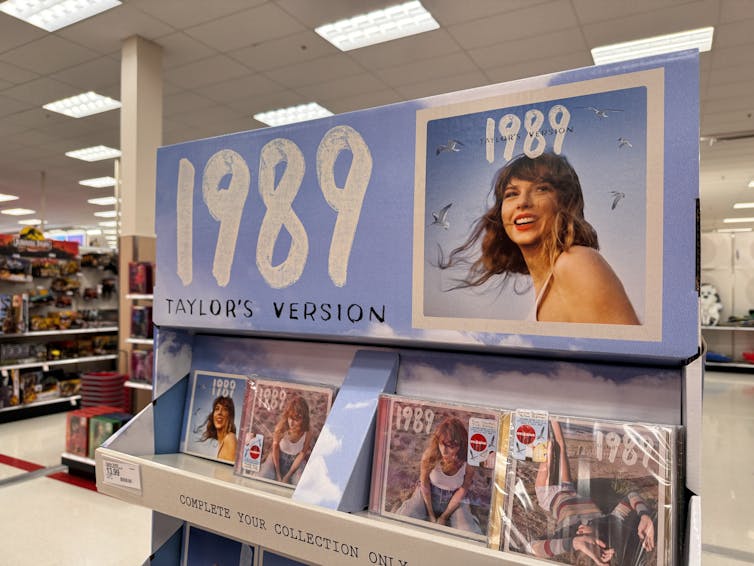
On Friday, Taylor Swift announced she now owns all the music she has ever made. This reported US$360 million acquisition includes all the master recordings to her first six albums, music videos, concert films, album art, photos and unreleased material.
The purchase of this catalogue from private equity firm Shamrock Capital is a profoundly happy event for Swift. She has expressed how personal and difficult it was not to own these works.
In her announcement, Swift acknowledged that it was due to her fans purchasing her rerecorded music (known as “Taylor’s Version”) and the financial success of the record-breaking Eras Tour which enabled this purchase.
The story behind “Taylor’s Version” and why she didn’t own the catalogue to her original six albums is due to copyright, music industry practices and contractual terms. Let’s break it down.
What’s in a music catalogue?
When it comes to valuing a music catalogue, it largely comes down to two types of rights: master rights and publishing rights.
Master rights are rights pertaining to the ownership of the actual sound recordings – the final recorded version. These are called “masters” because they’re the original source from which all copies are made.
Under traditional music industry contracts, record labels usually hold ownership of masters and associated materials. This can be music videos, tour videos, unreleased works, photographs and album covers.
Through licensing, the label controls the use of this material and retains the majority of the royalties. In return, the label provides the artist with financial backing, recording resources and marketing.
Publishing rights, on the other hand, relate to the underlying composition – the music and lyrics. The rights to music publishing usually belong to the songwriter, regardless of who performs the song.
Publishing rights govern how a song can be used and who earns royalties from that use. For example, a song may be played on a streaming platform, covered in a live performance or licensed for a commercial or film.
Swift’s contracts
Swift was 15-years-old when she was signed to Scott Borchetta’s Big Machine record label.
The agreed contractual terms were typical of the music industry. In exchange for the financial support to make, record and promote her subsequent albums and tours, Big Machine held the rights to Swift’s master recordings and associated materials in her first six albums. Her relationship with the label lasted 13 years.

As a songwriter, Swift retained separate publishing rights to her songs (the music and lyrics) from her first six albums, which she licensed through Sony/ATV Music Publishing.
In 2018, Swift was reportedly offered to re-sign with Big Machine, in a deal which would involve her “earning” the rights to one original album for each new one she produced.
Swift did not renew her contract and moved to Republic Records (Universal Music Group), who allow her to own her masters. She also moved to Universal Music Publishing Group for her music publishing.
Subsequent sales
In June 2019, Big Machine’s catalogue was sold to Scooter Braun’s Ithaca Holdings, for a reported US$330 million, with US$140 million representing Swift’s catalogue.
Swift described this as her “worst case scenario”, as she had a tumultuous history of alleged bullying from Braun. She also alleged she found out about the acquisition at the time it was announced to the world, without being given the opportunity to purchase her catalogue.
Throughout 2019 and 2020 it was reported she attempted to regain ownership, but negotiations fell through.
In October 2020, Swift’s catalogue was sold to Shamrock Capital, a private equity firm, for an estimated US$300+ million. In recent years, private equity firms have been purchasing music catalogues as profitable long-term financial assets, rather than for artistic or cultural reasons.
These events led Swift to rerecord her first six albums, branding them “Taylor’s Version”. Four have been released.

She was able to create new versions of her songs, with their own intellectual property rights attached.
As owner of these new masters, she has control over where these songs are used, and she receives a greater portion of the income from the streams, downloads and licensing.
The decision was enormously successful. Mobilising her fans’ support via social media, they prioritised purchasing “Taylor’s Version” over the original masters, diluting the value of the originals.
Successful futures
Swift has repeatedly emphasised the need for artists to retain control over their work and to receive fair compensation. In a 2020 interview she said she believes artists should always own their master records and licence them back to the label for a limited period.
This would mean the label could monetise, control and manage the recordings for a certain time, but the artist retains the ownership. They eventually gain back full control, rather than handing over permanent rights to the label.
Swift’s experience has sparked conversations within the industry, prompting emerging artists to approach record labels with caution and advocate for fairer deals and ownership rights. Olivia Rodrigo negotiated her contract with Swift’s saga as a cautionary tale.
Purchasing her catalogue and masters gives Swift autonomy about how the rights to all of her music is used. Her fans are likely to continue to support her and purchase both the originals and “Taylor’s Version”, so the value of her original albums may rise.
And, in the long-run, her new acquisition will likely make her much wealthier.
Authors: Wellett Potter, Lecturer in Law, University of New England


 Daily Bulletin


