

Read The Times Australia

Daily Bulletin

James Bradley’s thrilling, unsettling crime novel is set in a flooded Sydney in 2050

  • Written by: Catherine McKinnon, Deputy Head—School of the Arts, English and Media, University of Wollongong
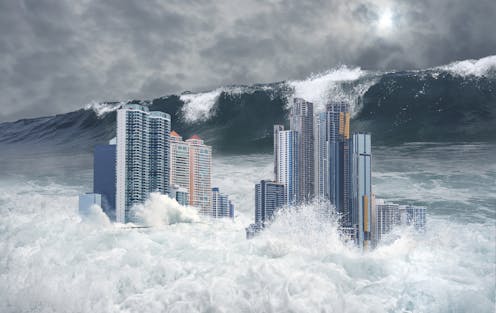
James Bradley’s thrilling, unsettling crime novel is set in a flooded Sydney in 2050

James Bradley is a brilliant writer of fiction, nonfiction and poetry. His recent book Deep Water (2024) is an elegiac essay in response to the wonders of the planet’s oceans. It celebrates undersea mysteries and the marvels of the surface, denounces the slavery and oppression connected with trade routes, and extols the sensuality of swimming and surfing.

Deep Water increased Bradley’s international reputation, but it was also an important milestone in a writing life dedicated to awakening readers to the harmony of the natural world and the need to act urgently to prevent human-induced climate catastrophe.

Landfall, Bradley’s seventh novel, continues his engagement with the environment. Coming on the heels of Clade (2015) and Ghost Species (2020) – both novels set in a precarious future – it again takes up the subject of a warming world.

Review: Landfall – James Bradley (Penguin)

Landfall is a haunting and propulsive crime novel set in 2050s Sydney. Through its compelling narrative, Bradley weighs the value of a human life on an ecologically ravaged planet.

The novel’s future world is one of extreme weather events and soaring daily temperatures. Parts of the metropolis are permanently underwater due to the Big Melt, a glacier event 20 years earlier that has caused sea level rise across the globe. The air is suffocatingly humid. Everyone carries water and is constantly thirsty. Waves lap at asphalt roads, parks are crowded with tents and people queue daily to fill water containers from plastic tanks. Children are sullen or silent; barking dogs harass. The homeless flock to food vans near Central Station.

In certain parts of the city, the urban environment is nothing more than “roofless buildings choked with garbage, dead trees, the rusting shells of abandoned cars and trucks”. Apartment blocks and houses need repair. Sandbags shore up bridges and makeshift walkways run above tidal waters, giving access to dwellings.

The divide between rich and poor has become more pronounced. The wealthy work in high-tech offices with AI assistants, security guards and air-conditioning; they live in luxury homes and their children still attend violin lessons. There is a lottery affordable only to those on high salaries, and the prize is resettlement in New Zealand. Property deals and capitalist ambitions are still in play.

Communities are stressed; there is anger in the streets. Sexism and racism are rife. Trust in authority is low.

A laser gaze

In this frazzled and divided environment, Senior Detective Sadiya Azad receives an early morning report about a five-year-old child, Casey Mitchell, who has not been seen since the night before. Casey and her family live at the Floodline, a reimagined Botany Bay, where the poor have taken over the higher, drier floors of abandoned buildings that rise, like shabby sentinels, from the water.

Sadiya and her new partner, Detective Sergeant Paul Findlay, start their investigations at the site of the child’s disappearance: an empty building owned by a company named Horizon and marked for redevelopment as part of a project that will erect a new seawall and “three thousand dwellings”.

Sadiya and Paul’s investigations are constantly frustrated. Cyclone Nasreen is due to hit the city in five days and untold damage is expected, so most of the police force is directed towards storm preparation and protection. When Horizon employee Nina Lukic also goes missing and a silver electric car seen outside the empty building is connected to her, Sadiya and Paul seek the help of Horizon’s top executive, Oliver Manning.

In speculative fiction, technology is foregrounded, either by its presence or absence. In Landfall, Bradley introduces new technology as a given. Rich and poor wear glasses that receive constant news feeds and have the ability to film events, send emails and share photos. Citizens’ data – their individual movements through the city, their finance, housing and vehicle information – can be quickly obtained by police. Surveillance ability has increased for the poor as well as the rich. Police actions are constantly being filmed by disgruntled citizens. AI assistants are part of daily life for the middle as well as the upper classes. What sets Landfall apart from other crime novels is Bradley’s laser gaze, particularly his evocation of the experience of climate refugees. Three perspectives are beautifully and intricately woven together: that of Sadiya, her father Arman Azad, who is suffering from dementia, and Tasim, a 15-year-old Indonesian illegal immigrant. The recollections of all three characters deftly map the past. They provide a rich undercurrent that deepens the main narrative. The Azads are migrants from Bangladesh. Through his fractured memories, Arman summons the day he and his family sought refuge from rising floodwater at the top of their Bangladesh apartment building. Arman managed to throw young Sadiya into a rescue boat, but strong currents swept away his wife and oldest daughter. In Australia, many years later, Arman’s recollections unravel him, but Sadiya’s memories strengthen her resolve. Having faced tremendous loss, she is tough, unrelenting. Her determination drives her to follow every clue, no matter how slight, in an effort to find the missing child. Tasim, having escaped his Australian detention centre, is eking out a living on the fringes of the city. His daily life is troubled, but it is the remembered horror of the overheated Indonesia he has escaped that terrifies him. In one gruelling memory, there is a power failure when temperatures are well above 50°C and Tasim’s sister, Dewie, suffering heat exhaustion, dies in his arms. Seeking coolness, Tasim wanders the streets, passing people lying “motionless” in doorways, and arrives at a river, where he wades through warm water in which dead bodies float among the living. In Sydney, having survived a dangerous sea crossing, Tasim is comforted by photos of Dewie. When he witnesses the abduction of Casey, he too commits to finding her.
James Bradley at the 2025 Jaipur Literature Festival. Sriya Sarkar, via Wikimedia Commons, CC BY

Greed and compassion

One of the pleasures of reading Landfall is that it is a stirring page-turner. The division of the book into five days creates a time pressure and a tense atmosphere of impending doom.

Through Sadiya and Tasim’s storylines, Bradley cleverly sets up two separate searches for the missing child. He draws on different social situations to portray the immoral lows of human behaviour and skilfully misdirect readers toward a range of plausible perpetrators. Importantly, when the real culprit is discovered, it is narratively satisfying.

As the crime genre demands of its leading detectives, Sadiya has her share of personal troubles: colleagues out for revenge; a commander-in-chief hassling her to find Casey, dead or alive; her wariness about opening up to her partner. She also has a father in need. The novel’s depiction of Arman’s vulnerability is deeply moving. His effort to comprehend a world he doesn’t recognise and the remorse-filled love he bears for his dead wife and child are a plaintive cry.

Yet the beating heart of the novel is its rendering of human kindness, there in the main characters as well as the minor ones: a hand held unexpectedly, a body washed with care, a surprising offer of help, tender scenes of human connection. Doctors are dedicated to the needs of their patients. The police force, despite having belligerent cops, also has solicitous ones, like Sadiya and Paul, who seek to make a difference. Tasim, though on the lowest rung of society, is morally superior to many, and more than once attends to others, risking his own life.

Landfall is a novel that thrills as much as it unsettles. On one level, it is a story of human greed: it registers the desire for individual security and wealth, and the lengths ruthless individuals will go to protect their own interests. On another level, it is a story about the fragile bonds of family and identity, the necessity of friendship and the importance of compassion.

It is also a cautionary tale about a future climate-changed world, where habitat loss and class inequality have led to social disruption and desperation. Through this warning, Landfall challenges human apathy and resonates as a powerful and persuasive call to action. Bradley convincingly represents the difference good deeds can make in a troubled environment. Moral cause and courage are important to the survival of one child, but they may also be the qualities needed to save our planet.

Authors: Catherine McKinnon, Deputy Head—School of the Arts, English and Media, University of Wollongong

Read more https://theconversation.com/james-bradleys-thrilling-unsettling-crime-novel-is-set-in-a-flooded-sydney-in-2050-256463

Business News

Is Your Brand Showing Up in AI Search? Most Melbourne Brands Aren't.

The New Front Door Nobody Told You About Something changed. Quietly. Without a press release. The way buyers find businesses in Australia has been rewired. Not replaced, rewired. Google isn't dead...

Daily Bulletin - avatar Daily Bulletin

How Australian Businesses Can Measure SEO ROI

SEO can feel vague when you are staring at a dashboard full of numbers that do not clearly connect to revenue. The key is to measure the right signals in the right order, then tie them back to outcome...

Daily Bulletin - avatar Daily Bulletin

How Commercial Roller Shutters Improve Site Security Without Slowing Operations

Security upgrades can be frustrating when they make everyday work harder. A door that takes too long to open, creates bottlenecks at shift change, or fails at the worst time can turn “better protectio...

Daily Bulletin - avatar Daily Bulletin

Why a Document Destruction Service Still Matters for Modern Businesses

Businesses generate large volumes of information every day, from staff records and contracts to invoices, reports and customer files. While attention often focuses on how documents are stored, the way...

Daily Bulletin - avatar Daily Bulletin

Bicycle Rack Safety and Space-Smart Storage

Bike storage problems usually show up as small annoyances first: tangled handlebars, scratched frames, and bikes that topple when you pull one out. Over time, those issues become safety risks, especia...

Daily Bulletin - avatar Daily Bulletin

How to Tell if a Childcare Centre Is a Good Fit for Your Child

Choosing childcare can feel like you’re making a huge decision with limited information. Tours are short, centres are often on their best behaviour, and your child might act differently in a new space...

Daily Bulletin - avatar Daily Bulletin

Car Import Timeline: What Usually Happens at Each Stage

Importing a car into Australia can feel confusing because multiple agencies and checkpoints are involved, and the timeline is shaped as much by paperwork quality as it is by shipping speed. The most u...

Daily Bulletin - avatar Daily Bulletin

Portable Toilet Hygiene Standards Explained: Clean vs Sanitised vs Disinfected

In portable toilet servicing, the words clean, sanitised, and disinfected often get used as if they mean the same thing. They don’t. And that difference matters because a unit can look tidy and still ...

Daily Bulletin - avatar Daily Bulletin

Options Available When a Company Faces Financial Distress

Financial distress can develop gradually or arrive suddenly, and when it does, the decisions made in the early stages often determine what options remain available later. Directors who act promptly ...

Daily Bulletin - avatar Daily Bulletin

The Daily Magazine

What Actually Makes a Good Criminal Lawyer in Melbourne

Most people only think about this question once. That is usually too late. Most people charged wi...

Why Working With A Chatswood Tutor Can Improve Academic Performance

Academic expectations continue increasing for students across primary school, high school, and senio...

Is It Worth Getting Solar Panels in Melbourne?

The real question is not whether solar works in Melbourne. It works. The question is what it is co...

How A Diploma Of Project Management Builds Practical Skills For Modern Work Environments

Developing the ability to plan, execute, and deliver outcomes efficiently is a key requirement in to...

How to Choose the Right Football for Every Level

Choosing a football may seem straightforward, but the right option depends on who will be using it a...

What to Ask a Wedding Photographer Before You Book

Booking a wedding photographer can feel deceptively simple: you like the photos, you like the vibe...

Why Stress Relief For Dogs Is Essential For Emotional Balance And Long-Term Wellbeing

Managing emotional health is just as important as physical care when it comes to pets, which is why ...

Australia’s Best Walking Trails and the Shoes You Need to Tackle Them

Australia is not short on spectacular walks. You can follow ocean cliffs in Victoria, cross ancien...

Why Pre-Purchase Building Inspections Are Essential Before Buying a Home in Australia

source Have you ever walked through an open home and started picturing your furniture, family d...