

How ocean giants are born: tracking the long-distance impact and danger of extreme swells
- Written by: Tom Shand, Honorary Senior Lecturer, Department of Civil and Environmental Engineering, University of Auckland, Waipapa Taumata Rau
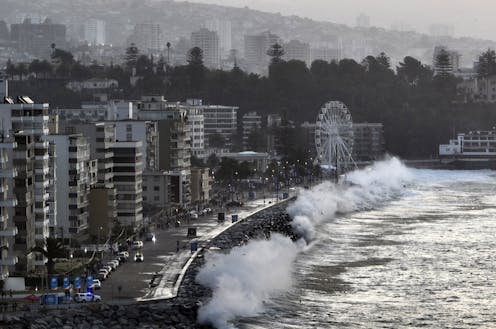
Late last year, a massive ocean swell caused by a low pressure system in the North Pacific generated waves up to 20 metres high, and damaged coastlines and property thousands of kilometres from its source.
Two years earlier, another storm system southeast of New Zealand also whipped up massive waves, with the swell reaching as far as Canada, battering Pacific island coasts along the way.
These storms, and the swells they create, are facts of nature. But while we understand a lot about the extraordinary forces at work, we can still do more to predict their impact and coordinate global warning systems.
How big waves are born
Waves are made by wind blowing over a water surface. The longer and stronger the wind blows, the more energy is transferred into those waves.
As well as an increase in wave height, sustained high wind speeds generate waves with a longer period – that is, the distance or time between successive wave crests. Oceanographers refer to the mix of wave heights and periods (and to some extent directions) as a “sea” state.
Once the wind stops blowing, or the sea moves away from the wind that is generating it, the waves become swell and start to separate. The longest-period waves move fastest and shorter-period waves more slowly.
Most waves resulting from a storm have periods of 12–16 seconds, with the individual waves travelling at speeds of 60–80km per hour.
But very large storms with high, sustained winds can generate waves with periods of more than 20 seconds. These waves travel much faster, over 100km per hour in the open ocean, and their energy (which travels more slowly than individual waves) can cover 1,500km in 24 hours.
Ocean waves, particularly long-period swells, lose very little energy as they travel. And unless they collide with an island and break, they are capable of travelling great distances.
By comparison, shorter period waves take much longer to travel and lose more energy. If they encounter a wind field moving in another direction, this also removes energy and reduces their height.
But sometimes, a particularly strong storm system can generate long-period waves with enough energy to travel across the Pacific, reaching shores thousands of kilometres away.
A unique characteristic of such long-range swells is that individual waves contain a lot more energy than shorter-period local waves. They grow to greater heights as they “shoal” in shallow water, and can hit shorelines and structures with greater force, causing more damage and danger.

The ‘Code Red 2’ swell
The “Code Red 2” swell was a good example of this in action. It was generated by a massive storm system southeast of New Zealand in July 2022. The “significant wave height”, or average of the largest third of the system’s waves, reached 13 metres. Individual waves were up to twice this height.
The storm system was unusual due to very strong southerly winds blowing northweard from near Antarctica for over 2,000km. This resulted in long-period (20 second) swells moving north into the Pacific Ocean.
The swell first reached Tahiti, where waves closed most of the south-facing coast, prompting a Code Red warning. This was only the second such warning since 2011 (hence its name), and resulted in massive waves at the Teahupo'o surf break, location of the 2024 Olympic surfing event.
The swell also caused flooding along the south coast of Rarotonga and other Pacific Islands before continuing north across the equator to reach the south coast of Hawaii – 7,000km from where it was generated.
Due to their direction and very long period, large waves reached places they don’t usually affect, literally crashing weddings and breaking over houses. The swell then carried on to hit the Californian coast some 10,000km away, and eventually reaching Canada more than a week after it was initially generated.

The ‘Eddie’ swell
More recently, the 2024 “Eddie” swell was generated from an extremely intense low pressure system in the North Pacific in December 2024. Waves near the centre of the storm reached heights of 20 metres, with a 22-second period.
The resulting swell hit Hawaii first, where waves were large enough to run the Eddie Aikau Big Wave Invitational at Waimea Bay, a surfing event that requires such large waves it has only been run 11 times in its 40-year history (and which gave the swell its name).
This extreme swell then reached California 3,000km away, where it also generated giant surf, damaged boats in coastal marinas and caused part of the Santa Cruz wharf to collapse.
Due to its very long period, the swell was able to continue southward, still with a lot of energy. It reached the north coast of Ecuador and Peru, 8,500km from where it began, where it destroyed fishing boats. And it finally hit Chile, 11,000km from its source, where it closed ports and inundated coastal promenades.
These coasts typically receive large southwest swells. But this rare, long-period north swell was able to reach normally protected north-facing sections of coast, causing uncharacteristic damage.
 Tracking the December 2024 Eddie swell across the Pacific.
CC BY-NC-ND
Tracking the December 2024 Eddie swell across the Pacific.
CC BY-NC-ND
Predicting local impacts
It can be difficult to sound warnings for these types of long-period waves, as they are generated so far from the affected shorelines they are missed by local forecasters and emergency managers.
Global wave models such as those driven by the National Oceanic and Atmospheric Administration’s National Centers for Environmental Prediction are capable of predicting and tracking these swells but require a more nuanced approach to predicting local impacts.
New early warning systems are being developed that take global wave forecasts and downscale them to take into account the shape of the local coastline. The wave information is then combined with predictions of tide and storm surge to give warnings of when coastal impacts may occur.
These systems will give emergency managers, ports and coastal infrastructure operators – and the public – better information and more time to prepare for these damaging wave events.
Authors: Tom Shand, Honorary Senior Lecturer, Department of Civil and Environmental Engineering, University of Auckland, Waipapa Taumata Rau


 Daily Bulletin


