

Facultative sex allows some animals to reproduce with or without a partner. So why can’t humans do it?
- Written by: Lucinda Aulsebrook, Postdoctoral Research Fellow, Marine Ecology and Environmental Change Lab, James Cook University
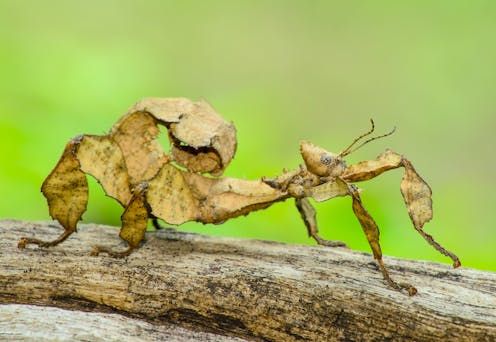
If you’ve ever had a spiny leaf insect as a pet, or you’re considering getting one, hopefully someone has warned you about this: if you put one in your enclosure, you might come back some time later to find two.
How?
These animals are among a handful of species that can choose to reproduce sexually or asexually. In other words, they can reproduce with a partner or totally on their own.
This is known as facultative sex. So why does it exist and why can’t humans do it?
What’s the difference between sexual and asexual reproduction?
In sexual reproduction, offspring are produced from two parents, where generally the sperm from a male combines with the egg from a female, and develops into a new individual.
Almost all animals reproduce sexually, as well as many plants and fungi species.
However, not all organisms reproduce sexually: asexual reproduction is common among single-cell organisms such as bacteria.
The key difference for asexual reproduction is that offspring are produced from one parent only. For bacteria, this simply involves the cell splitting in half to form two new cells.
However, asexual reproduction can also occur in some animals, such as in whiptail lizards and Amazon mollies (a type of fish).
In these cases, the species are entirely female, and eggs develop into new individuals without being fertilised by sperm. This process is called parthenogenesis, derived from the Greek words “partheno” (virgin) and “genesis” (birth/creation).
Advantages and disadvantages
There are advantages and disadvantages to both sexual and asexual reproduction.
In sexual reproduction, the offspring receive half their genes from their mother and half from their father, leading to unique genetic combinations.
This means every individual is different. Some may possess characteristics that turn out to be advantageous when the species is confronted with new threats or environmental change.
Since offspring are formed from only one parent in asexual reproduction, offspring are essentially clones of their parent.
This can mean that asexual populations are more vulnerable to being wiped out by new threats, since all the individuals may have the exact same traits.
However, asexual reproduction does not require individuals to seek out and find a mate, which can consume a lot of time and energy.
Asexual reproduction also allows offspring to be produced more rapidly than for sexual reproduction.
The best of both worlds?
Let’s get back to facultative sex.
While it is relatively rare, spiny leaf insects aren’t the only animals with this ability.
A variety of species across the animal kingdom can reproduce both sexually and asexually, including some types of starfish, water fleas, hammerhead sharks and Komodo dragons.
Komodo dragons in various zoos have made headlines for producing babies despite being isolated from males their entire lives.
Why do these animals do both sexual and asexual reproduction?
Facultative sex is often heralded as the best of both worlds. Species can experience the advantages of both sexual and asexual reproduction, without many of the associated limitations of either mode.
Consider the Komodo dragons. These reptiles can sexually reproduce to increase genetic diversity in their offspring. But if they are unable to find a mate, they can choose to reproduce asexually to ensure their lineage continues.
Additionally, many facultatively sexual animals alternate between sexual and asexual reproduction depending on environmental factors.
For example, water fleas generally reproduce asexually unless they encounter unfavourable conditions, such as food scarcity, temperature changes or the presence of predators.
When this happens, they switch to sexual reproduction until conditions improve again.
This enables water flea populations to rapidly increase in favourable conditions, but also persist in harsh conditions via increased genetic diversity.
Why can’t humans do it?
So, if facultative sex is so useful, why don’t we all do it? This question is actually puzzling to experts too.
Despite the apparent advantages of facultative sex, it’s far more common for animals to only reproduce sexually or asexually.
One possible explanation for this is that many species do not need the benefits of both options, meaning that over time, a lot of facultatively sexual organisms evolve to be entirely asexual or sexual.
And if prevailing conditions cause one reproductive mode to be preferred for a large period of time, a facultatively sexual species may gradually lose the traits that enable the other mode.
This makes the species dependent on one type of reproduction, even if conditions change later that would make facultative sex advantageous.
This might be why we humans don’t have the ability to naturally clone ourselves – for better or for worse.
Authors: Lucinda Aulsebrook, Postdoctoral Research Fellow, Marine Ecology and Environmental Change Lab, James Cook University


 Daily Bulletin


