

Ravaged jungle: just 25% of the world’s surviving tropical rainforests are in good condition
- Written by: Rajeev Pillay, Postdoctoral Fellow in Ecology, University of Northern British Columbia
We are now in the middle of the sixth mass extinction, caused by our emergence as a planet-shaping force. Species are going extinct far faster than the average natural rate of loss.
In response, conservationists are working to safeguard biodiversity strongholds such as tropical rainforests, famed for their remarkable richness of species. Many of these rainforests are household names, from the Amazon to the Congo to Australia’s Daintree and Wet Tropics.
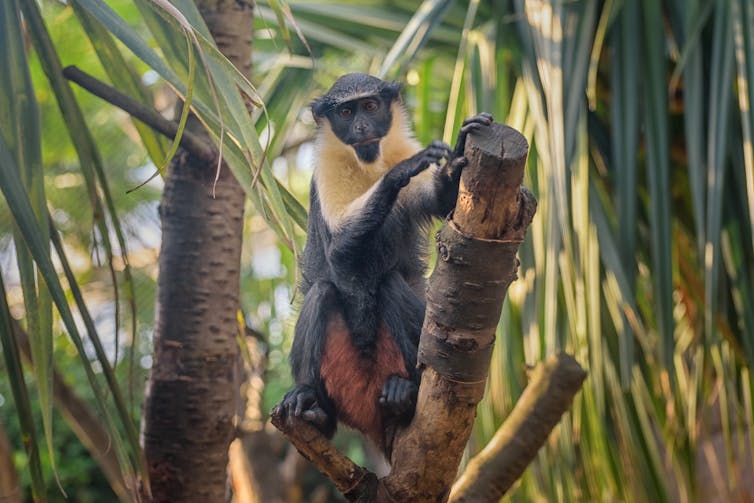
But these rainforests are being steadily cut down or degraded. It’s entirely possible for rainforests to look good in satellite images even though logging, mining or road-building mean they have become poor homes to species able to thrive only in the absence of major human disturbance, such as West Africa’s iconic Diana monkey (Cercopithecus diana).
How much rainforest is still in good condition and able to sustain the Daintree’s cassowaries and tree kangaroos, the Amazon’s sloths and anacondas and the Congo Basin’s forest elephants, bonobos and okapi? We looked at over 16,000 species of mammals, birds, reptiles and amphibians in our new research to answer this question.
At first glance, it seemed like good news – up to 90% of the geographic ranges of these species were still covered in forest. But when we drilled down further, we found the real problem. Barely 25% of the world’s remaining tropical rainforests are still of high quality. For threatened species and those in decline, there’s just 8% of their habitat left in good condition.

What makes a rainforest high quality?
To protect rainforests, conservationists have long focused on a key goal: reduce deforestation. The theory is that by slowing or stopping the rate at which trees are felled, rainforest habitat can be preserved.
We measure deforestation by looking at rates of native forest cover loss and assessing the size of the remaining canopy. But while forest cover is vital for many species, it’s not enough. Maintaining forest cover without considering its quality means ignoring major human sources of damage, such as logging, roadbuilding and mining which make rainforests increasingly degraded.
Degraded rainforests aren’t lifeless. They’re often full of life. But the species you find are usually those that thrive in disturbed, open areas such as the edges of forest, roadsides and agricultural lands. Such species take advantage of human-made disturbance to expand. This comes at the expense of many other forest dependent species, who often decline or disappear.
To be able to distinguish high quality from degraded rainforests, our team used high-resolution imagery of global rainforests from three NASA satellites to calculate the height of trees, canopy cover and how long the rainforest had stood without pressure from human industries.
We combined these three variables into a single measure of forest structural condition and overlaid our results with a map of major industrial human pressures such as expansion of cities, creation of farmland and building roads.
Bringing these data sources together lets us rank the condition of rainforests, which we dub the Forest Structural Integrity Index, first developed in 2020.
High quality rainforests have a multi-layered structure – a lower understorey of shrubs and small trees, a midstorey of medium trees, a canopy of the taller trees and an emergent layer where unusually tall trees poke through the sea of green.
In forests degraded by logging, very tall, tall and medium trees are logged or severely damaged, while the understorey is overtaken by dense brush. We know high quality rainforests are linked to a lower risk of extinction for vertebrates.
 Human uses such as oil palm plantations, logging and mining are still degrading or destroying tropical rainforests.
Rich Carey/Shutterstock
Human uses such as oil palm plantations, logging and mining are still degrading or destroying tropical rainforests.
Rich Carey/Shutterstock
High quality rainforest is getting harder to find
In our research, we define high quality rainforest as those left undisturbed since 2000, with little pressure from human industry. These forests have over 75% canopy cover and trees over 15 metres, indicating they are older.
High quality forests are better homes for wildlife than degraded forests, when we look at how many species live there, how plentiful these species are and how broad and functional the ecosystem is. High quality rainforests also provide irreplaceable ecosystem services to the planet and humans, such as stabilising the climate by sequestering large amounts of carbon in their wood.
Unfortunately, our new research shows the extent of the damage we have done. Only a fraction of rainforest cover can now be considered high quality habitat for over 16,000 mammal, bird, reptile and amphibian species – even though 90% of their geographic ranges are still “forested”.
What does this look like? Take the golden bowerbird (Prionodura newtonia), endemic to Queensland’s Wet Tropics. Its habitat appears well preserved, with 84% of its range still forested. But when we drill down, we find only 36% of the rainforest can still be considered high quality.
In West Africa’s rainforests, the Diana monkey still has forests covering 80% of its range – but just 0.7% of high quality.
 On paper, the rainforests which give the golden bowerbird a home are extensive. But the reality is different when it comes to their quality.
AlecTrusler2015/Shutterstock
On paper, the rainforests which give the golden bowerbird a home are extensive. But the reality is different when it comes to their quality.
AlecTrusler2015/Shutterstock
What should we do?
These findings are a wake-up call. They suggest many seemingly safe species could be at real risk of extinction. Just because a forest is still standing doesn’t mean it’s able to be a home.
This points to the urgency of stopping deforestation as rapidly as possible. Our last tracts of undisturbed tropical rainforest have to be protected.
But it also shows us that ending deforestation isn’t enough by itself. Many of the world’s surviving rainforests are not in great shape. We should let these rainforests recover by banning industrial-scale timber extraction, road building and other major pressures.
 Sometimes known as forest giraffes, okapi live in the rainforests of the Congo Basin.
Nisansala99/Shutterstock
Sometimes known as forest giraffes, okapi live in the rainforests of the Congo Basin.
Nisansala99/Shutterstock
In 2022, nations promised to end the routine destruction of tropical rainforests and other highly biodiverse areas within a decade.
We’re halfway to 2030, and tropical rainforests are still being felled or burned, even if there are some signs of progress.
Changing course away from a human-made mass extinction means redoubling our efforts to safeguard tropical rainforests, for nature and for us.
Authors: Rajeev Pillay, Postdoctoral Fellow in Ecology, University of Northern British Columbia


 Daily Bulletin


