

Indonesia is one of the world's largest democracies, but it's weaponising defamation laws to smother dissent
- Written by: Tim Mann, Associate Director, Centre for Indonesian Law, Islam and Society, The University of Melbourne
Two former coordinators of one of Indonesia’s most prominent human rights organisations have escaped conviction in a defamation case brought by a powerful government minister. While their astonishing acquittal is welcome, the case marked a bleak new low for freedom of expression in one of the world’s largest democracies.
Haris Azhar and Fatia Maulidiyanti, who had coordinated the Commission for the Disappeared and Victims of Violence (KontraS), were accused of defamation by Coordinating Minister for Maritime Affairs and Investment, Luhut Binsar Pandjaitan.
Luhut’s statements made it clear the case was expressly intended to create a chilling effect and smother civil society criticism of the government.
So what is the case about, and why is it so important?
Read more: Is Joko Widodo paving the way for a political dynasty in Indonesia?
A messy web of mining interests
The case related to a 2021 YouTube video in which Haris and Fatia discussed a report published jointly by a group of Indonesian civil society organisations. In the video, the pair mentioned that Luhut was “implicated” or “involved” (bermain) in mining in Wabu Block, in the Intan Jaya district of what is now Central Papua Province.
The details are a bit complicated, but a key part of the dispute centred on this point about mining.
In 2016, Australian mining firm West Wits Mining reported to the Australian Stock Exchange (ASX) that its Indonesian subsidiary Madinah Quarataa’in had entered into an agreement with another company, Tobacom Del Mandiri. They wanted to develop the Derewo River Gold Project in Intan Jaya.
Tobacom Del Mandiri is owned by another major Indonesian firm, Toba Sejahtra. Luhut has acknowledged he holds 99% of shares in Toba Sejahtra.
Representatives from both Indonesian companies have since said the partnership did not go ahead. But given his stock portfolio, the activists had a relatively firm basis for implying Luhut was “involved” in mining in Papua.
Luhut objected to this.
He also objected to Haris and Fatia referring to him as a “villain” (penjahat) and “Lord Luhut”, a favourite moniker of Indonesians online. He got the nickname because President Joko “Jokowi” Widodo has entrusted him to oversee a seemingly endless list of strategic projects.
Haris and Fatia were charged with defamation under the Law on Electronic Information and Transactions (commonly known as the ITE law). Unlike in Australia, defamation is a criminal offence in Indonesia. They also faced secondary fake news charges and defamation charges under the Criminal Code.
Read more: A twist in Indonesia's presidential election does not bode well for the country’s fragile democracy
Making an example of activism
Under Jokowi, there has been a dramatic escalation in abuse of the Electronic Information and Transactions Law to target activists, human rights defenders, journalists, and ordinary citizens.
According to Indonesian digital rights organisation SAFEnet, 89 people were reported under the law between January and October 2023.
Public anger over the arbitrary way the law has been applied led the government to publish guidelines for law enforcers on its implementation.
According to the guidelines, defamation charges should not be brought when assertions are based on analysis, opinion or facts.
Luhut reported Haris and Fatia to police just three months after these guidelines were published.

The trial ran from April 2023 through to January 8 2024. During the trial, Luhut complained that being called names was “deeply hurtful”.
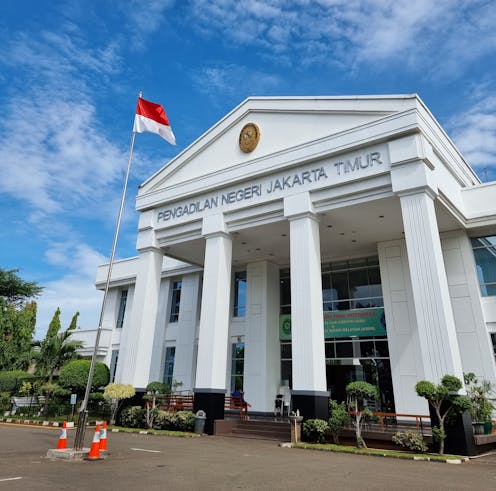
Delivering the court’s decision, Judge Muhammad Djohan Arifin said the YouTube conversation between Haris and Fatia constituted opinion and analysis of a civil society study and their use of the word “lord” was not defamatory.
Prosecutors have said they will consider appealing the decision.
Luhut claimed he reported the activists to defend his reputation. Other statements he made during the trial left no doubt as to his real motivations.
Luhut said he wants the case to serve as a “lesson”.
The prosecution concluded its sentencing demand with a quote from a minor politician, Teddy Gusnaidi, stating:
If using the label ‘activist’ means you are immune from prosecution, criminals will form NGOs (non-government organisations) to avoid consequences for their crimes.
Luhut also claimed that he wanted to conduct an “audit” of all non-government organisations in Indonesia to determine where they get their funding.
This is disingenuous.
Indonesian civil society organisations already need government approval to receive donor funds, and most openly publish their list of donors in their public annual reports.
The government also regularly subjects foreign donors to interrogation from everyone from police to intelligence agencies, about their planned activities.
Increasingly authoritarian tactics
Appealing to nationalistic sensibilities and raising questions about civil society organisations like this is a classic technique of authoritarian governments. It undermines organisations critical of government and redirects focus from the issues at hand.
Legal attacks like the one against Haris and Fatia are designed to wear civil society down. Fronting up in court every week is time consuming, emotionally draining, and takes activists away from their work.
Further, the use of judicial harassment to target activists, in contrast to cruder tactics such as cyberattacks or physical violence, is designed to lend an air of legitimacy to government repression.
Luhut has made it clear that the goal of the case against Haris and Fatia is to silence dissent. He appears to be succeeding.
There is already evidence that abuse of the Electronic Information and Transactions Law is having a chilling effect in Indonesian society, with a 2022 survey finding 62.9% of Indonesians were afraid of openly expressing their opinions.
Indonesian pro-democracy groups have long been willing to speak out against the state, even under the most challenging conditions. Yet repeated charges and arrests will eventually result in self-censorship and behavioural change.
In the face of mounting pressure, the government finally passed a revised version of the law on December 5 2023.
Activists have complained that, like other regressive laws enacted in Indonesia over recent years, deliberations on the revision were conducted largely behind closed doors.
The revised law does include some improvements, including that statements made in the public interest or to defend oneself cannot be prosecuted. The maximum sentence for defamation has also been decreased to two years, yet it remains longer than provisions on defamation in the new Criminal Code, which will come into force in 2026.
Activists have argued for a complete dropping of criminal charges for online defamation. Given they have proven such an effective tool for smothering dissent, there was never any chance legislators were going to simply give up this weapon.
Haris and Fatia may be the highest profile Indonesians charged under the Electronic Information and Transactions Law, but they will not be the last.
Authors: Tim Mann, Associate Director, Centre for Indonesian Law, Islam and Society, The University of Melbourne


 Daily Bulletin


