

If you want to avoid ‘giving away your first born’ make sure you read the terms and conditions before signing contracts
- Written by: Paul Harrison, Director, Master of Business Administration Program (MBA); Co-Director, Better Consumption Lab, Deakin University, Deakin University
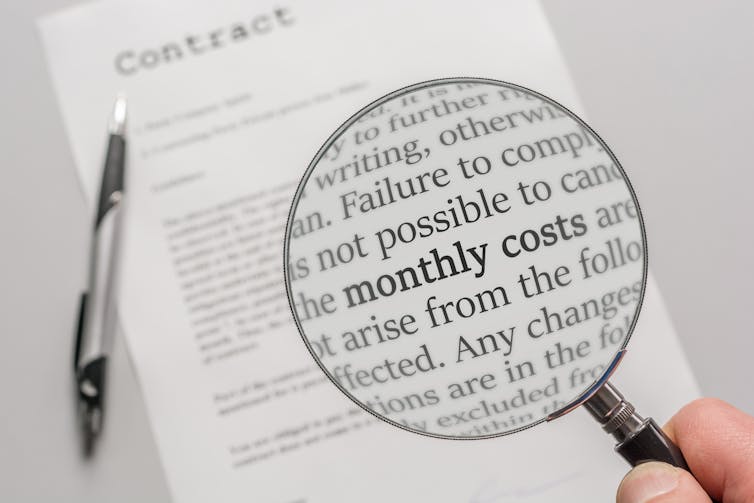
In 2019, a travel insurance company held a secret contest in which they included a line in the fine print of their policy promising $10,000 to the first person who spotted it.
Seventy-three policies were bought before the award was finally claimed. But those 73 who had obviously not read the policy, would not have been alone.
It seems most of us don’t read the terms and conditions of some relatively important, legally binding contracts before signing up.
In one study only 8% of people read a bank account contract, 19% a car rental contract and 25% a dry-cleaning contract before committing to a deal. Similarly, more than 80% of participants in a different study reported “not reading at all” or “not really” reading click through agreements.
A good reason to read a contract
Even more confrontingly, 98% of participants in another study effectively agreed to give up their first born child after supposedly having read the fictional terms and conditions of an agreement online.
The number of people who do actually read the terms and conditions may be even lower with another study finding only 0.1% of shoppers accessed the licence agreement and most only read a small portion.

Despite our best intentions, most of us simply sign terms and conditions, rarely read the fine print, and fail to appreciate the consequences.
However, once we are presented with a particular problem arising from or related to the contract, our attitude alters. Studies have shown the number of people who return to their contracts after a problem more than doubles for car rentals, triples for dry-cleaning issues and rises nearly seven times for a bank account.
Unsurprisingly though, most people don’t believe it’s their fault. Rather, they assume it’s to do with something they weren’t made aware of at the time of purchase or they believe it is easily fixed.
So, why don’t we read the fine print?
Like all things in human behaviour, it’s complicated.
Some reasons given by consumers include terms and conditions are too long and time-consuming, they are full of legal jargon, they seem all the same, they are irrelevant and they have no choice but to accept them if they want the particular product.
They also believed if there was something wrong with the agreement somebody else would have pointed it out (and fixed it before them) and vendors are usually reputable so they wouldn’t be put at risk.
The last two reasons point to a rational tendency to equate low probability risks with zero probability risks, as well as to use mental shortcuts that simplify decision-making and align with a person’s beliefs. There are also social norms and signals for us not to read the contract, such as the expectation to “sign the form and keep moving”.
Problems arise in markets where it appears easy to switch from one contract to another, but where there are complex agreements, including telecommunications, banking, health insurance and gyms. These sectors might use strong marketing tactics, such as bundling offers, along with apparently easily accessible customer service, which can cause consumers to be overconfident in their dealings with businesses.
Read more: Why you're probably paying more interest on your mortgage than you think
Sometimes it is simply the length and complexity of contracts that puts people off reading them. For example, assuming a reading rate of 240 words a minute, Spotify’s terms of service is estimated to take about 36 minutes, while TikTok’s would take 31. Microsoft would take over an hour. For comparison, reading all of Chinese war strategist Sun Tzu’s The Art of War would take only 50 minutes.
These extremely long policies, coupled with the fact individuals feel most information is unimportant, influence willingness to read the fine print. Realistically, failure to read the terms and conditions, particularly because contracts are rarely negotiable, seems like a perfectly rational response. This is made even more likely if we thinks the costs of reviewing a dense document outweighs its benefits.
Agreements are binding (kind of)
Legally, though, terms and conditions are enforceable and allow businesses to reduce costs that might otherwise be associated with bargaining.
Getting us to agree to the terms and conditions upfront also provides an opportunity for businesses to pass on certain risks to the consumer. Clearly this should be a concern for lawmakers. The idea of a well-informed consumer who understands their obligations and the rights under an agreement is a foundation of consumer law.
 An unfair contract can be voided under consumer law.
McLittle Stock/Shutterstock
An unfair contract can be voided under consumer law.
McLittle Stock/Shutterstock
The Australian Consumer Law does help reduce some risk by deeming terms of a standard consumer contract unfair if they have been presented unclearly or disadvantage one party, regardless of whether they have been accepted by the consumer.
However, it is unlikely most consumers read consumer law or use it given the complexity of challenging a vendor who is unwilling to abide by them.
Dealing with reality
If we are serious about the concept of the informed consumer, then we have to accept some realities.
We have to acknowledge consumer attention is limited and information overload and assymetry prevents people from comprehending what is and isn’t important.
We also have to accept the type of information and the way it’s presented does have an impact on whether people understand the consequences of signing an agreement.
Critically, most terms and conditions currently seem to be designed to protect the seller more than they are to help the consumer to make an informed choice.
Research does suggest consumers are more inclined to read terms and conditions before committing when the product or service cost is significant, the contract is perceived as short, and there is a belief they will be able to change or influence contract terms.
Indeed, if businesses seriously do want their customers to be informed, shorter, less abstract and more focused terms and conditions that highlight the critical information related to potential harm is one solution. Another might be to quiz participants with a short knowledge test as they sign the document to see if they have actually understood the agreement.
Or perhaps they could hide surprise $10,000 “Easter eggs” in their terms and conditions and create a culture of reward for effort, instead of the current deficit approach.
Authors: Paul Harrison, Director, Master of Business Administration Program (MBA); Co-Director, Better Consumption Lab, Deakin University, Deakin University


 Daily Bulletin


