

Australia has officially given up on eradicating the Varroa mite. Now what?
- Written by: Cooper Schouten, Project Manager - Bees for Sustainable Livelihoods, Southern Cross University
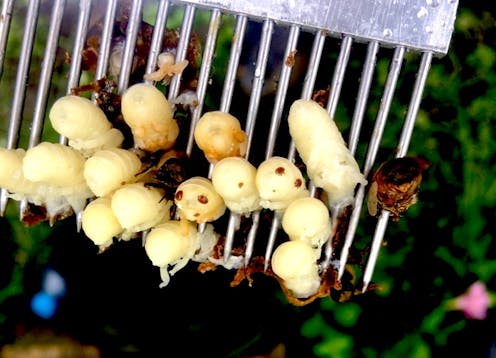
The federal government body in charge of pest control has announced Australia will abandon efforts on eradicating the Varroa mite.
This parasitic mite (Varroa destructor) lives in honey bee colonies, feeding on pupae and adult bees. The mites spread viruses, impair the bees’ ability to fly and communicate, and makes them more susceptible to pesticides, eventually causing a colony collapse if left unmanaged.
Until recently, Australia remained free of Varroa thanks to stringent biosecurity measures. But in June 2022, the mite was detected in the New South Wales coastal area near Newcastle and has continued to spread.
A recent increase in detections over a greater area has now made eradication technically unfeasible. As a result, Australia is transitioning from eradication to management of the Varroa mite.
Can we fight the mite?
It has been a tough time for beekeepers, the broader beekeeping community and the growers of crops relying on honey bees for pollination.
Varroa mite is already causing significant economic damage to livelihoods, due to restrictions on hive movements and the euthanasia of around 30,000 bee colonies.
To manage it, we will need to learn from overseas, where people have lived with Varroa for decades. However, Australia also has to develop its own solutions because of our unique climate, biodiversity and agricultural systems.
As seen in other countries, honey production and hive numbers may remain relatively stable. But beekeepers will need to invest significant time and resources to monitor, manage and replace hives due to Varroa losses.
There are effective chemical control options, but these cannot eliminate the mites completely. They also have impacts on bees and can leave residues in hive products. Over-reliance on synthetic chemicals will rapidly lead to resistance in Varroa populations, as seen in almost every country Varroa exists.
Effective organic and non-chemical treatments exist, but they are comparatively labour intensive – an additional burden on certified organic beekeepers.
To keep Varroa mite numbers below economically damaging thresholds, beekeepers will need to use integrated pest management solutions – a combination of approaches to reduce mite populaitons, while following up to ensure these appraoches have been effective.
Beekeeping will become more complex and expensive
Costs for the average-sized Australian bee business could increase by as much as 30%. Experience in other countries suggests there will be significant declines (up to 50%) of hobbyist and semi-commercial operators. Currently, recreational beekeeping is worth A$173 million in Australia annually.
We also know Varroa will progressively kill around 95% of Australia’s feral honey bees within approximately three years. Therefore, we will likely need more bee colonies per hectare to pollinate some crops effectively.
Cumulatively, increased costs of production, a decrease in the numbers of beekeepers and fewer feral bees will likely result in higher demand for bee hives to service 35 pollination dependent industries across the country. As seen in Aotearoa New Zealand, where the Varroa mite established in 2000, prices for bee hives rented to growers increased by 30–100% per hive within five years..
What should Australia do to minimise the impact?
We need a national program in Australia that monitors colony losses so we can quantify the impacts across the sector. This also holds true for Australian native bees which play an important role in pollination of tropical crops – we do not have the monitoring and baseline data needed to evaluate the changes about to occur.
Read more: Move over, honeybees: Aussie native bees steal the show with unique social and foraging behaviours
As an industry that contributes more than $14.2 billion to the economy, we now have a critical need for national capacity building for beekeeping, Varroa and pollination research, development and training.
Western Australia and Tasmania have significant opportunities to remain free from Varroa for as long as possible because the mite is currently only in NSW on the eastern boarder. Restricted movements of honey bees across the Bass Strait and the Nullarbor offer an additional biosecurity buffer.
Australia also remains free from virulent bee viruses, such as the deformed wing virus. Hopefully, the Varroa incursion will lead to strengthened biosecurity for honey bee pests and diseases we do not have in the country yet, like Tropilaelaps mites.
We also need to strengthen compliance with the honey bee biosecurity code of practice and improve monitoring of bee losses, bee viruses and native bees. In the long term, we will need to establish breeding programs for bees with Varroa tolerance, as seen in other countries such as the United States, New Zealand and Hawaii.
Authors: Cooper Schouten, Project Manager - Bees for Sustainable Livelihoods, Southern Cross University


 Daily Bulletin


