

Young people with disability have poorer mental health when they are unemployed – funding should tackle job barriers
- Written by: Marissa Shields, Research fellow, The University of Melbourne
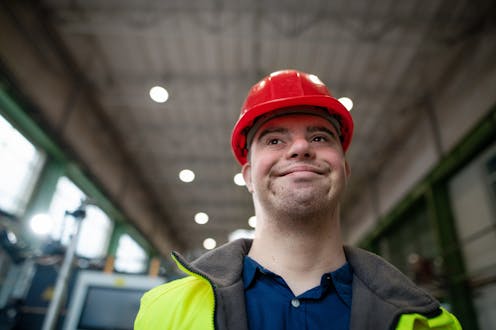
Australian governments spend a lot of money supporting young people with disability to find a job. But the success of these programs has been modest.
Employment rates for young people with disability have been persistently low for the past two decades, despite considerable investment in employment services and programs. While 80% of those Australian adults without disability are in jobs, only 48% of those with disability were in work in the most recent Survey of Disability, Ageing and Carers.
Young adults with disability are therefore also much less likely to be in jobs than their peers without disability. Our recently published research found young people with disability who do have jobs have better mental health.
Unfortunately, current efforts to boost workforce participation are focused solely on potential employees with disability, not the environments that could employ and support them.
Young people with disability have poorer mental health to start with
The mental health of young people with disability is considerably worse than their peers without disability and this gap looks to be widening.
We know having a job is good for a person’s mental health and that unemployment leads to poorer mental health. Our previous research showed being unemployed has a bigger negative effect on the mental health of young people with disability than young people without disability.
This may be due to factors like loss of work identity and financial stress which can affect all unemployed people. However, these and other impacts may be worse for people with disability due to the greater economic and social disadvantage they experience, and the greater barriers they face in gaining work.
Our study used Household, Income and Labour Dynamics in Australia survey data from 2016 to 2019 and included 3,435 young adults aged 20 to 35. The 377 young adults with disability in our sample had poorer mental health than young adults who didn’t report a disability. They were also less likely to be employed.
We checked to see how much of the poorer mental health experienced by young adults with disability could be improved if they had the same employment rate as their peers without disability. To do this, we used a method called “causal mediation analysis” which allowed us to estimate how much having a disability affects the mental health of young adults.
We then took this estimate and split it into two parts: the effect on mental health due to unemployment, and the effect on mental health not due to unemployment.
We found nearly 20% of the poorer mental health reported by young adults with disability could be alleviated by helping those who want to work into jobs.
Employment programs may not be hitting the mark
The National Disability Insurance Scheme (NDIS) promised to improve employment rates for young participants. The School Leaver Employment Supports program is the main way NDIS participants are supported to move out of school and into work. However, data in the most recent report shows only 29% of people in the program entered mainstream employment, and over half were unemployed when they left the program.
Other programs, like Disability Employment Services and Workforce Australia, provide support to people with disability to find and keep a job. Outside of school leaver supports, the NDIS can provide funding to help participants find and keep a job.
Our research suggests supporting more young people with disability into employment could start to close the gaps in mental health between them and those without disability. But the focus shouldn’t be just on the job seeker.
Room for improvement
NDIS Minister Bill Shorten has targeted the school leaver supports program for reform as part of concerns around the financial sustainability of the NDIS, including changing the way the School Leaver Employment Supports program is funded. This would mean incentivising providers to achieve good employment outcomes for young people with disability, instead of just providing services.
Currently, services focus on vocational training with the aim of improving the jobseeker’s capability and capacity to work. This can include education and training. But this is often outside a workplace setting rather than “on the job” training, which may be more effective.
Further, focusing only on the job seeker ignores the other barriers people with disability experience, like discrimination and systemic disadvantage. When looking for work, people with disability encounter job advertisements which use ableist language and application software that may screen out candidates who have gaps in their employment record. Inaccessible buildings may make it difficult for people with physical or sensory disability to participate in job interviews.
On the job, people with disability may face negative attitudes, employers who do not know how to provide reasonable adjustments and lack of flexible work arrangements. For some people with invisible disability, like psychosocial disability, talking to their employer may be especially difficult due to the fear of stigma and discrimination.
Meaningful government action is needed to address the discrimination people with disability experience when they look for jobs and in the workplace.
Additional barriers to employment, like accessible transportation to get to and from work, or safe and stable housing, also impact the employment outcomes of young people with disability.
Connections between government services and more training for workers could ensure job seekers with disability get help to address these life areas. Employers also need clear guidance and support to hire, accommodate, and build the careers of employees with disability.
Young adults want to work
We know young adults with disability want to work and to have the same opportunities as everyone else.
Helping young people with disability into suitable jobs that match their strengths, needs and goals is critical to supporting their mental health. But until we address these bigger issues that stop young people from getting work, young adults with disability will continue to have lower employment rates and poorer mental health that puts them at risk of poorer quality of life. Failing to address this issue also adds to welfare and health system expenses.
We owe it to young people with disability and their mental health to make job opportunities a reality.
Read more: 'On my worst day ...' How the NDIS fosters a deficit mindset and why that should change
Authors: Marissa Shields, Research fellow, The University of Melbourne


 Daily Bulletin


