

Does picking your nose really increase your risk of COVID?
- Written by: Thea van de Mortel, Professor, Nursing, School of Nursing and Midwifery, Griffith University
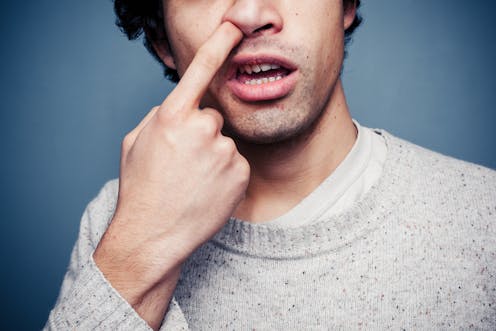
Picking your nose is linked to an increased risk of COVID, according to a study out today.
The study was conducted in health workers. This raises two main questions.
One, were these health workers washing their hands at work? Two, what does this study mean for the rest of us nose pickers?
What did the study find?
Some 219 Dutch health workers were monitored for COVID infection. They had regular antibody testing, which tells us if they had been exposed to SARS-CoV-2, the virus that causes COVID. They also reported the results of their own COVID tests.
Some 12-18 months later, the health workers were asked about their nose picking habits, and exposure to COVID via symptomatic workmates or from contacts outside work.
Just over 17% of health workers who reported picking their nose caught COVID versus about 6% of those who did not report nose picking.
At first glance, it might appear feasible that people who pick their noses would be at increased risk of contracting COVID.
That’s because COVID infection relies on the SARS-CoV-2 virus coming into contact with mucous membranes that line the respiratory system, including those in the nose.
So if someone touches a contaminated object or hand, then sticks their finger up their nose, this so-called fomite transmission can occur.
But the risk is comparatively low. The United States Centers for Disease Control estimates about one in 10,000 contacts with a contaminated surface results in SARS-CoV-2 transmission.
Read more: How clean is your hospital room? To reduce the spread of infections, it could probably be cleaner
Hang on a minute
But there are some odd results. For example, people who picked their noses only monthly had a higher chance of infection than daily nose pickers. Logically, you would expect the daily nose pickers to have a higher risk of infection due to more transmission opportunities.
There were also several aspects of how the study was designed that may have influenced the results.
Just over half of the people approached to participate in the study actually did so, which may cause selection bias. This is where people who choose to participate may differ in some key characteristic from those who don’t. These different characteristics can be “confounders” that influence the results.
This was a cohort study, which followed a defined group of people for a set time and asked them questions about their habits and exposure. This study design may also be subject to bias.
That’s because people tend to answer in ways that are socially desirable, even in anonymous surveys. They tend to under-report behaviours seen as socially unacceptable (such as binge drinking); they over-report those that are socially acceptable.
This study did not control for this type of bias. So we cannot say for certain if someone’s report of whether and how often they picked their nose is a true reflection of what actually happened.

People in the study may also have had trouble correctly remembering past behaviour (picking their nose) or exposures (to symptomatic people with COVID). The long time lag between when the infection data was collected and the retrospective survey increases the risk of recall error.
There is also some level of “guestimating” in the study, particularly when it comes to the risk of COVID exposure. Health workers were asked to note their contact with symptomatic people or working with COVID patients. But we can’t say if these were real “exposures”. That’s because people may not have symptoms and still have COVID (this would have under-estimated their exposure risk). Alternatively, COVID patients may not be that infectious if they don’t shed much virus (which may have over-estimated the COVID risk).
Then, it appears the analysis did not control for gender. This is potentially an issue as female health workers tend to be better at following hand hygiene guidelines. The study reported a higher rate of nose picking in males and doctors, and males and doctors are also worse at hand hygiene.
 How often did health workers wash their hands? The study didn’t say.
Shutterstock
How often did health workers wash their hands? The study didn’t say.
Shutterstock
So the nose pickers may also be worse at sanitising their hands. In other words, we don’t know if nose picking is the reason for the reported increased risk of COVID, the lack of hand hygiene, or both.
Another way of saying this is the researchers reported a correlation between nose picking and an increased risk of COVID. We cannot say one causes the other or if additional factors are involved.
Read more: Does picking your nose really increase your risk of dementia?
So, what now?
Given the above limitations, the study conclusions seem overly confident. Overall, the risk of SARS-CoV-2 transmission via nose picking is probably comparatively low, particularly for the general public who are not working in high COVID environments.
But you can definitely decrease your risk through good hand hygiene (and using a tissue that you dispose of afterwards).
Better still, avoid inhaling airborne viral particles, which is the most common mode of transmission of SARS-CoV-2. Wear a good fitting mask or respirator in public, particularly in poorly ventilated or crowded inside spaces.
Authors: Thea van de Mortel, Professor, Nursing, School of Nursing and Midwifery, Griffith University
Read more https://theconversation.com/does-picking-your-nose-really-increase-your-risk-of-covid-210879


 Daily Bulletin


