

How the world’s oldest known meteorite impact structure changed the chemistry of Earth’s crust
- Written by: Andreas Zametzer, PhD Candidate at Timescales of Mineral Systems Group, Curtin University
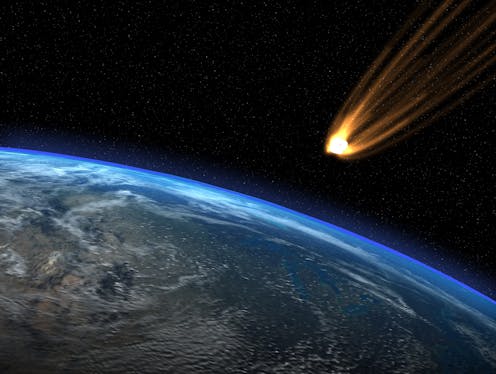
Meteorite impacts can be cataclysmic events in the history of a planet, melting rock, changing atmospheric chemistry, and wreaking general havoc.
However, impacts may also have created Earth’s continents, supported ecological niches that kick-started life, and even developed metal ores.
In a new study published in Earth and Planetary Science Letters, we examined what’s left of the world’s oldest known impact crater: the 2.29 billion-year-old site at Yarrabubba in Western Australia.
We found evidence hot water circulated in fractures in the rock after the impact, possibly because the impact melted some of the ice that covered much of the planet at that time. Hot water in fractured rock may have provided a niche for early life-forms, and its presence also has implications for our understanding of how deposits of metal ore form in Earth’s crust.
Space rocks have been key players in Earth’s history
Meteorite impacts appear to come and go in a 200 million year cycle over the course of Earth’s history.
Across the planet, about 200 major impact sites have been documented. The oldest of these is at Yarrabubba in Western Australia.
More than two billion years ago, a space rock slammed into the continental crust at Yarrabubba. This ancient crust had formed some 2.65 billion years before the present and was intensely changed by the impact.
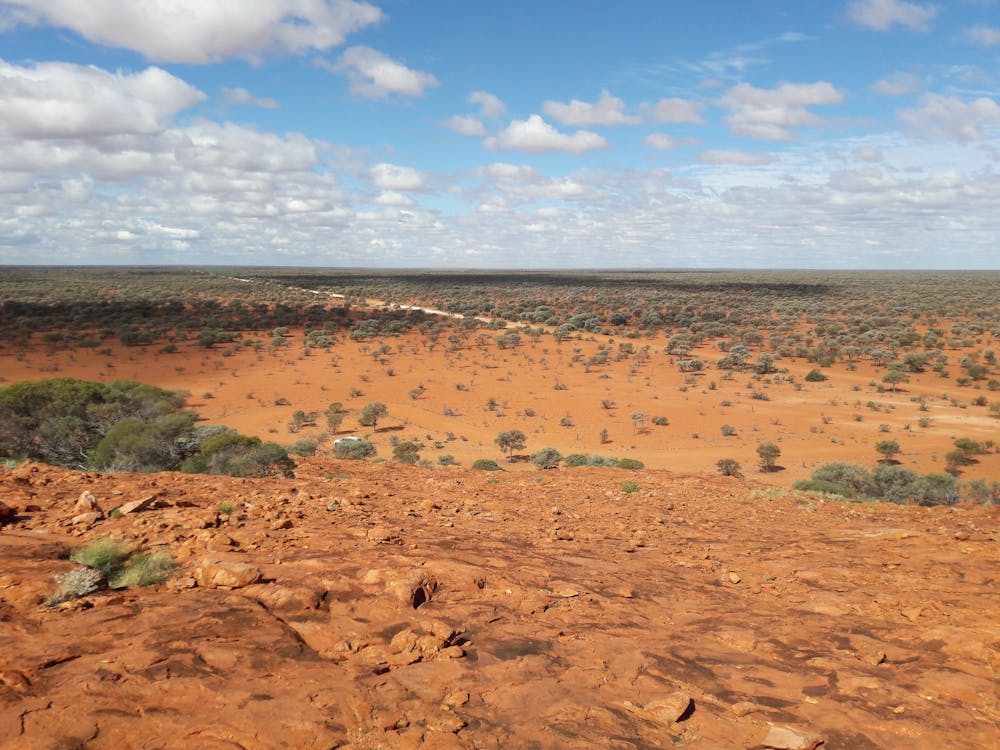
The result was a crater with an estimated diameter of about 70km, which is nowadays eroded to a mere pimple. The shock of the impact was so great it even melted parts of the surrounding crust, which is made of granite – a common type of rock you might see in fancy kitchen bench tops.
In our new research, we took a close look at what the impact did to the chemistry of the crust. The chemical effects of meteorite impacts are not often explored, but they may be important in understanding the full range of environmental consequences.
CSI: Rock
Geologists forensically study minerals trapped in rocks to investigate what happens inside Earth, in much the same way that crime scene investigators study materials at a scene to determine their origins.
One kind of clue geologists are particularly keen on is isotopes. These are different forms of a particular element.
Different isotopes of an element all behave the same in chemical reactions, but they contain different numbers of neutrons inside the atom. This makes some isotopes unstable: over time, they will radioactively decay into different elements.
Read more: Scientists have traced Earth's path through the galaxy via tiny crystals found in the crust
We can make use of this radioactive decay. For example, we can determine the age of the Yarrabubba crater and its surrounding rocks by measuring the ratio of uranium to lead isotopes, which acts like a stopwatch counting the time since a mineral has grown.
This tells us the age because uranium decays into lead over time, and we know the rate at which this decay happens. So measuring the isotopes of both elements in a sample shows us how much decay has happened, allowing us to calculate the mineral’s age.
Another way to use isotopes is in certain minerals where these ratios remain fixed over time and do not change. The isotopic signatures then become a powerful tool to track where material has come from, in much the same way that a person’s surname can give a clue to their family’s origin.
Messengers in a crystal bottle
We analysed the isotopic compositions of lead in mineral grains from the crust surrounding the crater at Yarrabubba.
We looked at crystals of feldspar, typically the pink-coloured grains in our granite bench top example, as these naturally contain lead but no uranium.
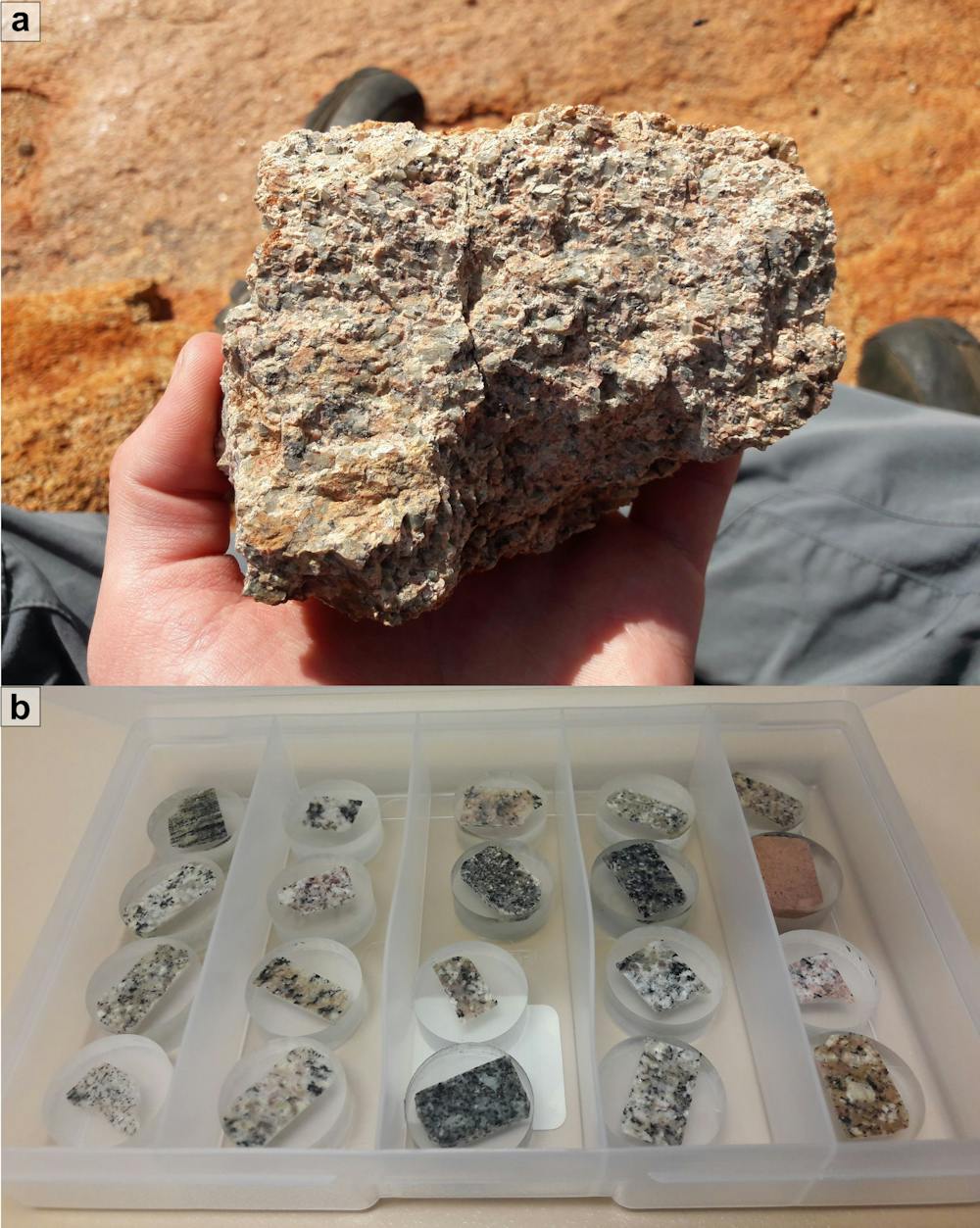 (a) Granite at the Yarrabubba impact structure. (b) Example rock samples to be analysed for isotopic composition. The pink grains in granite are typically feldspar that contains lead but no uranium and can be used for lead isotopic analyses.
Andreas Zametzer, Author provided
(a) Granite at the Yarrabubba impact structure. (b) Example rock samples to be analysed for isotopic composition. The pink grains in granite are typically feldspar that contains lead but no uranium and can be used for lead isotopic analyses.
Andreas Zametzer, Author provided
This is important as the lead isotopes trapped within this mineral reflect the composition of the liquid from which the mineral originally grew.
We found a wide range of lead isotopic compositions, as well as new uranium-bearing minerals that grew within fractures in the grains at the time of the impact, starting new stopwatches.
The only plausible explanation for these modifications of isotopic signatures is that the impact must have generated networks of circulating hot water that infiltrated damage zones throughout the rock. In the case of Yarrabubba, the water may well have come from the meteor hitting an ice sheet, as ice covered much of the world 2.29 billion years ago.
The impacts of impacts
Our documentation of the circulation of heated water produced by an impact is important from two very different perspectives.
First, hot fluid systems may have nurtured early life. Impacts were much larger and more frequent on the early Earth, and in some ways these violent and disruptive events would have stood in the way of complex life evolving.
Yet researchers have demonstrated that microbial communities can blossom where heat, water and nutrients meet pulverised rock: exactly the conditions impacts can produce. Some have even suggested impacts are a fundamental part of planetary evolution and necessary for creating a habitable planet.
Second, seeing how impact-generated hot water can transport metals can help us understand how ore deposits are created. Some of the first sources of metal for early humans were meteorites, from which they chipped away bits of metal for tools and jewellery.
Yet impact sites can contain larger concentrations of metals than just from the meteorite itself, which is often vaporised. Ore deposits typically form when there is a geological structure, for example a fracture within a rock, into which metals can be moved by fluids.
Impacts clearly shatter the crust, but they also provide circulating hot water. If there is metal present in the target rocks to begin with, this hot water may carry and concentrate these metals into a richer deposit.
Authors: Andreas Zametzer, PhD Candidate at Timescales of Mineral Systems Group, Curtin University


 Daily Bulletin


