

‘Have I just joined another cult?’: Daniella grew up in The Family, then joined the army – where she experienced toxic control, again
- Written by: Martine Kropkowski, Tutor, The University of Queensland
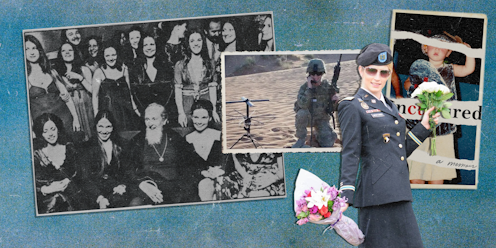
On Daniella Mestyanek Young’s first day of military training, she stands among her fellow recruits holding a duffle bag high in one arm above her head. As she ponders the other bodies lined up in her peripheral vision, all struggling to maintain the same pose, it gradually occurs to her that this feeling — of being owned, coerced, programmed — seems unsettlingly familiar: “Have I just joined another cult?”
This sense of suspicion forms a pattern in Mestyanek Young’s life, which she documents with remarkable insight in her memoir, Uncultured, exploring the systems of control in which toxicity can thrive.
Review: Uncultured – Daniella Mestyanek Young (Allen & Unwin)
Mestyanek Young was born into religious cult the Children of God, also known as The Family. (Not to be confused with Anne Hamilton Byrne’s Australian-based cult, also known as The Family.)
Mestyanek Young spent her childhood shuffled from compound to compound in Brazil, Mexico and the United States. At 15, she fled what she would come to recognise as a cult, made her way to Texas and put herself through school and college, eventually graduating as valedictorian and joining the US army, where she served as an intelligence officer.

But this book is not simply a survival story. It’s an exposé of the abuse that can run unchecked within cults. It’s a story about trauma, a war memoir, a meditation on the difference between culture and cults. And it’s a searing indictment of groups that continue to view those who are not men as subservient to those who are.
But at its core, Uncultured is a book about groups. It asks readers to look closely at the power mechanisms at work within the communities we call our own.
The Children of God
Mestyanek Young describes her childhood as a third-generation cult member (one of the “children of the children of the Children of God”) in chilling detail — but also striking detachment. The cult, also known as The Family, is infamous for its widespread and systematic abuse, especially of children.
The hierarchy cited the proverb, “Spare the rod, spoil the child”, to justify its exploitative treatment of children. It subjected children to routine beatings and demanded they remain perpetually available to satiate the sexual impulses of the cult’s adults. Mestyanek Young’s father was 49 years old when she was born; her mother was only 15.
Even as a young child programmed from birth, Mestyanek Young intuited that something about her world was deeply wrong. At just six years old, already questioning the legitimacy of the Bible, Mestyanek Young was locked in a room and repeatedly raped and beaten by one of the cult’s men, a distinguished uncle.
Despite the cult’s coercion tactics, however, Mestyanek Young was able to observe its inner workings from an unusually critical perspective, haunted by a sense that “even though I was the one getting punished, somewhere deep inside I suspected the wrong thing wasn’t me”.
Read more: Religious lies, conmen and coercive control: how cults corrupt our desire for love and connection
Defining a cult
Uncultured invites readers to reconsider what they think about the ways cults emerge and function. The Children of God falls easily under a recognisable definition of cult.
It had a leader, David Brandt Berg, thought charismatic by followers at the time. It had vernacular: defectors were backsliders; untouchable members of the hierarchy were selah. It divided the world into moral, inside members and evil, outsider systemites. It limited medical care and exploited its members’ labour. Its exit costs were high: excommunication, not only from loved ones but also from the stability, comfort and sense of purpose that scaffolds a life built around a clear mission.
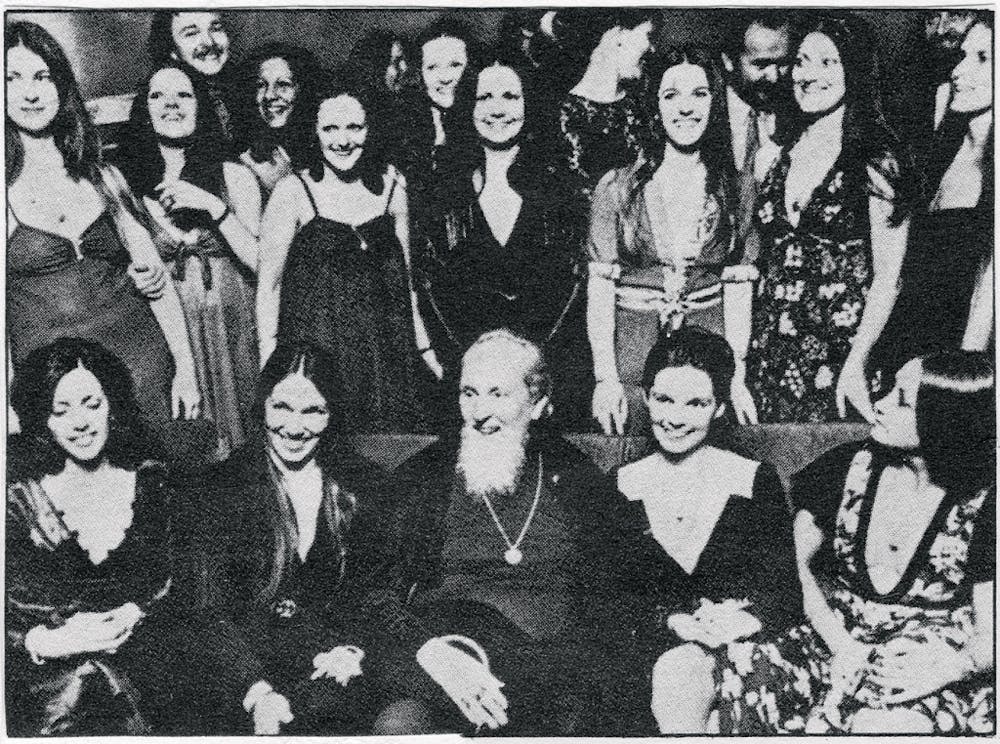 The Children of God cult and its leader, David Brandt Berg, who was thought charismatic by followers at the time.
Author provided
The Children of God cult and its leader, David Brandt Berg, who was thought charismatic by followers at the time.
Author provided
Cults have attracted significant scholarly attention over the last several decades, and working definitions suggest a cult is
[…] a very specific kind of social group that uses similar methods to entice supporters, transmit its ideology, control its members, and put its worldview into practice.
But Mestyanek Young takes a more expansive view. By drawing parallels between the systems of coercion and control she experienced in the Children of God and those she experienced in the army, she implicates a broad array of institutions in her characterisation of cult-like behaviour.
The cult(ure) of the army
As a recruit and officer in the US army, Mestyanek Young constantly recalls instances from her childhood that correspond to her military experiences.
She sees parallels everywhere: in the pageantry, the unrelenting demands, the chanting, the bespoke language, the ingrained sexism; in the unquestioning fidelity to superiors, the unique learning resources, the absolute, continual, exhaustive expectations of its members. She also sees parallels in the camaraderie, the sense of belonging, and the satisfaction of pursuing a clear objective alongside driven, like-minded people.
In particular, this book compels us to reflect on the entitlement of men in both groups: uncles and captains, for example, who operate within cultures that excuse the abhorrent behaviours of the worst of their members. The structure of both groups enables men to access the bodies of their subordinates in a way that is not only tolerated but expected.
Mestyanek Young details how the impulses of men were baked into the structure of power within both the Children of God and the US army – in the latter, particularly when she was deployed overseas.
As a member of the Children of God, Mestyanek Young was taught to “share in God’s love” by engaging in sexual acts without question whenever propositioned. In the army, Mestyanek Young found herself in a sexual relationship with her superior, a captain to whom “under the cover of darkness, I hadn’t felt at all powerful enough to say no”.
She was warned to not get herself raped on deployment, and simultaneously told that one in four women will be raped on deployment — by the men they serve alongside.
The army’s rape culture was buoyed by vernacular such as “rape alley”; by lore that positioned army women as one of only three categories: a bitch, dyke or slut. And by a culture that expected women to keep themselves safe, but didn’t expect men not to commit rape.
Mestyanek Young recounts the way workplace rape was shrugged off through a conversation with her superior, who casually remarks,
You know, before I got over here [to Afghanistan], I used to think that the women who said they were scared were just being dramatic. But the more I get used to what it’s like over here, the more I think that you probably will get raped on this deployment.
A former soldier’s ‘familiar’ perspective
Reading this memoir as a former solider in the Australian army, I found Mestyanek Young’s detailing of casual sexism exhaustingly familiar.
When I was a serving member, the often-used phrase, “There are no women in the army, only soldiers”, was meant to signal a type of equality: an erasure of the female gender that somehow signalled inclusivity.
But this type of phrase is not just a thought-stopping cliché masking an untruth. It’s not just a phrase that was deployed selectively and unfairly. It’s an erasure that misses the insights and additions from diverse points of view that can enrich an organisation.
On patrol in Kandahar, for example, Mestyanek Young enjoyed seeing children – in particular young girls – playing on the streets. On one patrol, Mestyanek Young notices there are none of these girls around. And this observation saves her patrol’s life: they pause, find an explosive device and abort the mission.
On the way to the helicopters, the patrol commander says, “I love having you girls on the team — you notice the silliest things.” Mestyanek Young reflects:
What if, our being so different, with such divergent life experiences, and all the silly, little things we notice, was the entire point? What if we could save lives, just by being women?
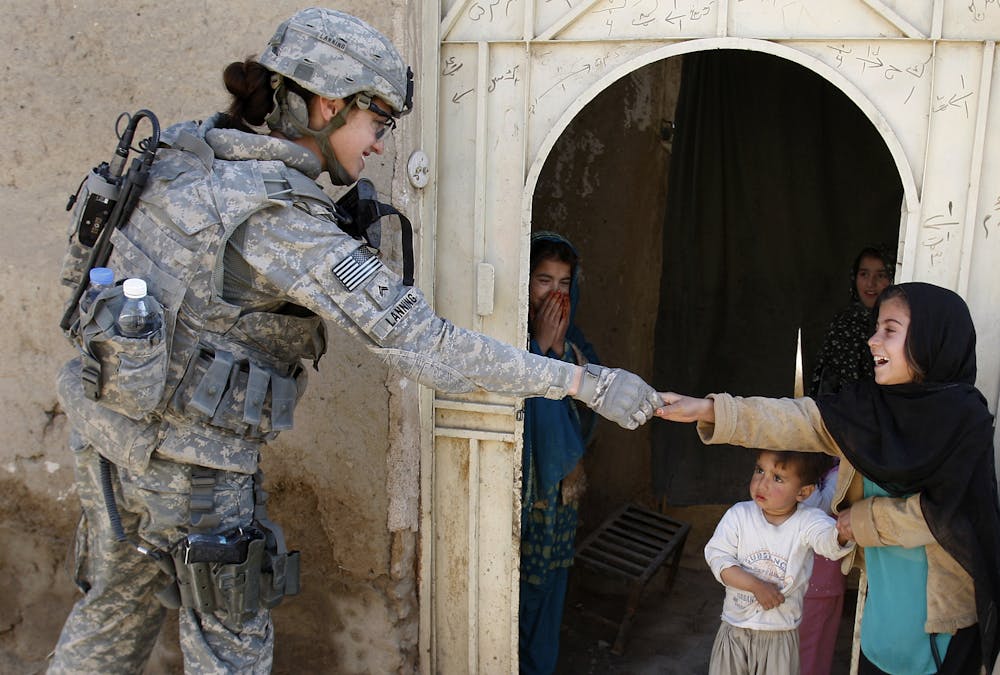 A US soldier meets Afghan girls during an information gathering operation in Kandahar City, 2010.
Kirsty Wigglesworth/AP
A US soldier meets Afghan girls during an information gathering operation in Kandahar City, 2010.
Kirsty Wigglesworth/AP
Mestyanek Young makes a number of salient points here. Firstly, it’s important that those inside a cult – those “good” members – challenge toxic culture. And strategies that normalise casual sexism and rape culture within organisations, which lead to the unique trauma women suffer when they deploy on a nation’s behalf, must be addressed.
We can extend Mestyanek Young’s observation on the value of diversity to endless group settings. But it can be difficult to see what’s going on from inside a cult – an organisation gone toxic.
Mestyanek Young demands that we look critically at our institutions, and the culture and cult behaviours that operate inside of them. She implores us to unpack the programming we have undergone as members of a society that finds it difficult to question the authority of its defence force.
Read more: Friday essay: why soldiers commit war crimes – and what we can do about it
Maybe groups are just groups
There’s no shortage of literature and scholarly debate about cults. What this book does particularly well is take our knowledge about cults and overlays it, by implication, on all types of groups.
Uncultured shows readers the methods of enticement, coercion and control that work so effectively within cults, so they might identify them in other areas of life.
She writes:
Maybe groups are just groups. Evil cults. Great armies. Wonderful families. Amazing countries. Pile whatever modifiers on them you want. Each one has the same inherent strengths, weaknesses, and potential pitfalls.
The book prompts us to reflect on our own groups — not just the social ones, but on our workplaces, institutions and governments — to reflect on our relationship to and within them. Because recognising toxic group behaviour in one context immunises us against it in all of the others.
 Are we being asked to hate? Is diversity of viewpoint actively suppressed? How much of my time am I devoting to this group, versus how much time I have for other things? What are the exit costs?
Scholars will continue to debate the precise definition of a cult. Discussions delineating the hazy line between a cult and culture will continue, and they should. But, as Mestyanek Young implies through this book, perhaps precise definitions aren’t really the point. Perhaps, identifying the systems of control that can grow and fester within all types of groups is what we should be focusing on.
Mestyanek Young’s observations about groups, and programming strategies, have many applications. Our current environment, for example, of algorithmic news curation, increasingly polarised politics, and ideologically driven broadcasting networks divides people into the “in” and “out” groups so central to cultic structures.
Against Uncultured’s thesis, we can understand these strategies as amounting to programming: a type that coaches people to make decisions based on identity and group-think, rather than reasoning and cooperation; a type of programming that has long been the modus operandi of cults.
In an era that includes extremist groups having unprecedented access to the general public through the internet, right through to business leaders, such as Elon Musk and Adam Neumann displaying behaviour some have described as cult-like, Uncultured is a timely and captivating read.
Authors: Martine Kropkowski, Tutor, The University of Queensland
Are we being asked to hate? Is diversity of viewpoint actively suppressed? How much of my time am I devoting to this group, versus how much time I have for other things? What are the exit costs?
Scholars will continue to debate the precise definition of a cult. Discussions delineating the hazy line between a cult and culture will continue, and they should. But, as Mestyanek Young implies through this book, perhaps precise definitions aren’t really the point. Perhaps, identifying the systems of control that can grow and fester within all types of groups is what we should be focusing on.
Mestyanek Young’s observations about groups, and programming strategies, have many applications. Our current environment, for example, of algorithmic news curation, increasingly polarised politics, and ideologically driven broadcasting networks divides people into the “in” and “out” groups so central to cultic structures.
Against Uncultured’s thesis, we can understand these strategies as amounting to programming: a type that coaches people to make decisions based on identity and group-think, rather than reasoning and cooperation; a type of programming that has long been the modus operandi of cults.
In an era that includes extremist groups having unprecedented access to the general public through the internet, right through to business leaders, such as Elon Musk and Adam Neumann displaying behaviour some have described as cult-like, Uncultured is a timely and captivating read.
Authors: Martine Kropkowski, Tutor, The University of Queensland


 Daily Bulletin


