

Daily Bulletin

Men's Weekly

.

  • Written by Ama Samarasinghe, Lecturer, RMIT University

Why would you dump a requirement for financial advisers to give advice that's in their client's best interests?

The findings about advisers in the landmark 2019 financial services royal commission couldn’t have been more stark.

Time after time financial advisers were found to have:

  • lacked skill and judgement

  • proposed actions that benefited the adviser

  • been unwilling to find out whether poor advice had been given

  • been unwilling to take timely steps to put bad advice right.

The result was a series of radical, but long-awaited changes in the industry, ranging from mandating a bachelor’s degree to enforcing ongoing professional development to introducing a legally-enforceable code of ethics.

Around 10,000 of the industry’s 25,000 advisers left, most retail banks offloaded their advice arms, and the median annual fee for ongoing advice climbed 40% from A$2,510 to $3,529.

‘Best interests’ or ‘good advice’?

In response, ahead of this year’s election the then financial services minister Jane Hume commissioned a quality of advice review, which is due to hand its final report to the new financial services minister Stephen Jones on Friday.

Ahead of its final report the review has published 12 draft proposals intended to make advice more affordable and accessible.

One of them would replace the present requirement for advisers to give advice that is in their clients “best interests” with advice that is merely “good advice”.
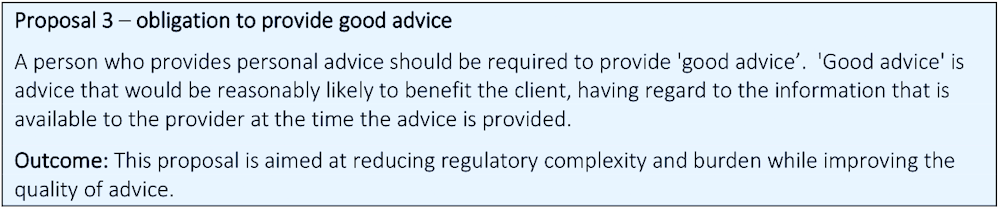
If that is what the review recommends, and if the recommendation is adopted, while stand-alone financial planners would still be required to provide advice that was in their client’s best interests (because of their code of ethics) banks, super funds and other providers would be able to give a lesser standard of advice. The core justification is reducing “regulatory complexity and burden while improving the quality of advice”. While it would certainly aid in reducing the compliance burden, and would make advice more accessible, it isn’t obvious that it would improve the quality of advice. Poorly defined The best interests duty requires advisers to put the client’s interests first, to make sure the advice is right for each particular client, and to warn the client if the advice is based on insufficient information. “Good advice” is defined simply as advice “reasonably expected to benefit clients”. Unless better defined, it will be a definition that leaves a lot to interpretation. Read more: Adviser 'reforms' will undermine a royal commission recommendation What banks and super funds believe they “reasonably expect” to be best for their customers, might not necessarily align with what’s best for their customers. While removing red tape is important, removing regulations that require advisers to act in their clients’ best interests might not be in their clients’ best interests. On Friday Stephen Jones will have to begin to consider whether “good advice” is good enough. It’s not a decision he should take lightly. Authors: Ama Samarasinghe, Lecturer, RMIT University

Read more https://theconversation.com/why-would-you-dump-a-requirement-for-financial-advisers-to-give-advice-thats-in-their-clients-best-interests-193719

Business News

Manhari Founder, Maddy Gupta, urges businesses to capitalise on the rising value of metals

Old and unwanted equipment and business assets are often worth far more than they appear particularly those containing valuable metals. Precious metals, led by gold and silver reaching record highs...

Daily Bulletin - avatar Daily Bulletin

Qualities to Check in an NDIS Provider

Everyone wants to live life with independence and dignity. For people with disabilities, achieving this often requires the right support. This is where NDIS providers play an important role. These pro...

Daily Bulletin - avatar Daily Bulletin

How Thorough Component Inspections Protect Your Supply Chain from Costly Failures

In the modern world, where manufacturing has become highly interconnected, the weakest components of the supply chain can only make the chain as strong as it is. One defective component might cause ...

Daily Bulletin - avatar Daily Bulletin

Speed Dating For Business