

Ancient DNA reveals a hidden history of human adaptation
- Written by: Yassine Souilmi, Group Leader, Genomics and Bioinformatics, Australian Centre for Ancient DNA, University of Adelaide
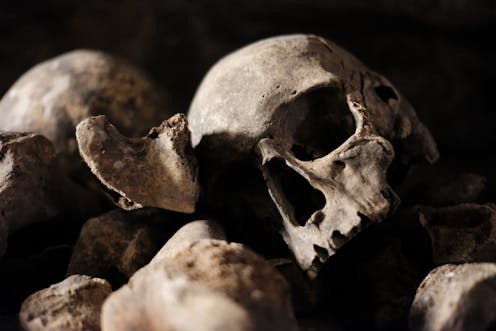
Humans may be just as vulnerable to environmental change as other animals, according to our new research analysing genetic data from more than a thousand people who lived across Europe and Asia over the past 45,000 years.
We found traces of more than 50 “hard sweeps” in which a rare genetic variant rapidly swept through a population – most likely after a change in conditions in which those lacking the variant died out. The most striking sweep occurred among early Anatolian farming people, in a genetic region associated with the immune system called MHC-III.
Hard sweeps have often been seen in other species, but until now there has been little sign of them in humans. The traces of the hard sweeps had been hidden by frequent mixing between populations over the past 8,000 years.
Our results show humans’ famed ability to adapt our behaviour and develop new tools and techniques has not always been enough to survive when times have grown tough.
How natural selection works
Modern humans live in a huge variety of natural environments, from the frozen Arctic to sweltering tropical rainforest.
Unlike most animals, humans can draw on cultural innovations – such as fire and clothing – to overcome the challenges these environments present.
However, these innovations may not always have been enough to cope with new environmental conditions. This is when genetic variability among individuals comes into play.
Read more: We found traces of humanity's age-old arms race with coronaviruses written in our DNA
Individuals with genetic variations that make them better equipped to deal with the new conditions will tend to leave more offspring. As a result, these beneficial variants become more common in future generations.
This process of genetic adaptation was dubbed “natural selection” by Charles Darwin nearly 200 years ago.
How humans adapt
Using statistical tools to search for evidence of hard sweeps, researchers have found ample evidence for past adaptive events in many animals and plants, but little in human genomes. More specifically, hard sweeps are conspicuously rare in humans.
As a result, some have speculated that genetic adaptation in humans is rare, perhaps because cultural innovations have made it largely unnecessary. Others have suggested selection has occurred across many moderately beneficial genetic variants, leading to subtle and hard-to-detect signals.
Hidden signals
Almost 40 years ago, new technologies to extract tiny amounts of DNA from archaeological skeletal remains were developed. This has made it possible to study the genomes of ancient populations, and changed our view of how ancient human groups and civilisations are related to each other.
Ancient DNA research revealed that over the past 10,000 years in Eurasia, intermixing between genetically divergent populations has been particularly frequent.
We thought these events might have erased historical sweep signals from modern human genomes – but that ancient genomes predating these intermixing events may still retain traces of the signals.
Read more: The origin of 'us': what we know so far about where we humans come from
Around 10,000 years ago, after the end of the last ice age, there was much more genetic variety among the the hunter-gatherers living in Europe than there is among the humans living there today.
In fact, the genetic differences between groups of ancient European hunter-gatherers were as large as the differences now observed between contemporary populations in western Europe and east Asia.
This extreme genetic differentiation collapsed over the past 8,000 years due to several migrations and mixing events, making modern Europeans much more genetically homogeneous.
‘Hard sweeps’ in human history
In our new research, published today in Nature Ecology & Evolution, we revisited this question by scanning more than a thousand ancient human genomes sourced from across Eurasia.
We wondered: could these relatively recent mixing events have masked historical selective sweeps, so they were invisible in modern human genomes?
To test this idea, we first carried out some computer simulations based on estimates of genetic mixing from studies of ancient Eurasian genomes. The simulation results suggested ancient selection signals could indeed be strongly diluted in modern genomes.
Read more: Nobel prize: Svante Pääbo's ancient DNA discoveries offer clues as to what makes us human
Next, we compiled and analysed genetic information from more than 1,000 ancient human remains, with the oldest sample being around 45,000 years old.
We compared selection signals in ancient genomes with those from modern genomes. The ancient data contained many more hard sweep signals than the modern samples. More recent sweeps were particularly prone to erasure, due to being rare or absent in at least one of the mixing populations.
Our results confirm hard sweeps were indeed part of the repertoire of human genetic adaptation. This suggests we may not be so different from other animal species after all.
The genetic basis of adaptation
Genetic evidence for historical mixing events between different populations is growing. This is not only in humans but also in other species, suggesting such mixing may be reasonably common in nature.
If these mixing events are widespread, our study suggests hard sweeps may also have been more common than we currently think. Overall, we may have a biased view of how species have genetically adapted to environmental pressures.
To more fully understand how adaptation works at a genetic level, we will need to develop new statistical methods to disentangle signals of hard sweeps and other selection events.
Read more: What’s next for ancient DNA studies after Nobel Prize honors groundbreaking field of paleogenomics
Authors: Yassine Souilmi, Group Leader, Genomics and Bioinformatics, Australian Centre for Ancient DNA, University of Adelaide
Read more https://theconversation.com/ancient-dna-reveals-a-hidden-history-of-human-adaptation-193251


 Daily Bulletin


