

Much ado about Shakespeare – why it's time for a New Zealand national theatre
- Written by: Barry King, Professor of Communications, Auckland University of Technology
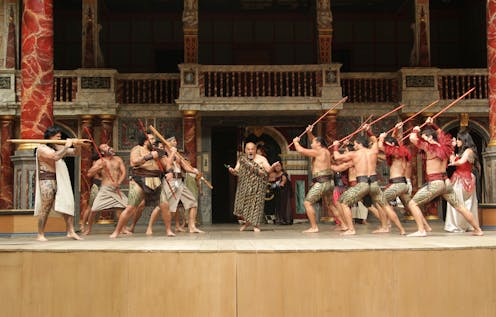
Whether you viewed it as a fresh front in the culture wars or merely a tempest in a teacup, the recent controversy over a shift in funding for the Shakespeare Globe Centre New Zealand was more evidence the country’s national culture is undergoing something of an identity crisis.
Behind the row lay an unanswered question: how does a post-settler, multicultural society create a national identity? This latest case put a spotlight on the performance arts in this evolving cultural debate. This raises its own question: what can theatre contribute to the nurturing of our national identity?
Live theatre is important in recalibrating the image of nationhood because of its direct connection to local audiences. Cinema and television, by and large, are committed to exploring themes and formats that target global audiences.
By contrast, theatre is charged with delivering original indigenous work; or at least, a distinctive local take on plays and performances. Perhaps it’s time, then, to revisit the concept of establishing a national theatre in Aotearoa New Zealand.
Ghosts of theatres past
Within the current debate about the funding policies of Creative New Zealand (CNZ), it has been suggested the theatre “ecology” is in crisis. Significant aspects of the crisis are economic: the impact of the pandemic on employment in the performance sector, and the impact of inflation on CNZ’s fixed investment budget.
But part of the crisis can be read as structural, conjuring up past efforts to create a national professional theatre – witness the efforts of Richard Campion and the New Zealand Players (1952-1960) and Wellington’s Downstage Theatre (1973-2013). Bruce Mason, in particular, strove to produce a distinctively postcolonial, Polynesian theatre.
The ghosts of such efforts are not well served by present funding policy. Following its 2015 Review of Theatre, CNZ adopted a funding model that consolidated the division between different forms of theatre.
On one side are fixed theatres operating in metropolitan centres, with special provision for Māori and young people’s theatre. On the other side are community-based theatre companies or solo performers, who perform in local theatres and non-theatrical venues such as civic buildings, schools, arts centres and community halls.
Unlike main centre theatres, CNZ sees community companies as a source of experimental work outside the traditional repertoire. The support received by such companies varies, based on a yearly competition. While not necessarily unfair, this structure enshrines the notion of separatism rather than cross-fertilisation.
Separate stages
Not surprisingly, reactions to recent funding decisions have raised questions about the way different performance arts are valued. As one critic of the current system asked, why does ballet, an “elite” art form with a comparatively small audience, receive greater funding than kapa haka, a popular art form with a larger audience?
A similar question was implied in the claim by one CNZ assessor that Shakespeare is “locked within a canon of imperialism”, without apparent consideration of how the plays might be performed.
Of the many questions about these decisions, two are fundamental. First, how should different performance arts be valued – for their market performance, or for their contribution to a national performance culture? Second, what form of theatre might most effectively express a national culture distinct from the colonial British or European heritage?
Read more: The show must go on, but it's time to re-think how we fund the arts in NZ
An essential flaw in current funding policy is that it perpetuates the divisions between different communities of dramatic practice, whereas a progressive policy would work to encourage cross-fertilisation between different forms of drama.
The increasingly multicultural composition of New Zealand’s population suggests the official policy of biculturalism needs to be reconsidered.
Even a cursory glance at contemporary New Zealand theatre reveals a wide range of practices, ranging from “well made” plays in the Western tradition, through to plays that draw on the Indigenous performance traditions and styles of diverse ethnic groups. How could the funding policy for theatre be realigned to the contemporary abundance of multicultural performance traditions?
Read more: 'Bloody-hunting slaughtermen', sieges and 'lechery': what does Shakespeare tell us of war?
Towards a Polynesian theatre
Rather than separating regional and local theatre, with their different approaches to performance, funding policy could be directed towards creating a national theatre with an umbrella approach that promotes interaction between different theatrical traditions and encourages the emergence of hybrid theatrical forms.
Such a national theatre could be structured as a permanent travelling company or a virtual academy. It could be based on a consortium of existing theatre educators, or an integrated consortium of mainstream and community theatres. It might be developed as a collaborative playwright’s theatre based on the current Playmarket model.
Read more: These high school 'classics' have been taught for generations – could they be on their way out?
Given the rise of “incidental” casting (considering all artists, regardless of gender, ethnicity, disability, sexual orientation or socioeconomic background for all roles), the actual meaning of a play depends as much, if not more, on the way it is cast and staged than on its content.
Theatre is a space in which plays perceived as “reactionary” or tied to a past can be revitalised and reconfigured. A national theatre, carefully considered, could be the crucible where Bruce Mason’s dream of a truly Polynesian theatre can be forged.
Authors: Barry King, Professor of Communications, Auckland University of Technology


 Daily Bulletin


