

Radioactive traces in tree rings reveal Earth's history of unexplained 'radiation storms'
- Written by: Benjamin Pope, ARC DECRA Fellow, The University of Queensland
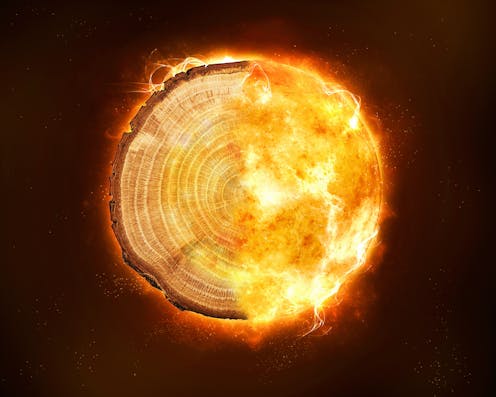
In searching for planets and studying their stars, I’ve had the privilege to use some of the world’s great telescopes. However, our team has recently turned to an even larger system to study the cosmos: Earth’s forests.
We analysed radioactive signatures left in tree rings around the world to study mysterious “radiation storms” that have swept over Earth half a dozen times in the past 10,000 years or so.
Our results, published today in Proceedings of the Royal Society A, rule out “solar superflares” as the culprit – but the true cause remains unknown.
A history written in tree rings
When high-energy radiation strikes the upper atmosphere it turns nitrogen atoms into radioactive carbon-14, or radiocarbon. The radiocarbon then filters through the air and the oceans, into sediments and bogs, into you and me, into animals and plants - including hardwoods with their yearly tree rings.
To archaeologists, radiocarbon is a godsend. After it is created, carbon-14 slowly and steadily decays back into nitrogen – which means it can be used as a clock to measure the age of organic samples, in what is called radiocarbon dating.
Read more: Explainer: what is radiocarbon dating and how does it work?
To astronomers, this is equally valuable. Tree rings give a year-by-year record of high-energy particles called “cosmic rays” going back millennia.
The magnetic fields of Earth and the Sun shield us from cosmic rays shooting through the Galaxy. More cosmic rays reach Earth when these magnetic fields are weaker, and fewer when the fields are stronger.
This means the rise and fall of carbon-14 levels in tree rings encodes a history of the 11-year cycle of the solar dynamo (which creates the Sun’s magnetic field) and the reversals of Earth’s magnetic field.
Miyake events
But tree rings also record events we cannot presently explain. In 2012, Japanese physicist Fusa Miyake discovered a spike in the radiocarbon content of tree rings from 774 AD. It was so big that several ordinary years’ worth of cosmic rays must have arrived all at once.
As more teams have joined the search, tree ring evidence has been uncovered of further “Miyake events”: from 993 AD and 663 BC, and prehistoric events in 5259 BC, 5410 BC, and 7176 BC.
These have already led to a revolution in archaeology. Finding one of these short, sharp spikes in an ancient sample pins its date down to a single year, instead of the decades or centuries of uncertainty from ordinary radiocarbon dating.
Among other things, our colleagues have used the 993 AD event to reveal the exact year of the first European settlement in the Americas, the Viking village at L'Anse aux Meadows in Newfoundland: 1021 AD.
Could huge radiation pulses happen again?
In physics and astronomy, these Miyake events remain a mystery.
How do you get such a huge pulse of radiation? A flurry of papers have blamed supernovae, gamma-ray bursts, explosions from magnetised neutron stars, and even comets.
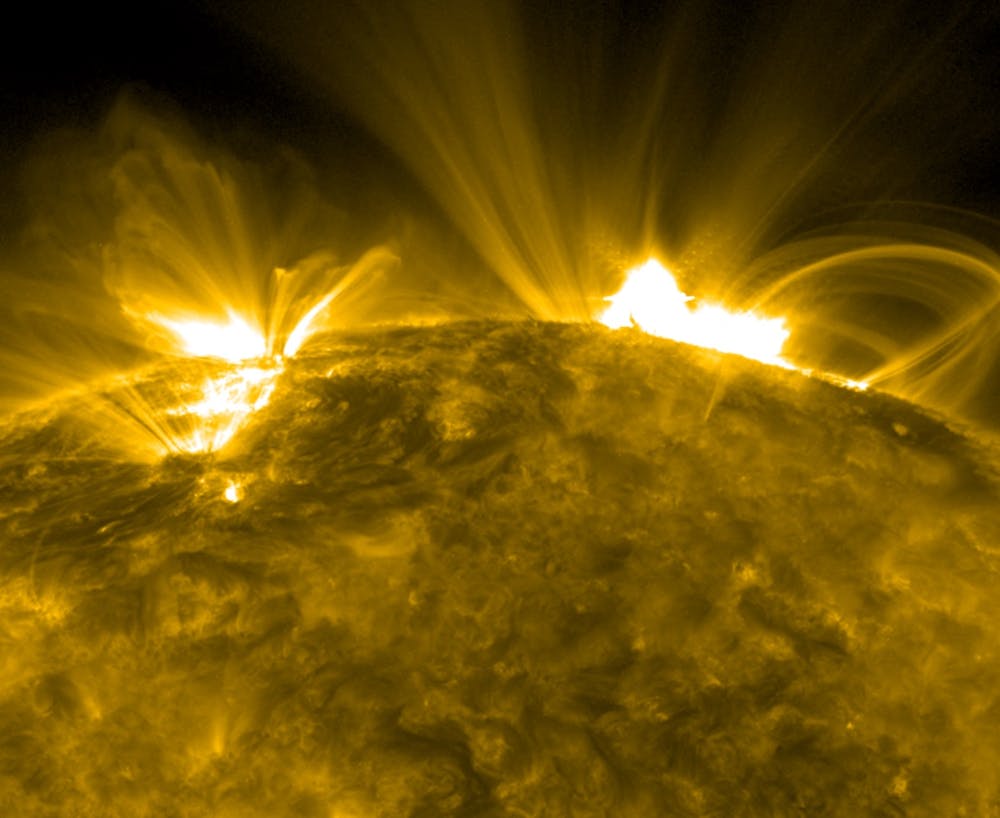
However, the most widely accepted explanation is that Miyake events are “solar superflares”. These hypothetical eruptions from the Sun would be perhaps 50–100 times more energetic than the biggest recorded in the modern era, the Carrington Event of 1859.
If an event like this occurred today, it would devastate power grids, telecommunications, and satellites. If these occur randomly, around once every thousand years, that is a 1% chance per decade – a serious risk.
Noisy data
Our team at UQ set out to sift through all the available tree ring data and pull out the intensity, timing, and duration of Miyake events.
To do this we had to develop software to solve a system of equations that model how radiocarbon filters through the entire global carbon cycle, to work out what fraction ends up in trees in what years, as opposed to the oceans, bogs, or you and me.
Working with archaeologists, we have just released the first reproducible, systematic study of all 98 trees of published data on Miyake events. We have also released open source modelling software as a platform for future work.
Storms of solar flares
Our results confirm each event delivers between one and four ordinary years’ worth of radiation in one go. Earlier research suggested trees closer to Earth’s poles recorded a bigger spike – which is what we would expect if solar superflares are responsible – but our work, looking at a larger sample of trees, shows this is not the case.
We also found these events can arrive at any point in the Sun’s 11-year activity cycle. Solar flares, on the other hand, tend to happen around the peak of the cycle.
Read more: Why is the sun going quiet?
Most puzzling, a couple of the spikes seem to take longer than can be explained by the slow creep of new radiocarbon through the carbon cycle. This suggests that either the events can sometimes take longer than a year, which is not expected for a giant solar flare, or the growing seasons of the trees are not as even as previously thought.
For my money, the Sun is still the most likely culprit for Miyake events. However, our results suggest we’re seeing something more like a storm of solar flares rather than one huge superflare.
To pin down what exactly happens in these events, we will need more data to give us a better picture of the events we already know about. To obtain this data, we will need more tree rings – and also other sources such as ice cores from the Arctic and Antarctic.
This is truly interdisciplinary science. Normally I think about beautifully clean, precise telescopes: it is much harder to understand the complex, interconnected Earth.
Authors: Benjamin Pope, ARC DECRA Fellow, The University of Queensland


 Daily Bulletin


