

Jim Chalmers' 'restraint' budget the first stage of a marathon for the treasurer
- Written by: Michelle Grattan, Professorial Fellow, University of Canberra
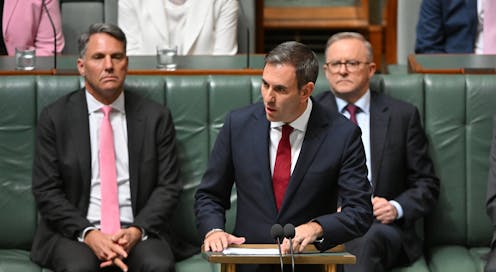
Jim Chalmers’ inaugural budget plants its feet as solidly as possible in the shifting sands of difficult and unpredictable international and local conditions.
Chalmers promised the budget would be “workmanlike”, not “flashy”, and he’s kept his word. Almost all of it had been pre-issued by the government, including measures and numbers.
This can be seen as an interim budget, a new government taking stock and getting some early action under way.
At one level, the budget does the easy things.
It hoes into some relatively soft targets left by the Coalition, which distributed giveaways galore as it became desperate before the election. And it implements a raft of promises on which Labor campaigned.
But framing any budget in such uncertain times involves tricky trade offs and careful judgement. So the opposition’s “line” before Tuesday – that this is just in effect a mid-year budget update – greatly understates the task.
The government has been sensibly cautious. Keeping spending tight was vital. Despite the hard times and the pressure to give people help, any splurging would have been inflationary and at cross purposes with the Reserve Bank’s efforts to cool the economy.
Interest rates are set to go up again before Christmas anyway – so the worst thing would have been a fiscal policy that forced the bank to push them up even further.
The emphasis on delivering election commitments in this first budget is important because it builds voter trust – and thus political capital – early in the government’s term.
On this front, Prime Minister Anthony Albanese was wise to pull back from Chalmers’ inclination to refashion the Stage 3 tax cuts. That would have transformed the budget story from “promises kept” to “promise broken”, with the potential to sour Labor’s compact with the electorate.
“Restraint is the name of the game in this budget,” Chalmers said at his news conference in the media “lock up”. While Tuesday’s effort passes the “restraint” test for now, it is obvious that there are tough decisions ahead.
The numbers show the deficit larger, compared to this financial year, in the second, third and fourth year of the forward estimates. Outlays in areas such as the National Disability Insurance Scheme (costed at nearly $52 billion in 2025-26 and potentially about $100 billion a year by 2032-33) will have to be tackled, and that will be much harder politically than cancelling a Coalition dam or some car parks.
The economists will like the budget, but what about the ordinary voters?
Leaving aside those in the pockets hit by the cuts, they are unlikely to be hostile. But nor will they see much in it for them.
And they will be dismayed by the horrendous forecasts for electricity and gas prices, and how far away is the hope of real wage rises. But more broadly, they will be already across the inflation story from their daily lives.
The promises on cheaper child care, lower costs for medicines, and more affordable housing are branded as part of “responsible cost of living relief”.
Read more: Jim Chalmers’ 2022-23 budget mantra: whatever you do, don’t fuel inflation
But it’s a misnomer. Only a minority of people at any one time will benefit from the child care changes. Housing will remain unaffordable for many people.
As cost-of-living relief, the budget measures pale when put beside the coming massive power costs and the interest rate rises of the last few months and those ahead.
This is not to say the budget should have given more direct cost-of-living assistance. It’s just to note there is some hyped “branding” by a government that puts a lot of store on how it labels things.
Chalmers emphasises this is the first of a suite of budgets, which will be preceded by “conversations”. It’s a fair bet the later ones will generate stronger headlines.
The future cuts will be more controversial. And at some stage the government will visit the tax issue, although when and in what form is unknown. “I think tax needs to be part of the conversation going forward,” Chalmers told the media.
It’s been a hard few months for Chalmers. But in reality, he’s been in the easy stage of what will be a marathon.
Read more: ‘The beginning of something new’: how the 2022-23 budget does things differently
Authors: Michelle Grattan, Professorial Fellow, University of Canberra


 Daily Bulletin


