Read The Times Australia

Daily Bulletin

Australia needs an honest conversation about tax and budgets – and Jim Chalmers is ready to talk

  • Written by: Peter Martin, Visiting Fellow, Crawford School of Public Policy, Australian National University
Australia needs an honest conversation about tax and budgets – and Jim Chalmers is ready to talk

Jim Chalmers is a wily operator. Ahead of delivering his first budget next Tuesday, he has given himself room to do the things a treasurer needs to do.

For a while, his predecessor Josh Frydenberg denied himself that room. In his first budget as treasurer under Scott Morrison ahead of the 2019 election, Frydenberg promised to get the budget “back in the black”.

That 2019 budget forecast increasing surpluses as far as the eye could see (which was ten years, the limit of the graphs presented in the budget papers). The Liberal Party began selling “back in the black” celebratory mugs at A$35 each.

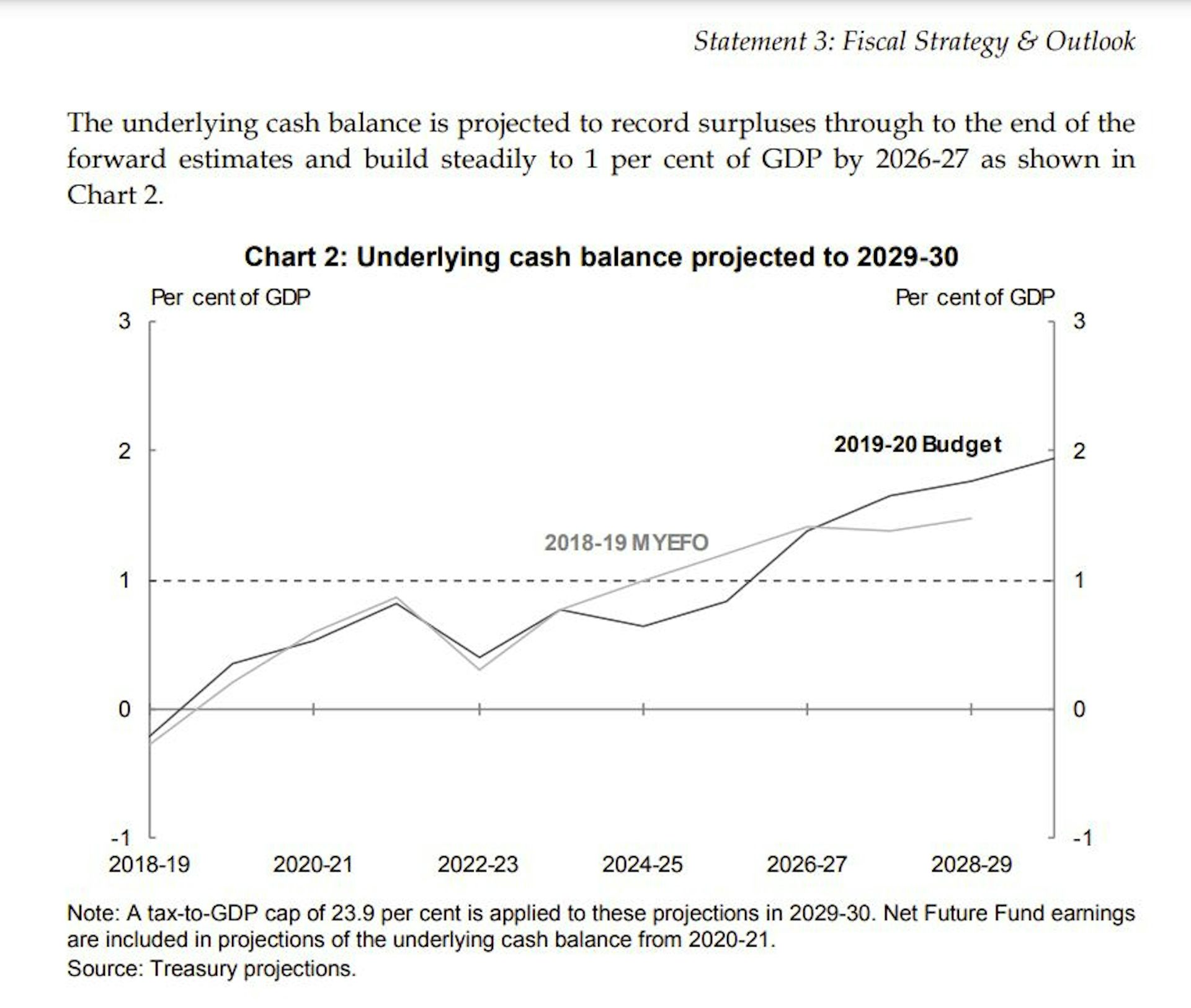
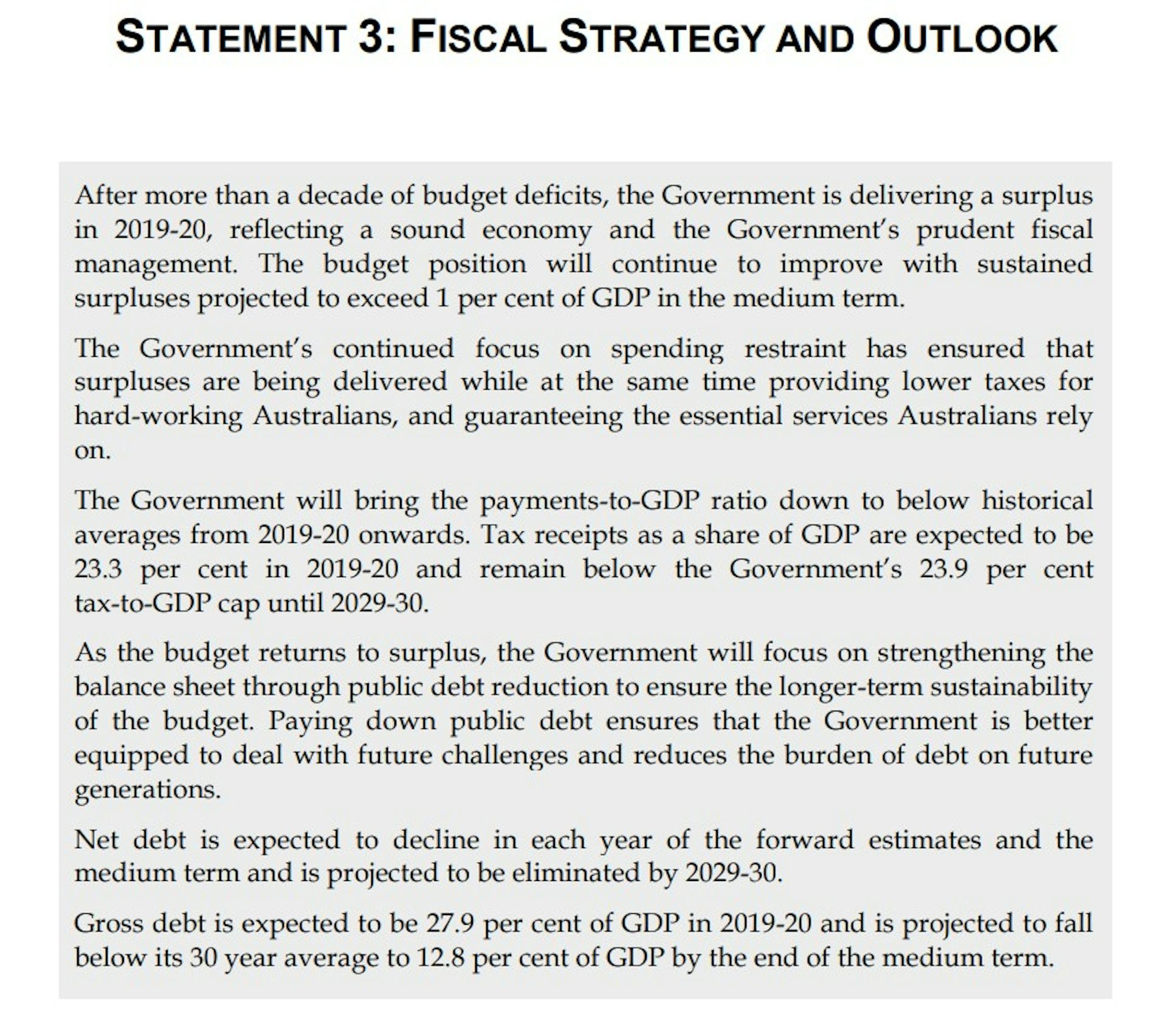
Liberal Party of Australia, 2019 The trick was that from then on, government spending would grow more slowly than the rest of the economy. As a proportion of GDP, it would slide from around 25% to 23.6% by 2029-30. For that to happen, all sorts of government programs would have to become and stay less ambitious for ten years. But instead of details, Frydenberg’s department gave us gobbledegook – such as that lower payment projections had been driven by lower than expected payments across a range of programs in the forward estimates flowing through to the medium term. It made substantial extra spending near-impossible. The 2019 budget assumed that the cost of National Disability Insurance Scheme couldn’t blow out (it has), that governments couldn’t spend more in response to aged care and disability royal commissions (they’ll have to), or pay aged care workers the big rises the Fair Work Commission is about to award, and so on. COVID changed everything – except the tax cap Just about every fairly foreseeable crisis couldn’t be responded to, if the assumptions in the 2019 budget were to be believed. Not even by raising more tax. A separate “tax cap” set out in the budget said the government would never collect more than an arbitrarily chosen 23.9% of GDP. Frydenberg tied his own hands in a way a treasurer who wanted to take charge of the nation’s finances would not have. Until COVID. Within a year, Frydenberg junked the “back in the black” pledge and spent big, because he had to. But he kept in place the bizarre 23.9% tax cap. The Liberal Party campaigned on it in the election, challenging Chalmers to adopt it. No tax cap – but what comes next? But here’s how much Chalmers really wanted the job of treasurer. In an election in which Labor repeatedly presented itself as a small target, Chalmers said “no” to the tax cap, over and over again. Asked on ABC’s 7.30 last month whether next week’s and future budgets would be bound by the tax cap written into Frydenberg’s final budget, he said the cap had been more or less “plucked out of the air”. And I had the courage, if I can say that, to say that before the election as well as during the election campaign. His task was to fit the budget to the conditions Australia faced: rising inflation, falling real wages, rising interest rates, and looming recessions worldwide. The amount he would have to spend, and the amount he would have to raise, would be the result of those deliberations. Read more: Election tip: 23.9% is a meaningless figure, ignore the tax-to-GDP ratio And it would be the result of things beyond any government’s control. Unexpectedly, the Coalition almost breached its tax cap in its final year in office because of a flood of revenue flowing from higher commodity prices and a greater than expected number of Australians in jobs. It took in 23.4% of GDP. What would it have done if it had breached the cap? Given the money back? Growing demands on the budget The demands on future budgets will be enormous. Not only paying for the National Disability Insurance Scheme and aged care, but also Medicare, hospitals, defence, education, rent assistance, boosting the scandalously low rate of JobSeeker, and dealing with increasingly frequent floods and climate change. Australians expect these challenges to be taken seriously. Labor’s actual election promises aren’t that expensive. The parliamentary budget office found a net impact of $6.9 billion over four years. In Tuesday’s budget, Chalmers will find much of the money for those promises by cancelling decisions made in Frydenberg’s March budget. An upside of having budgets in both March and October this year is that a lot of the money committed in March hasn’t yet been spent. How do we pay for what we need most? But beyond that, Chalmers says he is up for a serious conversation about how we pay for the services we need and have a right to expect. A former head of the prime minister’s department, Michael Keating, wants an expert committee (“not a royal commission made up of lawyers”) to prepare a bottom-up estimate of the extra revenue we will need to guarantee the essential services we are likely to need. After the committee has developed the estimate, Keating wants a second inquiry to work out how best to raise it. Read more: Memo to Labor: you need more tax, working out how much more is urgent Economist Ross Garnaut told September’s jobs summit that as a share of GDP, total federal, state and local government tax revenue was 5.7 percentage points below the developed country average. On one calculation, that means Australia could raise an extra A$140 billion a year and still be taxed at developed country rates. It needn’t all come from income tax. Most developed countries have much bigger goods and services taxes than we do, and many have windfall profits taxes, and effective taxes on energy exporters. And it needn’t all be raised now. There’s no point in taxing more for the sake of taxing more. But we are likely to need to raise more in future, to help fix the kinds of problems we’re likely to face in the future. That’s the overdue conversation we have to have, starting next Tuesday. Authors: Peter Martin, Visiting Fellow, Crawford School of Public Policy, Australian National University

Read more https://theconversation.com/australia-needs-an-honest-conversation-about-tax-and-budgets-and-jim-chalmers-is-ready-to-talk-192603

Business News

Options Available When a Company Faces Financial Distress

Financial distress can develop gradually or arrive suddenly, and when it does, the decisions made in the early stages often determine what options remain available later. Directors who act promptly ...

Daily Bulletin - avatar Daily Bulletin

What Healthcare Teams Look for When Choosing Specialist Surgical Supplies

In clinical environments, small details rarely stay small. A delayed instrument, a poorly matched device or inconsistent supply quality can affect theatre flow, staff confidence and patient outcomes. ...

Daily Bulletin - avatar Daily Bulletin

Reducing Sales Friction Through Centralized Content Delivery

Sales friction appears whenever buyers or sales teams face unnecessary obstacles in the buying journey. It can happen when information is hard to find, when messaging feels inconsistent, when product ...

Daily Bulletin - avatar Daily Bulletin

Why Choosing the Right Bollard Supplier Matters for Australian Businesses and Public Spaces

From busy CBD streetscapes to sprawling warehouse loading docks, bollards have become one of the most essential safety and security fixtures across Australia. Whether protecting pedestrians from veh...

Daily Bulletin - avatar Daily Bulletin

Why Modular Content Is Transforming Modern Marketing Teams

Modern marketing teams are expected to produce more content than ever before. They need to support websites, landing pages, email campaigns, social channels, product pages, sales enablement material...

Daily Bulletin - avatar Daily Bulletin

Everything You Need to Know About Getting Support from Optus

Whether you've been an Optus customer for years or you've just switched over, at some point you'll probably need to contact their support team. Maybe your bill looks different from what you expected. ...

Daily Bulletin - avatar Daily Bulletin

The Marketing Strategy That’s Quietly Draining Sydney Business Owners’ Bank Accounts

Sydney businesses are investing more in digital marketing than ever before. The intention is clear. More visibility should mean more leads, more customers, and steady growth. However, many business ...

Daily Bulletin - avatar Daily Bulletin

Why Mining Hose Solutions Are Essential For High-Performance Industrial Operations

In environments where the ground itself is constantly shifting, breaking, and being reshaped, every component must be built to endure. Mining operations are among the most demanding in the industria...

Daily Bulletin - avatar Daily Bulletin

The Reason Talented Teams Underperform

If you’re in business, you might have seen it before. A team of capable and smart people just suddenly slows down, and things start spiraling out of control. On paper, everything looks perfect, but ...

Daily Bulletin - avatar Daily Bulletin

The Daily Magazine

Why Stress Relief For Dogs Is Essential For Emotional Balance And Long-Term Wellbeing

Managing emotional health is just as important as physical care when it comes to pets, which is why ...

Australia’s Best Walking Trails and the Shoes You Need to Tackle Them

Australia is not short on spectacular walks. You can follow ocean cliffs in Victoria, cross ancien...

Why Pre-Purchase Building Inspections Are Essential Before Buying a Home in Australia

source Have you ever walked through an open home and started picturing your furniture, family d...

5 Signs Your Car Needs Immediate Attention Before It Breaks Down

Car problems rarely appear without warning. In most cases, your vehicle gives clear signals before...

Ensuring Safety and Efficiency with Professional Electrical Solutions

For businesses in Newcastle, a safe and fully functioning workplace remains a key part of day-to-d...

Choosing The Right Bin Hire Solution For Hassle-Free Waste Management

When it comes to managing waste efficiently, finding the right solution can save both time and eff...

Why Cleanliness Is Critical In Childcare Environments

Children explore the world with curiosity, often touching surfaces, sharing toys, and interacting ...

What to Look for in a Reliable Australian Engineering Partner

Choosing an engineering partner is rarely just about technical capability. Most businesses can fin...

How to Choose a Funeral Home That Supports Families with Care

Choosing a funeral home is rarely something families do under ideal circumstances. It often happen...