

20 years after the Bali bombings, survivors are still processing a unique kind of grief
- Written by: Garry Stevens, Director of Humanitarian and Development Studies, Western Sydney University
Today marks the 20th anniversary of the 2002 Bali bombings, which killed 202 people, including 88 Australians – our largest single loss of life from an act of terror.
But we hear less about the wider group of close family members and friends of people who died.
Twenty years on, these people are facing life without their loved ones and dealing with the way they were taken away.
Read more: Some survivors will find peace and healing in Bali 2002 – but others may find the series triggering
Grief after terrorism is different
Grief specialists describe grieving like a form of storytelling, a process by which we make sense of the loss and what the change means for our lives.
A key part is to connect the news of their passing with the many memories and routines that involved them. This “sorting” process can take months or years but is one way we move to a new story while also staying connected to them.
Losing a loved one in traumatic circumstances can interfere with these processes and lead to persistent or prolonged grief that does not ease over time.
Deaths that are sudden, violent and affect close relationships fall into this category. Reminders of the death can trigger traumatic memories for those left behind.
Terrorism has the further dimension of being both calculated and quite random in its impacts. It leaves survivors struggling to make sense of why this horror affected them.
Read more: Remembering the Bali bombings ten years on
What we found
Our interviews with Bali survivors eight years after the attacks found those physically injured or experiencing prolonged grief had the highest levels of distress.
Early steps in bereavement generally involve accepting the reality of the loss, partly by allowing yourself to experience the pain of the loss and being able to draw new connections and meaning.
However, after someone is harmed through violence, loved ones can avoid thinking about the loss. This can limit their ability to separate the life lost from how they died.
Over time, the two may “fuse” together, where thoughts about loved ones raise distress about what they experienced. So close family and friends can avoid reminiscing and the usual processing of grief.
Read more: There's not always 'closure' in the never-ending story of grief
Can anniversaries trigger distress?
The 20th anniversary is similar to other commemorations Bali survivors have worked through in the past two decades.
Many have learned to control or reduce their emotional triggers and are more likely to reflect upon and celebrate their loved ones than dwell upon the terrorism event itself.
At the same time, traumatic grief can last for decades, and most people do not receive effective treatment.
These people remain vulnerable to such triggers, particularly news that is unexpected or presents graphic detail.
Read more: Is it wrong to make a film about the Port Arthur massacre? A trauma expert's perspective
How best to support survivors psychologically?
Strong support networks and having people to confide in are critical to recovery.
Our study found married or partnered participants had the lowest levels of distress. Support that was non-judgmental and allowed “time and space” was also most valued, whether or not that came from a partner.
One family member told us what was important was:
People being there for you, where you are that day, and not telling you what to do or how to feel.
For others, working with authorities early on to get clear details of what happened brought some understanding and comfort. One person who lost several friends told us:
For me, it was being able to know the circumstances of their death.
Psychological “talk” therapies such as cognitive behavioural therapy are effective in up to 69% of cases of prolonged grief.
A key approach involves deliberate exposure to distressing thoughts and images related to their loved one’s death but in a safe and structured environment. This allows distress and trigger reactions to be reduced in a controlled way. Ultimately, this can support people to accept the loss.
One study participant told us:
I believe you should try and accept it, which is very hard, but if you don’t it is very difficult to get over it.
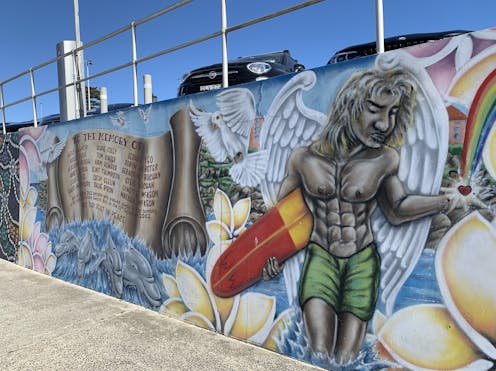
Memorial sites are important too
Memorial sites also have an important role. These are a focal point for support networks and rituals, helping to create new memories of their loved ones, based in the present.

The mural “Frangipani Girl” is a well-known example at Sydney’s Bondi Beach.
The mural is a celebration of the life of Chloe Byron, who died in Bali at the age of 15.
It also represents the journey through grief and renewal her father Dave has undertaken. He said in a podcast interview:
Every day I’ve got a choice between a happy memory of Chloe over the memory of her tragic death […] it’s the choice between a great day and a terrible one.
If this article has raised issues for you, or if you’re concerned about someone you know, call Lifeline on 13 11 14. You can also talk to a counsellor 24/7 at Beyond Blue.
Authors: Garry Stevens, Director of Humanitarian and Development Studies, Western Sydney University


 Daily Bulletin


