

Read The Times Australia

Daily Bulletin

Counting from left to right feels ‘natural’ – but new research shows our brains count faster from bottom to top

  • Written by: Luke Greenacre, Senior lecturer in marketing, Monash University
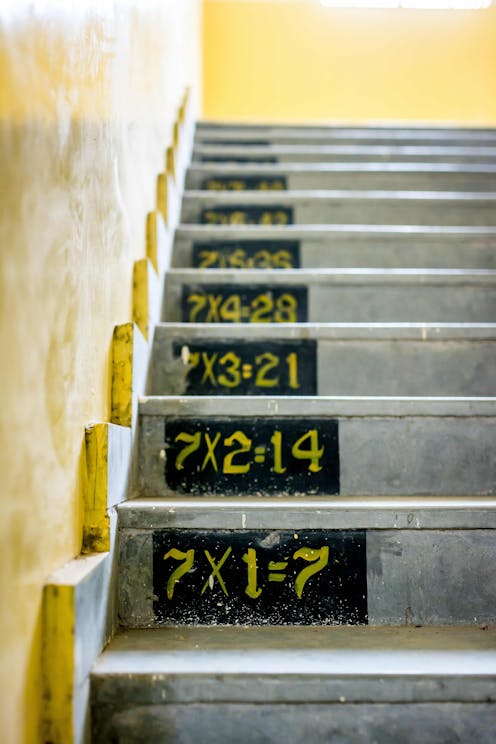
Counting from left to right feels ‘natural’ – but new research shows our brains count faster from bottom to top

When asked to write the numbers from one to ten in a sequence, how do you order them? Horizontally? Vertically? Left to right? Top to bottom? Would you place them randomly?

It has been often been assumed, and taught in schools in Western countries, that the “correct” ordering of numbers is from left to right (1, 2, 3, 4…) rather than right to left (10, 9, 8, 7…). The ordering of numbers along a horizontal dimension is known as a “mental number line” and describes an important way we represent number and quantity in space.

Studies show humans prefer to position larger numbers to the right and smaller numbers to the left. People are usually faster and more accurate at comparing numbers when larger ones are to the right and smaller ones are to the left, and people with brain damage that disrupts their spatial processing also show similar disruptions in number processing.

But so far, there has been little research testing whether the horizontal dimension is the most important one we associate with numbers. In new research published in PLOS ONE, we found that humans actually process numbers faster when they are displayed vertically – with smaller numbers at the bottom and larger numbers at the top.

Not just humans

Our associations between number and space are influenced by language and culture, but these links are not unique to humans.

Tests on three-day-old chicks show they seek smaller numbers with a leftwards bias and larger numbers with a rightwards one. Pigeons and blue jays seem to have a left-to-right or right-to-left mental number line, depending on the individual.

A photograph of baby chicks.
Even three-day-old chicks have something like a mental number line. Jason Leung / Unsplash

These findings suggest associations between space and numbers may be wired into the brains of humans and other animals.

However, while many studies have examined left-to-right and right-to-left horizontal mental number lines, few have explored whether our dominant mental number line is even horizontal at all.

Read more: Can bees do maths? Yes – new research shows they can add and subtract

How we test for these spatial-numerical associations

To test how quickly people can process numbers in different arrangements, we set up an experiment where people were shown pairs of numbers from 1 to 9 on a monitor and used a joystick to indicate where the larger number was located.

If the 6 and 8 were shown on the screen, for example, the correct answer would be 8. A participant would indicate this by moving the joystick towards the 8 as fast as possible.

To measure participant response times as accurately as possible, we used fast-refresh 120 Hertz monitors and high-performance zero-lag arcade joysticks.

Testing how participants show preferences for either horizontal or vertical mental number lines by indicating the larger number with a computer gaming joy stick.

What we found

When the numbers were separated both vertically and horizontally, we found only the vertical arrangement affected response time. This suggests that, given the opportunity to use either a horizontal or vertical mental representation of numbers in space, participants only used the vertical representation.

When the larger number was above the smaller number, people responded much more quickly than in any other arrangement of numbers.

This suggests our mental number line actually goes from bottom (small numbers) to top (large numbers).

Why is this important?

Numbers affect almost every part of our lives (and our safety). Pharmacists need to correctly measure doses of medicine, engineers need to determine stresses on buildings and structures, pilots need to know their speed and altitude, and all of us need to know what button to press on an elevator.

The way we learn to use numbers, and how designers choose to display numerical information to us, can have important implications for how we make fast and accurate decisions. In fact, in some time-critical decision-making environments, such as aeroplane cockpits and stock market floors, numbers are often displayed vertically.

Read more: Numbers on the mind: how maths can help explain the workings of our brain

Our findings, and another recent study, may have implications for designers seeking to help users quickly understand and use numerical information. Modern devices enable very innovative number display options, which could help people use technology more efficiently and safely.

There are also implications for education, suggesting we should teach children using vertical bottom-to-top mental number lines as well as the familiar left-to-right ones. Bottom-to-top appears to be how our brains are wired to be most efficient at using numbers – and that might help getting our heads around how numbers work a little easier.

Authors: Luke Greenacre, Senior lecturer in marketing, Monash University

Read more https://theconversation.com/counting-from-left-to-right-feels-natural-but-new-research-shows-our-brains-count-faster-from-bottom-to-top-189339

Business News

How Telematics Helps Australian Companies Improve Productivity

Operating a commercial fleet in Australia is a uniquely demanding endeavour. Between the sprawling urban sprawl of cities like Sydney and Melbourne and the immense, unforgiving stretches of the Outb...

Daily Bulletin - avatar Daily Bulletin

Inside the Icon: The BridgeMuseum Officially Opens at the Sydney Harbour Bridge

A bold new way to experience one of Australia’s most recognisable landmarks has arrived, with BridgeClimb Sydney officially opening the all-new BridgeMuseum.  Located inside the Sydney Harbour Brid...

Daily Bulletin - avatar Daily Bulletin

Is Your Brand Showing Up in AI Search? Most Melbourne Brands Aren't.

The New Front Door Nobody Told You About Something changed. Quietly. Without a press release. The way buyers find businesses in Australia has been rewired. Not replaced, rewired. Google isn't dead...

Daily Bulletin - avatar Daily Bulletin

How Australian Businesses Can Measure SEO ROI

SEO can feel vague when you are staring at a dashboard full of numbers that do not clearly connect to revenue. The key is to measure the right signals in the right order, then tie them back to outcome...

Daily Bulletin - avatar Daily Bulletin

How Commercial Roller Shutters Improve Site Security Without Slowing Operations

Security upgrades can be frustrating when they make everyday work harder. A door that takes too long to open, creates bottlenecks at shift change, or fails at the worst time can turn “better protectio...

Daily Bulletin - avatar Daily Bulletin

Why a Document Destruction Service Still Matters for Modern Businesses

Businesses generate large volumes of information every day, from staff records and contracts to invoices, reports and customer files. While attention often focuses on how documents are stored, the way...

Daily Bulletin - avatar Daily Bulletin

Bicycle Rack Safety and Space-Smart Storage

Bike storage problems usually show up as small annoyances first: tangled handlebars, scratched frames, and bikes that topple when you pull one out. Over time, those issues become safety risks, especia...

Daily Bulletin - avatar Daily Bulletin

How to Tell if a Childcare Centre Is a Good Fit for Your Child

Choosing childcare can feel like you’re making a huge decision with limited information. Tours are short, centres are often on their best behaviour, and your child might act differently in a new space...

Daily Bulletin - avatar Daily Bulletin

Car Import Timeline: What Usually Happens at Each Stage

Importing a car into Australia can feel confusing because multiple agencies and checkpoints are involved, and the timeline is shaped as much by paperwork quality as it is by shipping speed. The most u...

Daily Bulletin - avatar Daily Bulletin

The Daily Magazine

Gold Migration Lawyers in Liquidation: How the Closure Affects Your ART Appeal

If your appeal was with Gold Migration Lawyers, a recent change to how the Tribunal decides cases ...

The pressure cooker: life in urban Australia in 2026

Australian cities have always been demanding. Long commutes, rising housing costs, busy schedules a...

What Actually Makes a Good Criminal Lawyer in Melbourne

Most people only think about this question once. That is usually too late. Most people charged wi...

Why Working With A Chatswood Tutor Can Improve Academic Performance

Academic expectations continue increasing for students across primary school, high school, and senio...

Is It Worth Getting Solar Panels in Melbourne?

The real question is not whether solar works in Melbourne. It works. The question is what it is co...

How A Diploma Of Project Management Builds Practical Skills For Modern Work Environments

Developing the ability to plan, execute, and deliver outcomes efficiently is a key requirement in to...

How to Choose the Right Football for Every Level

Choosing a football may seem straightforward, but the right option depends on who will be using it a...

What to Ask a Wedding Photographer Before You Book

Booking a wedding photographer can feel deceptively simple: you like the photos, you like the vibe...

Why Stress Relief For Dogs Is Essential For Emotional Balance And Long-Term Wellbeing

Managing emotional health is just as important as physical care when it comes to pets, which is why ...