

NDIS participants are left waiting for too long in hospital beds due to bureaucratic delays
- Written by: Di Winkler, Adjunct Associate Professor, La Trobe University

Eighteen months ago, a Melbourne woman named Leila had a stroke and went to a local hospital. After medical support over a few weeks, Leila was ready to be discharged from the hospital, but required some specialist support due to her disability.
Three weeks ago Leila finally left hospital care. After nearly 18 months in limbo, left lying in a hospital bed, Leila can finally get on with her life.
Unfortunately Leila’s story is not unique. More than 1,430 people with disability are waiting 160 days to be discharged from hospitals around Australia. To those of us who work in this sector it is not surprising.
NDIS Participant Leila & her sister Helen interviewed by Dr George Taleporos on Reasonable & Necessary podcast.Once segregated
For decades we housed people with disability in segregated accommodation and institutions. Shut away where they couldn’t be seen or heard, abuse was rife and positive life outcomes for residents were rare. At best it was a case of “out of sight, out of mind”. At worst, it revealed something more sinister about the way we viewed disability.
Thankfully, as a society we have come a long way. The advent of the National Disability Insurance Scheme (NDIS) brought disability into the spotlight. At the recent federal election, it attracted renewed political focus.
And yet, people with disability remain stuck in hospital for months or years after they are ready to be discharged. There is no practical reason for this and it doesn’t save costs. In fact, it is twice as expensive to accommodate NDIS participants in hospital compared to disability housing.
Timely discharge is evidence-based
The issue is not that we don’t know what to do. There is clear evidence for ways to support the timely discharge of NDIS participants to age-appropriate housing.
And the issue is not the availability of housing. The NDIS has its world leading Specialist Disability Accommodation (SDA) policy, which provides housing for participants with high needs. Right now, there are more than 3,000 vacancies in SDA around Australia including more than 1,000 new, purpose built homes.
However the SDA market is being held back by the very people responsible for “stewarding” the market. The principles that underpin the SDA policy and the entire NDIS are insurance principles. Improved outcomes and reduced costs require investment in innovation, housing that is fit for purpose and service redesign.
There are 3,000 vacancies in disability housing and 1,430 NDIS participants stuck in hospital because the bureaucratic process of securing adequate NDIA funding for housing and support is complex and takes many months or years.
Instead, the focus of the NDIA appears to be on reducing short-term up-front costs. This means slow and inaccurate decisions that affect NDIS participants.
The NDIS appears to be creating friction as a way of containing scheme costs but there is an urgent need to make faster decisions for NDIS participants stuck in hospital or at risk of admission to aged care.
The Summer Foundation’s recent financial modelling shows well-designed housing is part of the solution to the NDIS’s sustainability issues and the growing cost of support in traditional disability housing.
Slowly, way too slowly
The main barrier to discharge is NDIA bureaucracy. The number one reason NDIS participants are stuck in hospitals is that they are waiting for the NDIS to process paperwork.
The NDIA promised both NDIS participants and providers to streamline funding decisions. However, independent data shows the NDIA has become slower in making SDA decisions over the past 18 months.
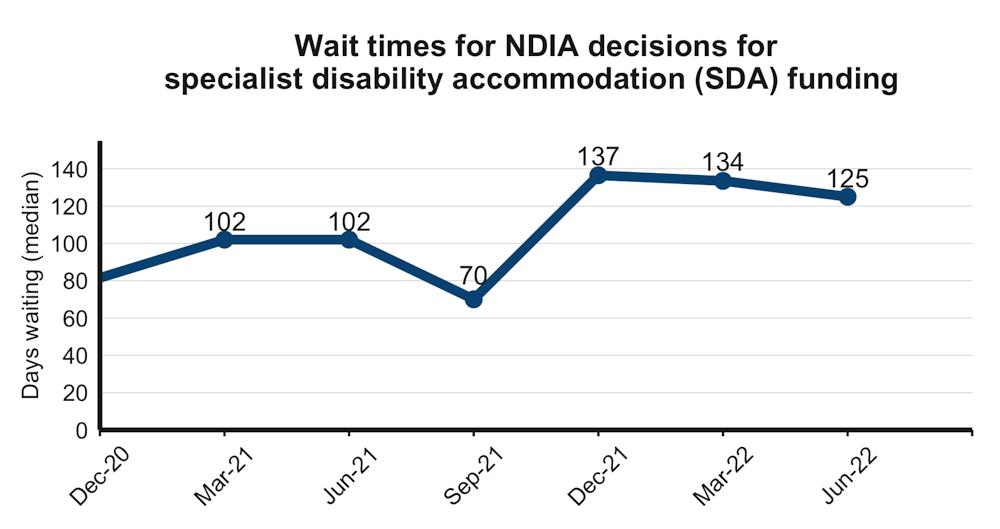
NDIS participants take months or years to navigate the process of requesting specialist housing and then appealing unfair decisions, the majority of which are overturned. Many NDIS participants give up and lose hope along the way. The resources spent on legal costs are another extraordinary waste of taxpayers money.
A better approach
There are three steps the NDIA could quickly take to address this issue.
One, make faster decisions on housing and support for people stuck in hospitals. Two, make the best use of the thousands of vacant specialist disability dwellings. And three, invest in providing better support for hospitals to enable timely discharge.
The human cost of remaining in hospital for months or years is dire for everyone involved. NDIS participants lose the gains made in rehabilitation as well as condition, skills, confidence and social connections. NDIS participants are also at risk of COVID and other illnesses in hospital.
Promises have been made and there is goodwill evident from Disability Minister Bill Shorten, his colleagues around the country and every hospital we have worked with. But now it’s time the NDIS stepped up and delivered. Those stuck in hospital have already waited long enough.
Thousands of people with disabilities are waiting in hospital or aged care for the support they are entitled to.Read more: What the NDIS needs to do to rebuild trust, in the words of the people who use it
Authors: Di Winkler, Adjunct Associate Professor, La Trobe University


 Daily Bulletin


