

Who's holding back electric cars in Australia? We've long known the answer – and it's time to clear the road
- Written by: John Quiggin, Professor, School of Economics, The University of Queensland
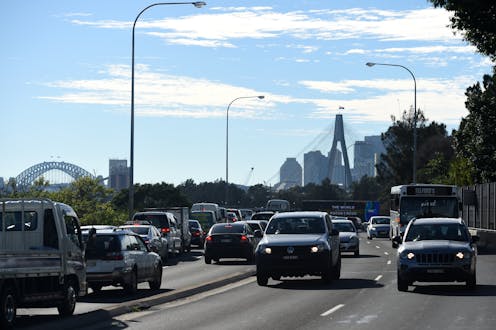
New analysis this week found strong fuel efficiency standards would have saved Australia A$5.9 billion in fuel costs and emissions equal to a year’s worth of domestic flights if the policy was adopted in 2015.
The finding, by think-tank the Australia Institute, puts further pressure on the new federal government to bring our fuel efficiency standards in line with Europe and other developed nations.
Unlike other comparable countries, Australia does not have fuel efficiency standards for motor vehicles. On the face of it this is puzzling; aside from lower costs for motorists and fewer emissions, the policy would also decrease our reliance on imported oil.
But opposition from vested interests – including oil refineries and the car dealership industry – has held Australia back. The onus is now on the Albanese government to enact this obvious and long overdue policy which is crucial to the electric vehicle transition.
Long road, little progress
So how would a fuel efficiency standard work?
Under a likely model, the government would set a national limit, averaged across all new cars sold, stipulating grams of CO₂ that can be emitted for each kilometre driven. This measure depends on fuel-efficiency: that is, the amount of fuel burnt per kilometre.
The limit would not apply to individual cars. Instead, each supplier of new light vehicles to Australia would have to make sure the mix of vehicles does not exceed the limit. Low-efficiency vehicles could still be sold, but car dealers would have to balance this out by selling enough high-efficiency vehicles.
Because electric vehicles don’t use fuel (or use less, in the case of hybrids), a fuel efficiency standard would give suppliers an incentive to include electric vehicles in the mix of vehicles they supply.
The prospect of fuel efficiency standards on light vehicles has regularly hit the national agenda in recent years.
In 2014, the Climate Change Authority prepared a detailed plan for a standard and estimated the likely economic savings. The plan seemed well timed. Australia has traditionally produced large, fuel-guzzling cars like the Holden Commodore and Ford Falcon. At the time of the plan’s release, however, the last remaining domestic car manufacturers had just announced plans to close, removing the most likely source of political resistance.
But the Coalition government sat on the idea. It ran a string of reviews before ultimately letting the issue drop.
In 2019, then-Opposition Leader Bill Shorten pledged fuel efficiency standards, as well as a target for electric vehicles to comprise half of new car sales by 2030. But he soon ran into Scott Morrison’s jibe that Labor wanted to “end the weekend” and take away people’s utes.
Labor, of course, lost that election and Anthony Albanese dumped the fuel standards idea on becoming party leader.
Read more: Transport is letting Australia down in the race to cut emissions
But what about the benefits?
A fuel efficiency standard would deliver significant benefits to Australia.
The first is economic. The report released this week is just the latest of many studies showing motorists would have been slugged far less at the bowser if our cars used fuel more efficiently.
The second benefit is tackling climate change. Transport accounts for nearly 20% of Australia’s emissions and this share is increasing.
And while lab tests suggest cars sold in Australia are becoming somewhat more efficient, real world testing shows the opposite. If we are to achieve emissions cuts consistent with the goals of the Paris agreement, cutting emissions from transport is essential.
Third, Australia is almost entirely dependent on foreign fuel. So new efficiency standards would decrease overall liquid fuel consumption, leaving us less reliant on imports.
Read more: We thought Australian cars were using less fuel. New research shows we were wrong
What’s holding us back
So why hasn’t Australia introduced this clearly beneficial policy? In short, because fuel inefficiency is deeply embedded in Australia’s automotive sector.
The strongest initial resistance to fuel efficiency standards came from the operators of refineries. Fuel-efficient cars require high-quality fuel. But Australia has long had among the dirtiest petrol in the developed world in terms of sulphur content.
Australian refiners resisted fuel efficiency standards because they said the cost of upgrading their plants would put them out of business. But the Morrison government last year funded upgrades at Australia’s last two oil refineries, removing one obstacle.
Further resistance has come from car dealers. From a dealership perspective, it’s easier to sell a car with a low sticker price even if lifetime running costs are higher.
Fuel efficiency standards, and the subsequent large-scale shift to electric vehicles, would fundamentally undermine the business model of the Australian car dealership industry. Much of its profitability comes from after-sales services required to maintain warranty protection, such as oil changes, transmission fluid and tune-ups.
None of these are needed in electric vehicles. The lifetime costs of maintaining an electric vehicle engine are about half those for a comparable internal combustion engine. At some point in their lives, an electric vehicle will require a new battery. But this will occur long after the initial sale.
Given all this, it’s not surprising the car industry is reportedly campaigning to limit any new fuel efficiency standards and delay the shift to electric vehicles.
What now?
The Albanese government has proposed some incentives to encourage a shift towards electric vehicles. But these limited measures won’t drive the dramatic transition that is needed.
Strong fuel efficiency standards would save motorists money, cut emissions and reduce Australia’s dependence on imported fuel. Anyway you look at it, the policy makes sense.
Authors: John Quiggin, Professor, School of Economics, The University of Queensland


 Daily Bulletin


