

Why Papua New Guinea urgently needs to elect more women to parliament
- Written by: Ian Kemish, Adjunct Professor, School of Historical and Philosophical Inquiry, The University of Queensland
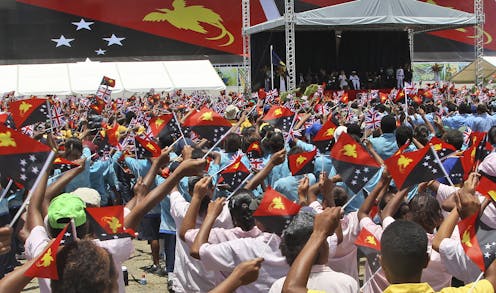
Counting is still underway following Papua New Guinea’s national elections, and there is still some hope that at least one woman might be elected to the country’s 118-seat parliament. At this point, Kessy Sawang may yet emerge as the winner in the Rai Coast electorate in Madang province. However, the overall picture is very disappointing. There were only 167 women out of more than 3000 candidates, and as its current term nears the end, PNG’s parliament is at the bottom of global rankings for female representation, with no women at all among its membership.
Things have been marginally better at some points in the past. Three women were elected in 2012, but Papua New Guineans have only sent seven women to their national parliament since the country achieved independence in 1975.
Why increased representation matters
The case for more women in PNG’s legislature is clear. A parliament that includes women is more likely to do something about the unacceptable conditions faced by many women across the country.
Women’s rights are severely restricted by poverty, poor access to education and health care, and patriarchal cultural practices. Gender based violence (GBV) is a serious problem and is generally under-reported. PNG is ranked 161 out of 162 countries on the United Nations gender inequality index.
Research also confirms that electing more women to public office strengthens democratic institutions and improves both the quality of government spending and the overall health of the national population.
Read more: The more women in government, the healthier a population
And let’s face it - the men running PNG aren’t doing very well. Administrative weakness and corruption are serious challenges, and the economy is in bad shape. Health and education services are woefully inadequate for the country’s rapidly growing population, and people are dying in significant numbers from preventable diseases. The nation desperately needs a more thoughtful, mature approach from its elected leaders.
Efforts over time to address the huge gender imbalance in the national parliament have centred on advocacy for “temporary special measures” to boost women’s participation such as introducing reserved seats for a limited but undefined period. The rationale is to help build a base on which women’s representation can win acceptance and begin to be “normalised”, and for these measures to be withdrawn when the playing field levels out.
Women in PNG are leading the way
The UN, Australia and other donors have worked in the background to support this advocacy, with PNG women leading the way. External partners are anxious to avoid a perception that these are “foreign” ideas being pushed on PNG’s traditional society. They tend to combine this support with programs that address other challenges for women, such as combating GBV, education, and supporting economic empowerment.

There have been moments of hope in PNG’s recent history. Dame Carol Kidu, the only woman in parliament between 2007 and 2012, drove a strong campaign to establish 22 reserved seats for women – one for each of the country’s provinces. This proposal won the backing of then Prime Minister Peter O’Neill, which parliament voted to support in the December 2011 Equality and Participation Act.
But by the time the required enabling legislation came to parliament the following year, misgivings had grown about this challenge to male dominance, and it was voted down.
There have been other moments when a breakthrough seemed possible. In 2019 a special parliamentary committee recommended the establishment of five reserved seats, but Prime Minister James Marape decided the focus should be on supporting and encouraging women to engage in the existing, “open” electoral process. The political will to make systemic changes remains elusive.
Areas of success
The women of PNG can look internationally for success stories. In 2003, Rwanda reserved 24 out of 80 seats in the Chamber of Deputies for women; today, more than 60% of its members are women.
In Samoa, a provision in the national constitution, inserted in 2013, holds that at least 10% of the parliament should be women. Arguments over the interpretation of this clause did not, in the end, prevent Fiamē Naomi Mataʻafa from becoming her country’s first female prime minister last year.
And New Caledonia is covered by the French constitutional requirement, passed in 1999, that women must constitute fifty percent of the candidacy lists for certain legislative and executive posts.
Read more: The case for quotas in politics: the absence of women isn't merit-based
Papua New Guineans don’t even need to look that far for inspiration. There are three reserved seats for women in the 39-member regional parliament of PNG’s autonomous region of Bougainville. Some may argue Bougainville’s culture is different from the rest of PNG, but a key factor was that Bougainvillean men came to recognise the contribution women made to end the region’s bloody civil war.
Some Papua New Guineans have expressed concerns that these reserved Bougainvillean seats would prove to be a ceiling, rather than a floor, for women’s participation. In fact, several women have lined up to contest “open” seats in the parliament, and so far, two of them have overcome a field of men to win these contests. One of them, Theonila Matbob, is the region’s education minister today.
It may not sound like much, but it is better than PNG’s national parliament has managed in recent years.
Authors: Ian Kemish, Adjunct Professor, School of Historical and Philosophical Inquiry, The University of Queensland


 Daily Bulletin


