

Chalmers' challenge: why the treasurer's words on the economy carry so much weight
- Written by: Mark Kenny, Professor, Australian Studies Institute, Australian National University
When Bill Clinton’s campaign manager, James Carville, scrawled, “the economy, stupid” on a sign in 1992, he merely wanted the campaign volunteers to stick to their presidential candidate’s talking points.
After Clinton became president, Carville’s axiom – by then lengthened to “it’s the economy, stupid” – seemed pitch-perfect for the pro-market zeitgeist taking hold in most Western democracies.
Policy initiatives were increasingly dashed against this irreducible metric. The economy was emerging as an end in itself – as if separate from the people and reified as the foundation of happiness, national fulfilment and political success.
In Australia’s parliamentary system, economic ministers happily embraced placing the economy at the centre of all political conversation. The role of treasurer is often seen as the penultimate political position before becoming prime minister: if the person is seen as performing well in the role, they can become political stars. If not? Well, their political careers can be cut short.
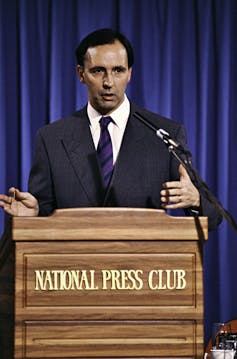
Even before Clinton’s arrival in the White House, Paul Keating had come to dominate as Bob Hawke’s bold reforming treasurer – the architect of a new and determinedly rational Australian prosperity. Tariffs went by the wayside, the dollar was floated, government services were privatised.
Until 1983, the price of goods was “set by officials”, Keating told author George Megalogenis in 2015, lamenting that everything from wages to import tariffs and quotas had been centrally fixed.
So when I became treasurer, on the Cabinet table sat the rate of exchange and interest rates […] I had to decide whether to be a passive participant in the scam, or to blow the scam up.
Desperate to unlock the opportunities of global and regional integration, Keating also began educating Australian voters in the economic lexicon, frequently referring to the current accounts, the J-curve, monetary policy and inflation.
The results of this new econo-politics were mixed. Keating said Australia risked being seen as a “banana republic” if it refused to pitch its producers and their markets against foreign competitors.
That made headlines, but it was his remark in the sharp downturn of November 1990 that really attracted criticism. Amid double-digit unemployment, he said this was the recession “we had to have” to tame inflation.
Intentionally or not, Keating had found the outer political limits of technical economic argument. So while he recovered to win the 1993 election (by then as prime minister), it was largely because the Liberals under John Hewson had delved even further into arcane economic jargon with his unpopular Fightback manifesto.
Read more: Issues that swung elections: the 'unlosable election' of 1993 still resonates loudly
Several treasurers later, and the role of administering economic medicine now resides with Jim Chalmers, Anthony Albanese’s freshly minted treasurer. He will deliver his first budget on October 25. Before then, on July 28, he will deliver his state-of-the-economy address to parliament.
The circumstances he faces are diabolical.
Which is why in the weeks since Labor’s election Chalmers has been reframing expectations about what is achievable. And therefore, what is not.
An ongoing pandemic, natural disasters and a war in Europe following Russia’s illegal invasion have combined with the fiscal hangover of Australia’s effervescent (pre-election) COVID response. All of this has coalesced into a cost-of-living crisis.
Now that crisis is being deepened further by the use of monetary policy (interest rates) to bring inflation under control. Voters will be asked to accept that in order to stem rising prices, their housing costs will be dramatically increased. It is an argument only an economist could love.
A historically low jobless rate of 3.5% and strong demand two-and-a-half years into the pandemic reflect the previous government’s decisions to close the international border through 2020 and 2021, and to pump more than $300 billion into the economy to keep it buoyant. The result is an economy that is now faced with galloping inflation, capacity constraints and large budget deficits into the future.
Read more: View from The Hill: Chalmers warns he'll deliver bad news
All with a budget heaving with a trillion dollars of debt, as Chalmers told parliament.
Hopes for reform possibilities under a new centre-left government are being hosed down as Chalmers girds voters for bad news.
His message is: do not to expect the direct cash handouts of the lockdown years because the national credit card is maxed out, and any such expenditure would feed inflation and send interest rates even higher.
Politically, the question is: will voters grant the new Labor government the latitude to navigate out of this inflation-and-interest-rate spiral, or will voters expect relief? Will they blame Labor for a situation that has been brewing since last year? And how culpable is the Reserve Bank for setting interest rates so low and promising to leave them there?
That may be a judgment for the review of the RBA Chalmers has asked to have back on his desk by March. That will be before he fills two vacancies on the board, and considers reappointing the current RBA governor, Philip Lowe.
Another element of Labor’s expectation adjustment is the conception of the economy itself.
Albanese believes it should be viewed through the prism of jobs and wages.
“It’s not an economy for itself, but it’s an economy in terms of the impact that it has on living standards,” he told 7.30’s Sarah Ferguson on Wednesday. “We want an economy that works for people, not the other way around.”
Wednesday’s inflation number of 1.8% for the June quarter made for a worrying 6.1% rate of inflation over 12 months.
When Chalmers makes his economic statement to federal parliament on Thursday, fresh in his mind will be the latest warning from the International Monetary Fund that inflation will remain high globally until 2024.
“Tighter monetary policy will inevitably have real economic costs, but delaying it will only exacerbate the hardship. Central banks that have started tightening should stay the course until inflation is tamed,” said IMF economic counsellor Pierre-Olivier Gourinchas, in comments not a million miles away from saying this might be a recession we have to have.
But you won’t hear that from Chalmers.
Authors: Mark Kenny, Professor, Australian Studies Institute, Australian National University


 Daily Bulletin


