

An ever innovative director, Peter Brook reminded us how high the stakes of theatre can be
- Written by: Paul Rae, Associate Professor, English and Theatre Studies, The University of Melbourne
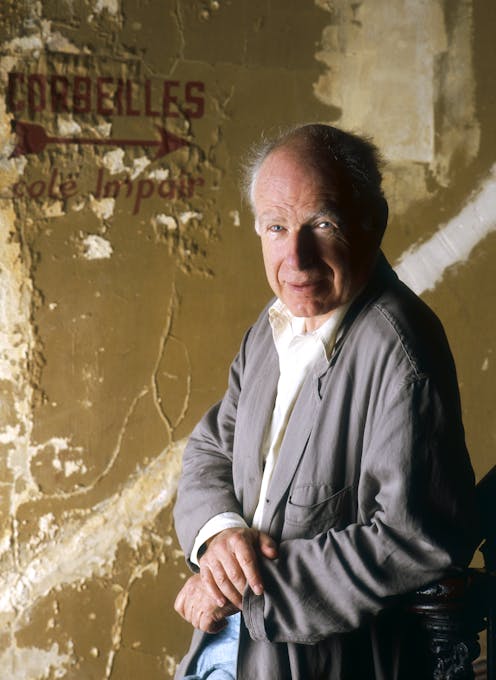
I can take any empty space and call it a bare stage. A man walks across this empty space whilst someone else is watching him, and this is all that is needed for an act of theatre to be engaged.
So begins The Empty Space (1968) by the visionary British theatre director Peter Brook, who died on Saturday, aged 97.
While Brook’s gendered pronouns show that not all aspects of The Empty Space have aged equally well, it remains one of the most influential books on modern drama. Its core idea, encapsulated in Brook’s opening sentence, perfectly captures his enduring but complex legacy.
Born in London in 1925, Brook came of age as a precocious young director for the Royal Shakespeare Company during a period when the work of now-canonical European innovators of 20th century theatre was beginning to make its presence felt in Great Britain.
The Russian director Konstantin Stanislavski (1863-1938) advocated psychological realism in acting. The Marxist aesthetics of Germany’s Bertolt Brecht (1998-1956) sought to cultivate in audiences a critical perspective on exploitative social forces. French writer Antonin Artaud (1896-1948) imagined a primal “theatre of cruelty” directly impacting the body.
This wholesale questioning of what theatre should be inspired Brook towards methodological and aesthetic innovation, and modelled for him a way of writing about theatre for a popular readership in striking, vivid prose, that he would pursue throughout his career.
Read more: From the Moscow stage to Monroe and De Niro: how the Method defined 20th-century acting
The essentials of being human
For Brook, all that is needed for theatre is a location, an actor and an audience member. Everything else is supplementary.
He set about demonstrating this with a series of intensely focused and increasingly pared-back productions.
These included an austere production of King Lear (1962) featuring Paul Scofield and adapted for film in 1971. Then there was the controlled madness of his Marat/Sade (1964), and an iconic white box production of A Midsummer Night’s Dream (1970).
This investigative impetus would soon take Brook beyond the British theatre establishment. He established the International Centre for Theatre Research in Paris in 1970, and began to travel widely.
His goal, as he put it, was to work “outside of contexts”, asking:
In what conditions is it possible for what happens in a theatre experience to originate from a group of actors and be received and shared by spectators without the help and hindrance of […] shared cultural signs and tokens?
In 1979, Brook took his international troupe (including a young Helen Mirren) on an 8,500 km, three and a half month trip through Saharan Africa, presenting The Conference of the Birds, a play based on a 12th Century Persian poem, to audiences with whom they expected to have nothing in common.
The Mahabharata and critical backlash
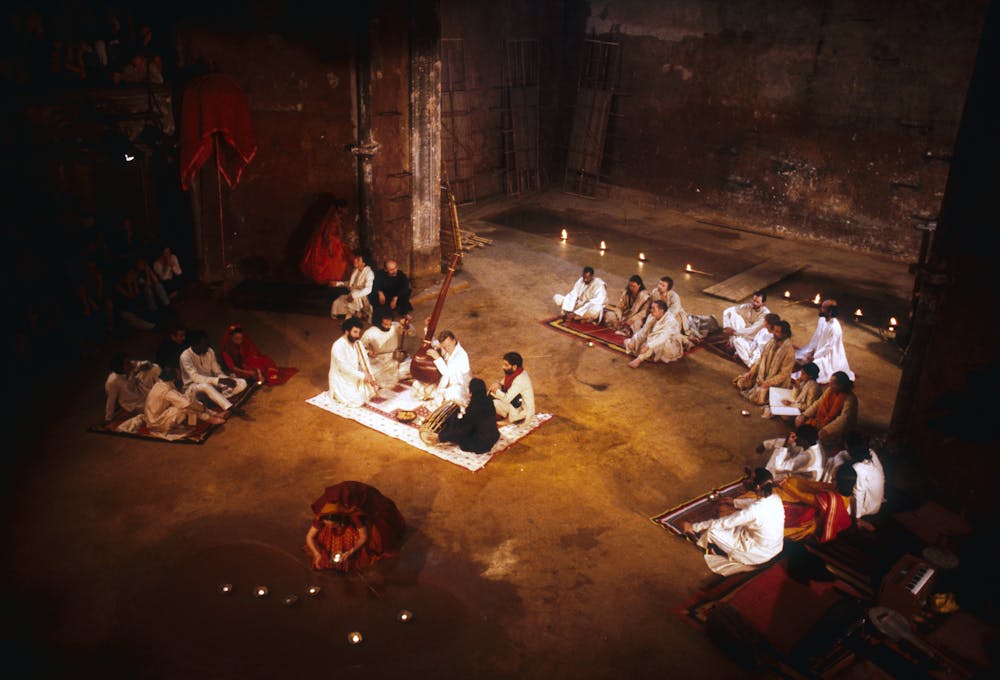
This phase of what came to be called intercultural theatre culminated in a famous adaptation of the Sanskrit epic The Mahabharata.
Premiering at the Avignon festival in 1985 (it was performed in Adelaide in 1988 and filmed in 1989) with a cast drawn from many cultures and theatrical traditions, critics praised the beauty and limpid theatricality of the production.
However, it also triggered a critical backlash which, in retrospect, had been a long time coming.
As Australians well know, there are no “empty spaces” that are simply there for the taking. There are no cultural forms that exist “outside of contexts”.
Brook was not naive about this, but he struggled to square local particularity with his universalist instincts.
He acknowledged The Mahabharata “would never have existed without India”, yet at the same time, stated
we had to avoid allowing the suggestion of India to be so strong as to inhibit human identification to too great an extent.
For a growing number of critics, this was not only intellectually unsustainable, but compounded historical wrongs.
In 1990, the Indian theatre scholar Rustom Bharucha published Theatre and the World, a broadside against western appropriations of Asian theatrical forms that went back to Stanislavski, Brecht and Artaud, and were exemplified in Brook’s work.
Bharucha accused Brook of trivialising and decontextualising Indian culture, and exploiting Indian performers.
The Mahabharata would mark a significant shift in how intercultural collaborations would be approached in future: greater attention being paid to who has the right to represent what, and how the material and intellectual resources in any given production are distributed.
A director of influence
Through the 1990s and into the new millennium, Brook remained consistently active.
He continued to create classic and intercultural performances at the Théâtre des Bouffes du Nord in Paris.
He worked with international artists on projects that would tour widely. Le Costume (The Suit), an adaptation of a 1963 story by Can Themba made seemingly limitless use of the anthropomorphic properties of an empty suit to tell a touching parable of love and loss in apartheid-era South Africa.
Brook’s clarifying focus on what really matters in theatre – paring everything back from staging to acting style and infusing what remains with complexity, nuance and intelligence – can be discerned across the spectrum of contemporary theatrical activity.
We see it, for example, in the the physical inventiveness of Complicité, the raw character work of Ivo van Hove and the compositional sensibilities of Katie Mitchell.
Then there are the intercultural experiments of Ariane Mnouchkine and Ong Keng Sen. We can even trace it to the combination of technological refinement and narrative momentum in Kip Williams’s current Australian hit The Picture of Dorian Grey.
Read more: The Picture of Dorian Grey review: Eryn Jean Norvill stuns in all 26 roles
Brook raised the bar on what audiences should expect of theatre, but also what creators could demand of their audiences.
He advocated a theatre in which a rigorous creative process underpinned an absolute commitment by actors to the present moment of performance. In response, audiences would feel compelled to bring their own investments, attention and desires.
Brook’s work was not without controversy, but it rarely strayed far from the centre of debates over the human stakes in the creation of theatre.
Brook reminded us how high those stakes can be – as long as we all work towards meeting the criteria for, as he put it in The Empty Space, “an act of theatre to be engaged”.
Authors: Paul Rae, Associate Professor, English and Theatre Studies, The University of Melbourne


 Daily Bulletin


