

'Cold case' gay murders: two books illuminate Australia's dark history of police and military violence
- Written by: Scott McKinnon, PERL Research Fellow, University of Wollongong
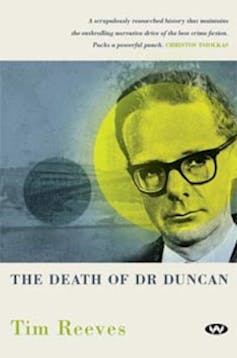
In 1972, Dr George Duncan was a newly employed law lecturer at the University of Adelaide. Late one night, he visited a well-known beat on the banks of the River Torrens where men would meet for sex. There, Duncan and another man, Roger James, were attacked and thrown into the water. James’s ankle was broken, but he managed to pull himself out to safety. Duncan drowned.
Review: The Death of Dr Duncan – Tim Reeves (Wakefield Press) and The Boy in the Dress – Jonathan Butler (Affirm Press)
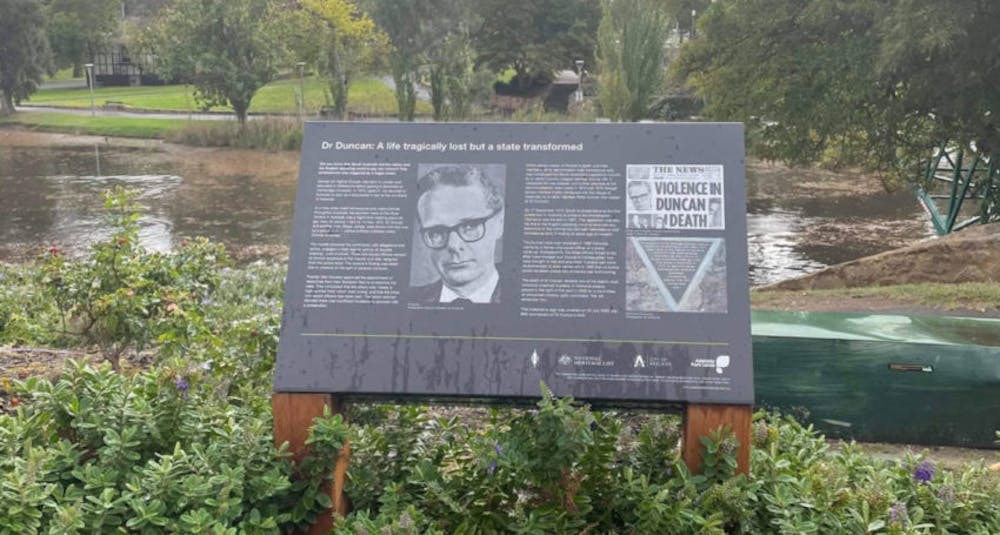
Duncan’s murder may well have disappeared as another largely ignored death of a “pervert” – seen as sad, perhaps, but hardly worth investigating. Unusually, however, the crime led to multiple inquiries, had significant political impacts, and is still commemorated today.
As Reeves points out, Duncan was a well-regarded legal academic with prominent colleagues able to push for his murder to be investigated. His death also occurred at a moment when lesbian and gay activism was emerging as a political force. Activists condemned police harassment of men at beats and argued that Duncan’s murder was evidence of the desperate need for homosexual law reform.
Read more: Friday essay: hidden in plain sight — Australian queer men and women before gay liberation
The Death of Dr Duncan is divided into two sections, the first exploring the various investigations into Duncan’s murder and the second the process of law reform that saw SA become the first Australian state to decriminalise sex between men.
Given that inquiries into the crime continued well beyond decriminalisation in 1975, this creates a slightly disjointed narrative that might have been avoided if the two threads had been interwoven. Nonetheless, Reeves’ exhaustive research and deep knowledge of the case, gained over many years, forms the basis of an important work investigating a pivotal historical moment.
True crime and queer joy
The Death of Dr Duncan joins a growing list of recent popular histories examining historical violence against gay and bisexual men in Australia. Indeed, its publication is aligned with the first performances of Watershed: The Death of Dr Duncan, an oratorio by composer Joe Twist and co-lyricists Alana Valentine and Christos Tsiolkas, based on Reeves’ research.
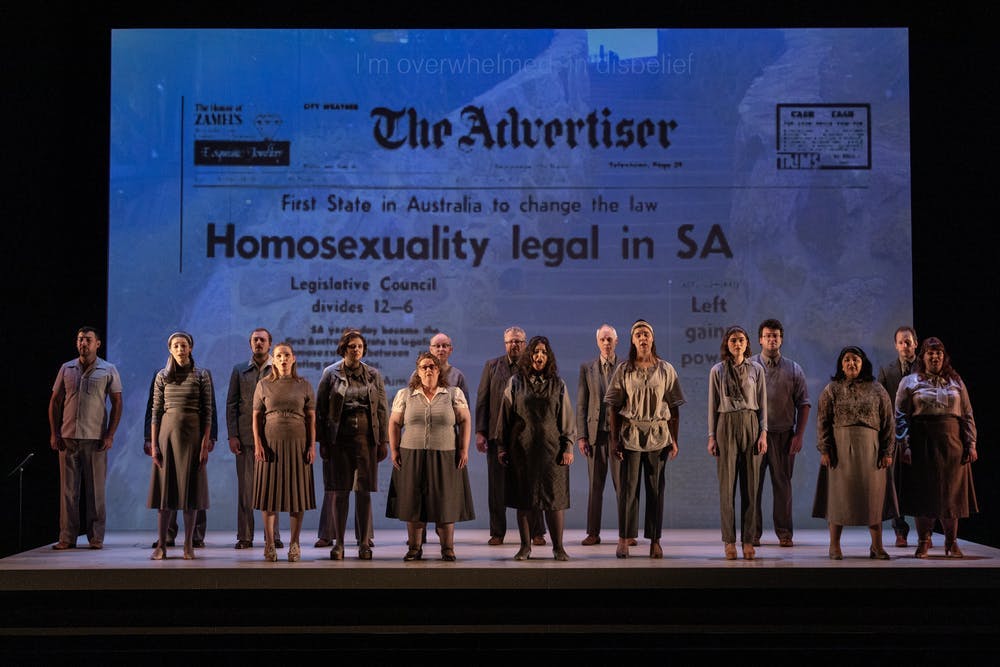 Watershed: The Death of Dr Duncan, performed at Adelaide Festival, March 2022.
Former police officer Duncan McNab’s 2017 book Getting Away with Murder was a damning account of New South Wales policing in the 1980s and 1990s, when at least 80 gay and bisexual men and transgender women were murdered in Sydney. Their deaths were often met with a lack of interest by police, who seemed happy to assume suicide even when the evidence suggested otherwise.
Podcast Bondi Badlands (investigating murders and disappearances of gay men on the southern headland at Bondi Beach in the late 1980s) and television series Deep Water similarly tell the stories of these Sydney cases. The TV movie Riot contained a moving portrayal of the first Sydney Mardi Gras, when a street party was violently shut down by police. The recently released podcast The Greatest Menace examines the dark history of Cooma Gaol, where men charged with homosexual acts were imprisoned in the 1950s.
This focus on violence represents, in part, the recent surge in the popularity of true crime. It also represents a truth of the archives. Male homosexuality was decriminalised state by state in Australia, with Tasmania last, in 1997. Although things began to change in the 1960s, for much of the criminalisation era, homosexual people had little or no opportunity for the kinds of open social or cultural participation that would leave a written record.
In fact, the consequences of exposure meant that many worked very hard not to leave evidence of their sexual and romantic lives. To find queer histories in the archive, it is often necessary to rely on records of trials and police investigations.
We know very little about George Duncan’s social and sexual life because its discovery would have cost him his career as a legal academic – and possibly his freedom. The main reason evidence of his sexuality survives is that he was the victim of a violent crime.
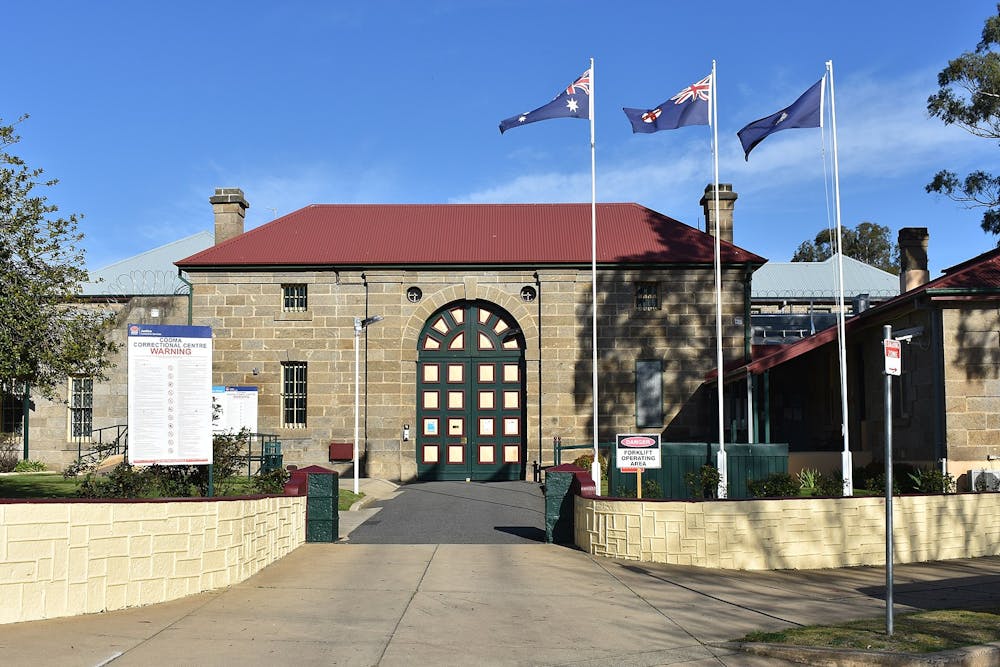 Cooma Correctional Centre, Australia’s only ‘gay jail’.
As a result, stories of gay tragedy are often better known than stories of happiness and pleasure. Yet, oral history interviews and surviving letters or diaries tell us that, even in the highly oppressive days of the 1950s, well before Duncan visited the River Torrens beat, there was immense joy to be had in a queer life.
The activism emerging at the time of Duncan’s murder was angry and determined, certainly, but also centred humour, sex and joy in ways that were both politically effective and enormously fun. Activists specifically rejected the idea that they should keep themselves hidden from view, creating newsletters, books, movies and other stories that celebrated queer lives by making them visible.
Read more: Pages and prejudice: how queer texts could fight homophobia in Australian schools
The Boy in the Dress
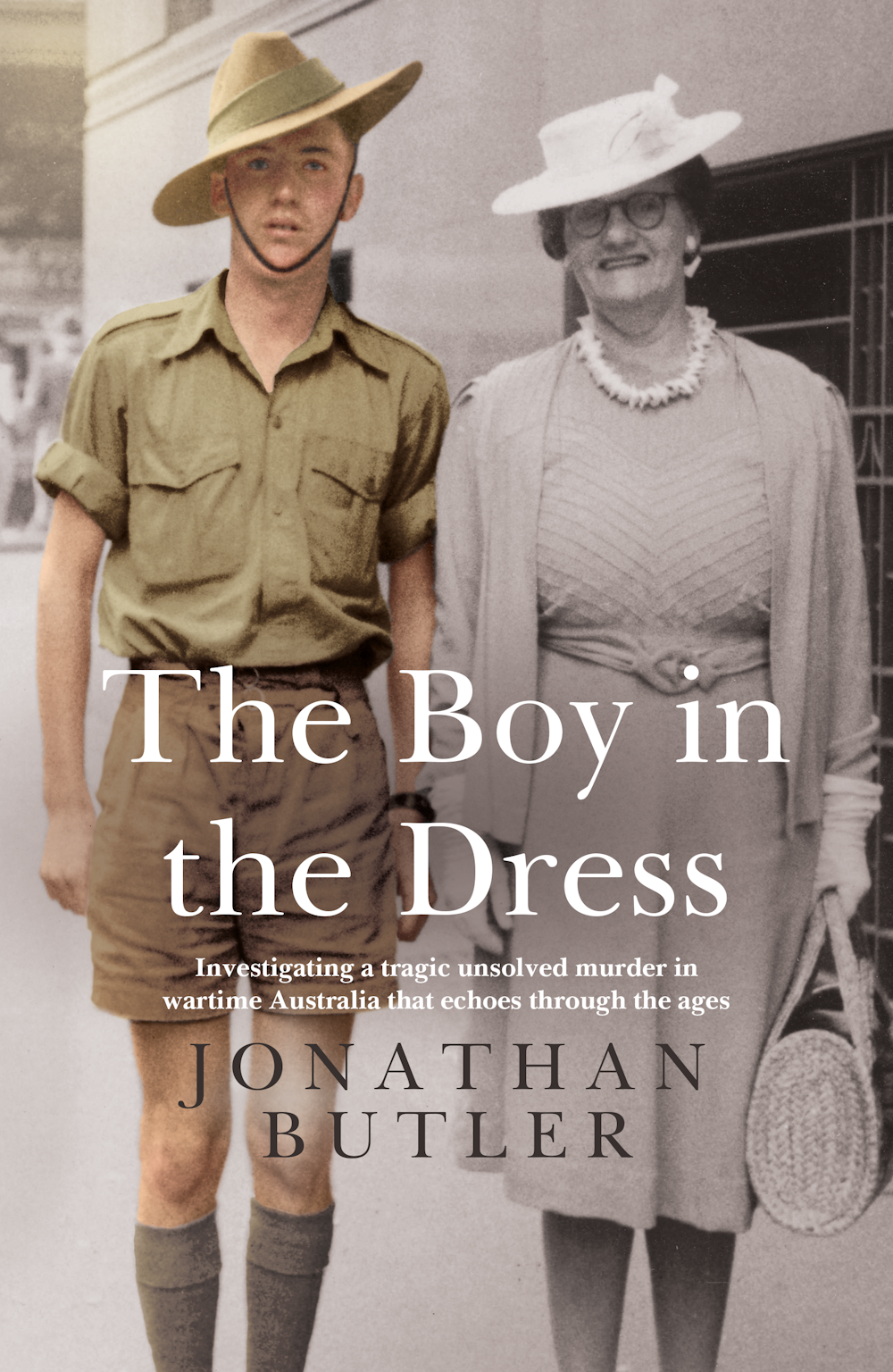
In The Boy in the Dress, a combination of memoir, true crime, and deeply researched history, Jonathan Butler describes the broader ramifications when homosexual lives are understood as inherently tragic.
 As a teenager in 2007, Butler came out as gay to his parents, and both responded negatively. Their reaction was based, in part, on fears that his “sexuality would put [him] directly in harm’s way” and “there were just too many ways to die or be hurt as a gay man.”
Butler’s parents each had their own stories of homosexuality’s tragic outcomes. A gay schoolfriend of his father had died by suicide. And his mother’s family would tell, in whispered tones, the story of a murdered relative, Warwick Meale. That latter story forms the basis of Butler’s book.
As a young child more interested in the clothes and toys of his sisters than proper “boy” things, Butler was fascinated by a photograph of his grandmother and her cousin Warwick playing dress-ups as kids. In the photo, his grandmother was dressed as a boy, while young Warwick was looking joyful wearing a dress.
Like many LGBTQ+ people in their childhoods, Butler faced bullying and ridicule for his inability to perform gender “correctly”. He had little information about gay lives through which he might understand (let alone celebrate) his feelings of difference and begin to build an identity.
As a teenager in 2007, Butler came out as gay to his parents, and both responded negatively. Their reaction was based, in part, on fears that his “sexuality would put [him] directly in harm’s way” and “there were just too many ways to die or be hurt as a gay man.”
Butler’s parents each had their own stories of homosexuality’s tragic outcomes. A gay schoolfriend of his father had died by suicide. And his mother’s family would tell, in whispered tones, the story of a murdered relative, Warwick Meale. That latter story forms the basis of Butler’s book.
As a young child more interested in the clothes and toys of his sisters than proper “boy” things, Butler was fascinated by a photograph of his grandmother and her cousin Warwick playing dress-ups as kids. In the photo, his grandmother was dressed as a boy, while young Warwick was looking joyful wearing a dress.
Like many LGBTQ+ people in their childhoods, Butler faced bullying and ridicule for his inability to perform gender “correctly”. He had little information about gay lives through which he might understand (let alone celebrate) his feelings of difference and begin to build an identity.
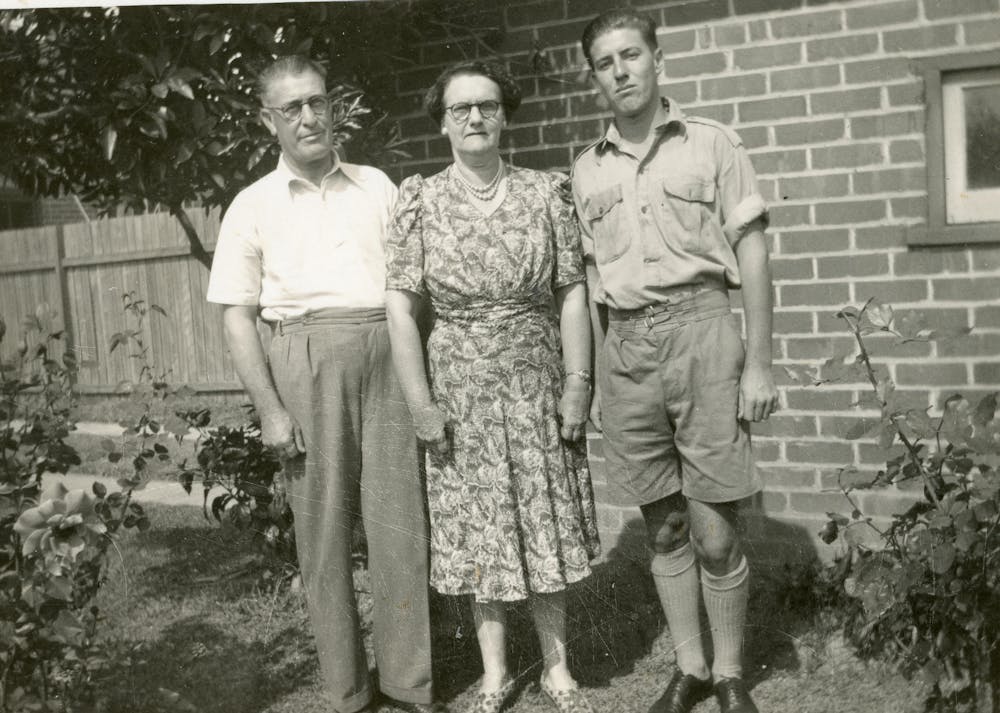 Warwick (right) in his summer uniform with his parents, Irene and Sidney, at their family home in Earlwood. They saw him for the first time on home leave in 1944.
The kind of history Butler explores is rarely, if ever, taught in schools. Indeed, Australia’s obsession with our military history leaves little place for the fact that some soldiers were queer.
Butler’s clear passion for his research stems, at least in part, from its revelation that people like him have a place in Australia’s most treasured historical narratives. Once isolated and bullied for his difference, Butler is reassured to now know that we were there, too. Some of the nation’s war heroes, generally imagined as archetypes of masculine heterosexuality, were once little boys who loved to wear dresses.
Police history of violence towards queer people
These books, and other recent historical true crime stories, hope that shining a light on historical injustice will lead to positive change in the present. Discussion of these crimes might prompt some form of reckoning.
It is unlikely the murderers of Dr Duncan will ever be punished. The only form of justice now available is to keep his story alive and use it as a basis for change.
The government has just announced a new Museum of Australian Policing, to be opened in Canberra. The announcement included a list of likely exhibits, providing evidence of police successfully fighting crime and protecting the nation’s citizens. This raises the question of whether the museum will be an honest account of policing histories, or an expensive marketing tool for present-day police forces.
Warwick (right) in his summer uniform with his parents, Irene and Sidney, at their family home in Earlwood. They saw him for the first time on home leave in 1944.
The kind of history Butler explores is rarely, if ever, taught in schools. Indeed, Australia’s obsession with our military history leaves little place for the fact that some soldiers were queer.
Butler’s clear passion for his research stems, at least in part, from its revelation that people like him have a place in Australia’s most treasured historical narratives. Once isolated and bullied for his difference, Butler is reassured to now know that we were there, too. Some of the nation’s war heroes, generally imagined as archetypes of masculine heterosexuality, were once little boys who loved to wear dresses.
Police history of violence towards queer people
These books, and other recent historical true crime stories, hope that shining a light on historical injustice will lead to positive change in the present. Discussion of these crimes might prompt some form of reckoning.
It is unlikely the murderers of Dr Duncan will ever be punished. The only form of justice now available is to keep his story alive and use it as a basis for change.
The government has just announced a new Museum of Australian Policing, to be opened in Canberra. The announcement included a list of likely exhibits, providing evidence of police successfully fighting crime and protecting the nation’s citizens. This raises the question of whether the museum will be an honest account of policing histories, or an expensive marketing tool for present-day police forces.
 South Australia Police Traffic Division Courtesy Patrol, 1959.
State Library of South Australia/Flickr, CC BY
Stories of homophobic, biphobic and transphobic (not to mention racist and misogynist) violence – whether committed, deliberately ignored, or inadequately investigated by police – are an alternate narrative.
Reeves’ book, in particular, would make an excellent starting point for an exhibition exploring the history of police either failing to protect queer people from violence or deploying violence to oppress otherwise joyful queer lives.
There could be space, certainly, for the valiant efforts of some police to reshape their organisations towards greater inclusivity. But at its core, the exhibition would reflect on one element of Australian policing’s darker histories.
Reeves concludes:
That a state-funded apparatus operated – with the potential for imprisonment – to entrap and brutalise homosexuals is a powerful commentary on the irrational fear that then existed around a sexual minority.
As these books reveal, the history of that fear shouldn’t be understood as prompted by or inherent in LGBTQ+ lives – but as instigated, perpetuated and acted upon by violent criminals, often operating in a system that explicitly supported their crimes.
Authors: Scott McKinnon, PERL Research Fellow, University of Wollongong
South Australia Police Traffic Division Courtesy Patrol, 1959.
State Library of South Australia/Flickr, CC BY
Stories of homophobic, biphobic and transphobic (not to mention racist and misogynist) violence – whether committed, deliberately ignored, or inadequately investigated by police – are an alternate narrative.
Reeves’ book, in particular, would make an excellent starting point for an exhibition exploring the history of police either failing to protect queer people from violence or deploying violence to oppress otherwise joyful queer lives.
There could be space, certainly, for the valiant efforts of some police to reshape their organisations towards greater inclusivity. But at its core, the exhibition would reflect on one element of Australian policing’s darker histories.
Reeves concludes:
That a state-funded apparatus operated – with the potential for imprisonment – to entrap and brutalise homosexuals is a powerful commentary on the irrational fear that then existed around a sexual minority.
As these books reveal, the history of that fear shouldn’t be understood as prompted by or inherent in LGBTQ+ lives – but as instigated, perpetuated and acted upon by violent criminals, often operating in a system that explicitly supported their crimes.
Authors: Scott McKinnon, PERL Research Fellow, University of Wollongong


 Daily Bulletin


