

Do you shop for second-hand clothes? You're likely to be more stylish
- Written by: Louise Grimmer, Associate Head Research Performance and Senior Lecturer in Retail Marketing, University of Tasmania
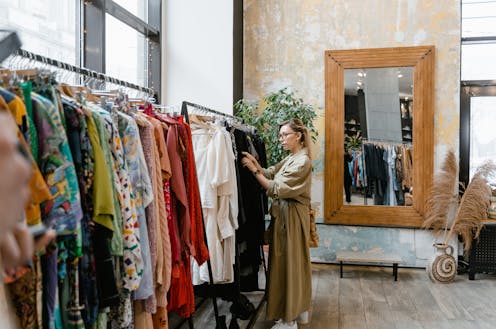
Not only is second-hand shopping good for the planet and your wallet, our new research finds the more style-conscious you are, the more likely you are to shop for second-hand clothes and accessories.
In the 2020-21 financial year, 72% of Australians purchased at least one item of second-hand clothes – but we wanted to know more about people who were shopping second hand.
It is often assumed those who shop for second-hand clothes do so to save money or reduce their impact on the environment.
In our study, we found the higher people rate on style-consciousness, the more likely they are to shop second hand. In fact, style-consciousness was a bigger predictor of second-hand shopping than being frugal or ecologically-conscious.
Style-conscious shoppers are very different from fashion-conscious shoppers. Fashion is all about the “new”: fashion is a novelty and constantly evolving.
Style, on the other hand, is about expressing long-term individual identity.
The problem with fashion
Fashion shoppers are used to a continuous supply of new trends and “fast fashion” products. Fast fashion works quickly to replicate an ever moving stream of fashion trends, generating large volumes of low-quality apparel.
The impact of fast fashion on the environment is significant and well-documented. Globally, the fast fashion industry creates 92 million tonnes of waste per year and uses 79 trillion litres of water. Less than 15% of clothes are recycled or reused.
Poorly made and low-quality fast fashion items are a significant problem for charity stores, who are forced to send fast fashion items they can’t sell to landfill.
But, going against this fast fashion trend, growing numbers of people are shopping for second-hand clothing and accessories.
Read more: 'I can only do so much': we asked fast-fashion shoppers how ethical concerns shape their choices
A growing market
It’s difficult to determine the size of the second-hand market because many sales take place in informal settings such as pre-loved markets and online platforms like Facebook Marketplace.
However, sales data from online platforms shows an explosion in growth. James Reinhart, CEO of online second-hand fashion retailer Thredup, has predicted the global second-hand market will double in the next five years to US$77 billion (A$102 billion).
He also predicts the second-hand market will be double the size of fast fashion by 2030.
Younger shoppers are driving growth in popularity of second-hand shopping, especially via online platforms.
Our research suggests much of this growth is due to shoppers considering themselves to be style-conscious.
What makes a second-hand shopper?
We surveyed 515 Australian female-identifying consumers looking at their “orientation” (the preference to behave in a certain way) when it comes to shopping. Each participant was measured for their orientation towards frugality, how ecologically conscious they are, their level of materialism, how prone they are towards nostalgia, their fashion-consciousness and their style-consciousness.
While we found there are frugal and ecologically-conscious second-hand shoppers, our research revealed overwhelmingly that style-consciousness is the greatest predictor of second-hand fashion shopping.
People who scored highly on the style-consciousness scale were more likely to shop for second-hand clothes than any of the other orientations.
A style-conscious person expresses themselves through their clothes. These shoppers want clothes that complement their personal style and values. They look for authentic and original pieces and avoid mainstream trends and fast fashion.
Style-conscious shoppers buy high-quality, durable clothing and accessories. While fashion-conscious shoppers are constantly buying new clothes to keep up with current trends, style-conscious shoppers buy clothes that are timeless, well-crafted and allow them to express their individual identity over the long-term.
Traditional thrift shops run by charities are responding to consumer demand, reinventing their stores with carefully selected, high-quality clothes, improved merchandising and store design, online sales and improved digital and social media marketing.
The number of independently owned, highly-curated “pre-loved” stores and online sales platforms is also increasing.
Social media influencers have driven much of this growth. Their accounts embrace second-hand fashion, the circular economy (which highlights reuse, repair, repurpose and recycle) and promote the notion of #secondhandfirst.
Helping the planet…with style
We hope with increasing numbers of second-hand stores, markets and online platforms selling a range of quality, pre-loved clothes at different price points for different budgets – coupled with the growing acceptance of second-hand shopping – shoppers will consider buying second-hand more often.
For those who already embrace “not needing new”, not only are you helping the planet – our research shows you are also likely to be doing it with style.
Authors: Louise Grimmer, Associate Head Research Performance and Senior Lecturer in Retail Marketing, University of Tasmania


 Daily Bulletin


