

Serving up choice and dignity in aged care – how meals are enjoyed is about more than what's on the plate
- Written by: Jade Cartwright, Associate Professor, University of Tasmania

Meals are rituals built around pleasures and choices. While what is served at mealtimes in aged care homes has received recent attention and Labor has pledged to improve the food offered, new research highlights that how meals are offered is just as important.
More than 50% of aged care residents live with dementia, and outside of mealtimes, spend the majority of their days alone. Mealtimes are the time of the day when people come together, providing opportunities for social connection, celebration, and honouring individual preferences and culture.
And yet, staffing shortages and insufficient time to help residents eat and drink means mealtimes are frequently highly structured and depersonalised, with the focus being on food intake rather than the dining experience.
Further, current aged care funding does not incentivise quality in food, or mealtime autonomy.
Innovation in mealtime care is needed to turn this around and give aged care residents back their basic rights. One proven approach draws on Montessori principles traditionally used within the early childhood field.
Read more: Labor's plans for aged care are targeted but fall short of what's needed
Careful planning allows more freedom
The revolutionary thinking of Italian physician and educator Maria Montessori has been increasingly applied to dementia care – introduced to the field by psychologist Cameron Camp in the 1990s. The Montessori approach respects the abilities and preferences of the person – young or old – engaging people at their own pace and rhythm.
Montessori methods focus on a carefully prepared environment and work with the retained strengths of a person with dementia to enable engagement and involvement in everyday life. This helps people with dementia reclaim skills, such as the ability to eat independently.
The approach can change people’s expectations of what a person with dementia is capable of and promote a sense of community.
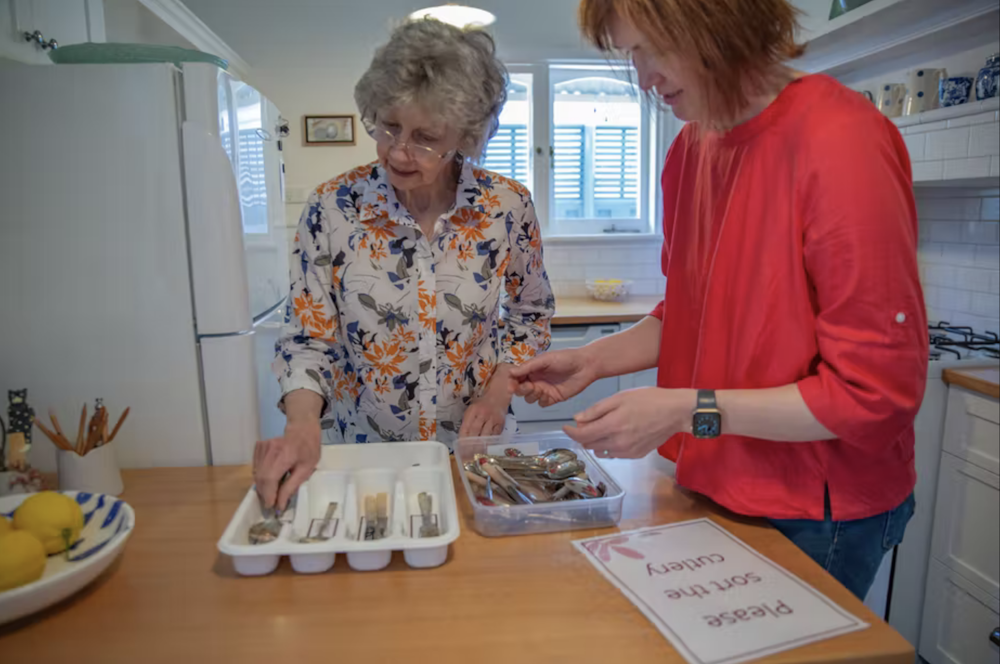
Our study looked at how applying Montessori strategies changed mealtimes for staff and residents in a residential aged care setting. We periodically filmed mealtimes, starting before any changes were made and ending with new practices in place.
Routines, materials, and external aids were established to support memory loss and independence. For example, signage invited residents to help themselves to snacks, and a buffet encouraged residents to serve their own meals.
Extending the duration of the breakfast service enabled residents to eat at their own pace, while the preparation of additional food ensured residents had the opportunity for second or third helpings.
Staff across all levels of the organisation were trained and mentored in the Montessori approach. For example, the Montessori mantra “Everything you do for me; you take away from me” was introduced to staff – transforming the way they thought about empowering residents and their own caring roles.
Care staff were encouraged to involve residents in mealtime routines and create meaningful roles, such as setting the table, filling water jugs or writing up the daily menu.
 Meals are about sharing food and coming together.
Shutterstock
Meals are about sharing food and coming together.
Shutterstock
Read more: Today's aged care falls well short of how we'd like to be treated – but there is another way
What we saw
Our observational research evaluated mealtime routines before and after the Montessori model of care was introduced and the findings were promising for everyone involved – residents, families, and staff. We can see this by examining the experience of a resident we’ll call “Marjory”.
Before Montessori, Marjory’s meal was chosen by a staff member and there were no second options should she not like the selection. Marjory’s main meal and dessert were placed together on the bare table, with no explanation as to what they were. She did not choose who she sat with, or which drink was served with her meal. Marjory ate her meal in silence.
We noted this as a familiar pattern, highlighted in previous research, that featured very little social interaction between care staff and residents.
Since Montessori strategies were introduced, Marjory selects what and how much she would like from the labelled buffet. She eats at a table that is beautifully set with a tablecloth, cutlery, and condiments. Marjory can help herself to a second helping if she likes and she socialises during her meal. Afterwards, she helps staff by taking her dishes to the sink.
We watched on as opportunities for choice significantly increased, as did social interaction between staff and residents. Mealtime care had become more respectful and centred around people.
Transforming care
Examples of positive innovation in aged care need to be shared if we are to change public perceptions of dementia and show how more humanistic models of care are possible.
The Montessori approach is an innovative way to transform care – helping aged care staff rethink their role in enabling people with dementia. With mealtimes occurring several times each day, improved mealtime experiences can provide a pathway to person-centred care.
Cultural change isn’t easy and creative strategies and commitment are needed. Care staff require quality training and ongoing support.
The aged care sector must place greater emphasis on quality outcomes for residents, rewarding providers who enable residents to live well – engaged, involved, and connected.
Read more: How to choose a legal decision-maker as you get older – 3 things to consider
Authors: Jade Cartwright, Associate Professor, University of Tasmania


 Daily Bulletin


