

Read The Times Australia

Daily Bulletin

'I will not hide': Helen Garner's radical gift is the shock of plain-speaking

  • Written by: Edwina Preston, PhD Candidate, The University of Melbourne
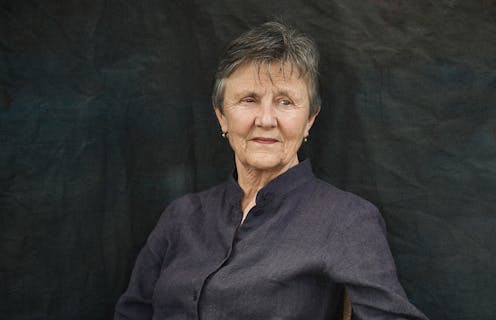
'I will not hide': Helen Garner's radical gift is the shock of plain-speaking

Most readers of Helen Garner will be able to pinpoint a first personal encounter with her work: a book, or even a sentence, that cut through like sharp light; a local landmark suddenly immortalised on the page; an unsayable bodily experience transformed into the unabashedly said.

Reading Garner, it’s as though doors and windows have been flung open and there, over the cups and dishes and fruit bowls, is the stuff of life – frankly, tenderly, impeccably revealed. Garner’s clarity is such that it almost aches.

Review: Writers on Writers – Sean O’Beirne on Helen Garner – Sean O'Beirne (Black Inc. in association with the University of Melbourne and the State Library Victoria)

My first encounter came in Christmas 1984, when an aunt gave me a slender novel called The Children’s Bach. Chosen probably on account of its brevity – I’d just turned 14 – this tensile little book was, for me, bewildering in its adult complexity, disorienting in its fragmentary narrative style, indecipherable if I applied the principles of storytelling I was accustomed to. It refused to fill me in, to explain itself, to tell me. It was an initiation of sorts: my first foray into the exciting work that goes with adult literary reading.

Personal confession and concealment

Sean O’Beirne is the same age as me and has followed the “phases” of Garner – my word, not his – much as I have. In his book-length essay on Garner, he doesn’t organise her works into phases, so much as entwine them into a single unfurling ribbon of the self: in different permutations, across time and intents and, of course, books.

Every phase, every work, gets attention. There is the “close to self I” of Nora in Monkey Grip; the “Not-I” of her early and mid-career fiction (The Children’s Bach, Postcards from Surfers, Honour and Other People’s Children, Cosmo Cosmolino); and the “collective I” of her later non-fiction – which he explains as a sort of personal “I” nested within society.

In puzzling these selves in Garner, O’Beirne examines the impulse towards self in his own work. What results is an essay that examines personal confession and concealment in his own writing as scrupulously as it traces these in Garner’s.

O’Beirne’s is one of a series of book-length essays by writers on writers published by Black Inc., in association with the University of Melbourne and the State Library of Victoria. None of the subjects in the series needs introduction. Shirley Hazzard, David Malouf, Patrick White, Beverley Farmer: these are the literary cartographers of 20th-century Australia. Some of the essay writers occupy this same rarefied plane – Christos Tsiolkas, Michelle De Kretser – but other highly accomplished contributors (Josephine Rowe, Richard Cooke), like O’Beirne, will be new to many readers. There is clearly a generational impetus to the selections Black Inc. has made in commissioning this series – a desire to trace influences, connections and continuities across time and writers. Read more: A new literary portrait of Helen Garner leaves you wanting to know more Impersonal, efficient vulnerability O’Beirne, for his part, approaches Garner from what he calls a “place in the junior writing position”. He is the author, so far, of one well-received book: the 2020 short-story collection A Couple of Things Before the End (also Black Inc.). A consistently intelligent humility runs throughout his essay, but O’Beirne is no less probing for his preparedness to defer to Garner’s art. He “carefully, respectfully” adjudicates Cosmo Cosmolino as a “bad book”, for instance, describing it as a sliding-doors moment in Garner’s career in which she might’ve fallen prey to a magical realism that is less cogent, less compelling than her signature crisp realism – yet he remains open to the novel’s innovations. There is a persistent sense that O’Beirne is reaching for something in himself through Garner; something that may well be unreachable, but is worth reaching for all the same. Partly, this is Garner’s receptiveness to self and other, her preparedness to commandeer her vulnerability and plant it, with “brisk impersonal efficiency”, on the page. O’Beirne writes, at one point, that he wishes to “do the good work of less impersonation” in his own writing, to stop disguising himself in fictional personae, to cast off his reticence and put himself frankly there.
Sean O'Beirne.

His tendency to “hide” is partially explained in the spare details he gives of his traditional Australian boyhood in outer-suburban Melbourne where, in order to survive, an impersonation of “manhood” was crucial. You couldn’t be a soft-thinking, sports-averse, self-doubting “boy” who didn’t even know how to have an orgasm. You had to be pretend that you were part of a “bunch of blokes”, swiftly disguising any weakness if it threatened to spill over into the performance. O'Beirne’s habit of disguise is a habit of self-preservation, and Garner thrilled him by showing that being imprisoned in the ashamed not-quite-right self might be a blessing; that “it was contradictorily interesting and delicious and bad and lonely to be so steeped in, waterlogged with the problem of me”.

But, as he is first to admit, the “real man” behind the essayist does not fully materialise here. O’Beirne remains conceptual, not visceral – he wonders why he feels comfortable giving such bodily experiences as a first sexual encounter to a character, but retreats from owning it on the page as himself. He may, like Garner, be prepared to wriggle on the end of his own hook, but he retreats where Garner boldly goes forth.

In elucidating his ideas, O’Beirne employs an idiosyncratic prose style that determinedly avoids the administrative, structural, institutional literary – the world of “Them”, which, he says, Garner also eschews. Often this enables him to say things for which there are no existing words, or no sufficiently illuminating words.

Sometimes, though, in preserving his prose from the already-said, O’Beirne’s choices confound rather than illuminate. His tendency to noun phrases (“my not-as-socially-approved awareness”, “a starting amount of more open confession”, “a trying to be with someone else”) occasionally ruptured my sense of being a co-traveller on his thought journey. Similarly, his choice of the Australian vernacular (“bloke” and “I reckon”) made aesthetic or even ideological sense but nevertheless grated.

When they work, however, his hyphenated compounds, rammed together like a string of mismatched train carriages, led me on new journeys, or even jumped the rails entirely and deposited me in completely fresh territory. Sometimes I couldn’t go there with him, but I was elated when I could.

Read more: Remembering Janet Malcolm: her intellectual courage shaped journalism, biographies and Helen Garner

Primal shock

“I will not hide” is Garner’s gift, O’Beirne says. It remains a radical gift, even in the face of other recent acts of radical literary self-revelation – in the work, for instance, of Maggie Nelson and Sheila Heti, which O’Beirne cites. Yet, for any shock value in Heti’s Motherhood or Nelson’s bone-crackingly good The Argonauts, the primal, bodily shock of Garner (a forgotten tampon, a slow fuck, a shit sucked back up into the body) has always been the shock of plain-speaking, not of sensation or transgression.

O’Beirne doesn’t seek transgression either: just honesty and bravery, the things he admires in his subject. He wants to be like Garner; he cannot be like Garner; the best he can do is be O’Beirne. Ultimately – for me and for him – that’s enough. In this essay, O’Beirne’s honesty may not be of Garner’s register, but it’s honesty all the same.

Authors: Edwina Preston, PhD Candidate, The University of Melbourne

Read more https://theconversation.com/i-will-not-hide-helen-garners-radical-gift-is-the-shock-of-plain-speaking-179090

Business News

Is Your Brand Showing Up in AI Search? Most Melbourne Brands Aren't.

The New Front Door Nobody Told You About Something changed. Quietly. Without a press release. The way buyers find businesses in Australia has been rewired. Not replaced, rewired. Google isn't dead...

Daily Bulletin - avatar Daily Bulletin

How Australian Businesses Can Measure SEO ROI

SEO can feel vague when you are staring at a dashboard full of numbers that do not clearly connect to revenue. The key is to measure the right signals in the right order, then tie them back to outcome...

Daily Bulletin - avatar Daily Bulletin

How Commercial Roller Shutters Improve Site Security Without Slowing Operations

Security upgrades can be frustrating when they make everyday work harder. A door that takes too long to open, creates bottlenecks at shift change, or fails at the worst time can turn “better protectio...

Daily Bulletin - avatar Daily Bulletin

Why a Document Destruction Service Still Matters for Modern Businesses

Businesses generate large volumes of information every day, from staff records and contracts to invoices, reports and customer files. While attention often focuses on how documents are stored, the way...

Daily Bulletin - avatar Daily Bulletin

Bicycle Rack Safety and Space-Smart Storage

Bike storage problems usually show up as small annoyances first: tangled handlebars, scratched frames, and bikes that topple when you pull one out. Over time, those issues become safety risks, especia...

Daily Bulletin - avatar Daily Bulletin

How to Tell if a Childcare Centre Is a Good Fit for Your Child

Choosing childcare can feel like you’re making a huge decision with limited information. Tours are short, centres are often on their best behaviour, and your child might act differently in a new space...

Daily Bulletin - avatar Daily Bulletin

Car Import Timeline: What Usually Happens at Each Stage

Importing a car into Australia can feel confusing because multiple agencies and checkpoints are involved, and the timeline is shaped as much by paperwork quality as it is by shipping speed. The most u...

Daily Bulletin - avatar Daily Bulletin

Portable Toilet Hygiene Standards Explained: Clean vs Sanitised vs Disinfected

In portable toilet servicing, the words clean, sanitised, and disinfected often get used as if they mean the same thing. They don’t. And that difference matters because a unit can look tidy and still ...

Daily Bulletin - avatar Daily Bulletin

Options Available When a Company Faces Financial Distress

Financial distress can develop gradually or arrive suddenly, and when it does, the decisions made in the early stages often determine what options remain available later. Directors who act promptly ...

Daily Bulletin - avatar Daily Bulletin

The Daily Magazine

What Actually Makes a Good Criminal Lawyer in Melbourne

Most people only think about this question once. That is usually too late. Most people charged wi...

Why Working With A Chatswood Tutor Can Improve Academic Performance

Academic expectations continue increasing for students across primary school, high school, and senio...

Is It Worth Getting Solar Panels in Melbourne?

The real question is not whether solar works in Melbourne. It works. The question is what it is co...

How A Diploma Of Project Management Builds Practical Skills For Modern Work Environments

Developing the ability to plan, execute, and deliver outcomes efficiently is a key requirement in to...

How to Choose the Right Football for Every Level

Choosing a football may seem straightforward, but the right option depends on who will be using it a...

What to Ask a Wedding Photographer Before You Book

Booking a wedding photographer can feel deceptively simple: you like the photos, you like the vibe...

Why Stress Relief For Dogs Is Essential For Emotional Balance And Long-Term Wellbeing

Managing emotional health is just as important as physical care when it comes to pets, which is why ...

Australia’s Best Walking Trails and the Shoes You Need to Tackle Them

Australia is not short on spectacular walks. You can follow ocean cliffs in Victoria, cross ancien...

Why Pre-Purchase Building Inspections Are Essential Before Buying a Home in Australia

source Have you ever walked through an open home and started picturing your furniture, family d...