

First come floods, then domestic violence. We need to prepare for the next inevitable crisis
- Written by: Kim Usher, Professor of Nursing, University of New England
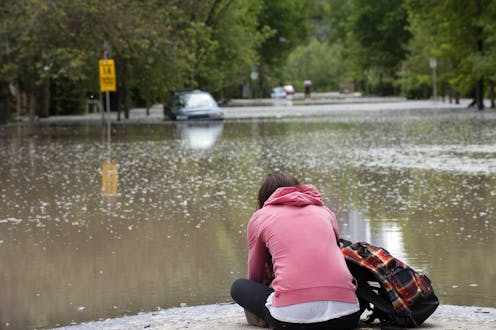
Catastrophic flooding in New South Wales and southeast Queensland has led to lost lives, homes, belongings, pets and livelihoods.
As the process of cleaning up after the floods continues, we can expect an often unspoken outcome of natural disasters.
Domestic violence rates surge during and after bushfires, pandemics, earthquakes, cyclones and floods.
We’ve known this for years
Domestic violence may include one or a combination of psychological, physical, financial and sexual abuse.
It’s most often directed at women and children, may occur for the first time during a disaster, or may transform from one type to another during or after a disaster.
Researchers have been studying the links between natural disasters and domestic violence for years.
Previous floods, including after Hurricane Katrina in the United States, have led to increased rates of domestic and family violence.
In the four years after the Black Saturday bushfires in Victoria, there was a rise in domestic violence rates with worse-affected areas reporting higher levels of abuse.
Internationally, we’ve seen an increased risk of domestic violence during the COVID-19 pandemic. Our Australian research shows there is growing public concern about pandemic-related domestic violence, and about the lack of services to support women.
Studies have also reported increases in requests for women’s shelters after disasters, as women seek refuge from violent relationships.
Why is domestic violence more likely?
Fear and uncertainty are common during disasters and people’s reactions to disasters vary. In some, these feelings can trigger domestic and other types of violence.
The many associated losses related to disasters – including loss of homes and their contents, cars and livelihoods – often cause financial strain, which may also place added pressure on families and relationships.
Grief, loss and trauma can also leave people feeling overwhelmed and test a person’s coping skills. Experiencing life-threatening situations or those that bring about loss and trauma can also lead to mental health issues, such as postraumatic stress disorder. This too, can complicate family dynamics and change people’s ability to cope.
Drug and alcohol use often soars during and after disasters, which may also exacerbate tensions in relationships.
When people are displaced and need to stay with other community members or in shelters, the rates of violence against women also rises. In those cases, women and children tend to experience more violence in general, not just domestic violence.
Read more: Pregnant women are at increased risk of domestic violence in all cultural groups
What can we do to prepare?
As climate change is predicted to cause more of these types of catastrophic weather events in the future, we need to start prevention strategies for the next inevitable disaster.
So local, state and national government departments need to start enacting these as soon as a disaster occurs.
We can group these prevention strategies into two broad areas, those aimed at entire disaster-affected communities and those targeted towards supporting people who experience domestic violence during and after disasters.
Whole communities
Helping entire communities affected by floods and other natural disasters will minimise the kind of conditions – the fear and uncertainty – our research has shown triggers domestic violence. Strategies include:
government funding to help people and businesses clean up after the disaster, rebuild communities and get back on track. This could be along similar lines to COVID payments we saw earlier in the pandemic to support individuals and businesses
swift provision of daily essentials such as food, shelter and clothing. This could include governments partnering with community organisations and volunteers
governments mobilising extra support, such as from the Australian Defence Force, promptly and efficiently, a move criticised as being too little too late during the recent NSW floods.
Helping survivors
To help people affected by domestic violence, we need:
locally available domestic violence services ready to act when disasters occur, not weeks later, as that may be too late for some women. These need to be properly funded, accessible to survivors and widely publicised on social media
to avoid telling people who experience domestic violence that things will improve once life gets back to normal. If women’s concerns are brushed off this way, they are more likely to have poor mental health in the future
to recognise the importance of first-line responders in these times. We need to make sure they are trained to recognise the signs and triggers of domestic violence
to support health-care professionals, teachers, relatives and other community members who might suspect domestic violence. They need to know where they can refer people and what services are available in the community.
If this article has raised issues for you, or if you’re concerned about someone you know, call the 1800 Respect national helpline on 1800 737 732 or Lifeline on 13 11 14.
Authors: Kim Usher, Professor of Nursing, University of New England


 Daily Bulletin


