

Weather forecasts won't save us – we must pre-empt monster floods years before they hit
- Written by: Mark Gibbs, Leader of the Knowledge to Innovation team, Institute for Future Environments and Science and Engineering Faculty, Queensland University of Technology
Most people’s lives are largely removed from nature. We spend our days in temperature-controlled rooms, immersed in virtual environments. Our cars transport us from underground car parks to our garages in comfort, no matter what the outside conditions.
And when a natural hazard hits, we often rely on technology-driven weather forecasts to understand and avoid the risks.
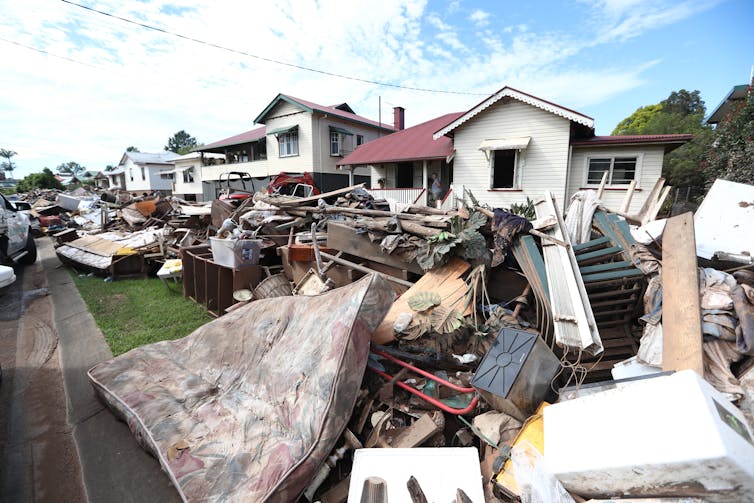
But now, Southeast Queensland and parts of New South Wales are inundated yet again. Clearly, short-term weather forecasts alone are not enough to protect communities in times like these.
Withstanding natural disasters requires recognising the threat earlier, and enacting the systemic change needed to survive.
Living with nature
The public demands accurate weather forecasts. People want to know how the weather will affect their family, work and social schedules so they can minimise the disruptions.
The technology used to determine future weather conditions is continually being refined. Now, sophisticated computer models churn out 24/7 forecasts and radars provide real-time images of where rain is falling.
But projecting the arrival and behaviour of extreme weather remains challenging.
These events, such as intense rain, can develop and intensify within hours. Short-term forecasts often change throughout the day as conditions develop.
The recent heavy rain and flooding shows how we’re pushing the limits of this technology. It has also exposed vulnerabilities in our collective ability to apply the information generated.
Advancing technologies
Australia has the fourth-largest weather radar network in the world.
Radars work by emitting electromagnetic waves. When the waves hit an object, such as a water in the atmosphere, the signal bounces back to the radar. This information is then converted into data on a map that can be viewed by the public.
Rain radars tell us where rain is falling, and how heavily. Experts can use this information to infer what the rain might do next. But weather forecasting is not an exact science and, as with any technology, there’s always room for improvement.
For example, changes to coastal temperatures and humidity over small areas, in a short period, can thwart a forecast’s accuracy.
Forecasters also use weather models – computers that simulate conditions in the atmosphere, ocean, and above land and apply mathematical equations to predict future weather.
Low pressure systems and especially east coast and tropical lows, which can lead to storms, are harder to predict than high pressure systems which tend to bring calm conditions.
Read more: All hail new weather radar technology, which can spot hailstones lurking in thunderstorms
Wired to predict
There is widespread misunderstanding of what rain radars actually tell us. They show what is happening now, and what has just occurred. They do not predict future conditions.
But the human brains is wired to predict. So people sometimes make assumptions about the trajectory and future intensity of storm cells they see in radar images.
The media can also undermine the credibility of the forecasting system. News reporting of weather events can sometimes be over-dramatised. And the media does not always update its coverage of extreme weather forecasts – for example, not telling the public when a weather warning has been downgraded.
Just-in-time flood response is risky
We can’t directly stop natural hazards occurring. But we can try to make communities better able to withstand them.
Relying on just-in-time weather information is a poor substitute for better planning and preparedness.
For months, we’ve known this summer would be wet. But sadly, many in the community did not act on these projections.
A La Niña event occurred in the summer of 2020-21 and brought above-average rain and widespread floods. As others have noted, since 1958 about half of La Niña events have reoccurred the following year.
So the odds were already in favour of the 2021-22 summer also being wet. And the second La Niña was confirmed in November.
But by and large, these indications were not acted upon.
For example, the Queensland government delivers a generic advertising campaign for storm awareness, but it’s not tailored to specific seasonal conditions or impending events.
As reported in The Conversation this week, Australia has a poor record on implementing plans for natural disaster risk reduction. This includes the National Climate Resilience and Adaptation Strategy, released late last year, which contains no new funding and little detail.
At a government agency level, better flood preparedness would involve, among other things, overhauling planning laws to ensure the built environment is resilient to natural hazards.
It would also involve ensuring local councils are properly resourced to help residents on the ground.
Individuals can also take action to minimise flood damage to their property.
I spent last week cleaning mud from the basement of a large apartment block in Brisbane. The damage showed very clearly which residents had moved or protected valuables in basement areas well in advance of the water, and which had not.
Back to the future
The flooding in Queensland comes just a decade or so after the devastating Brisbane floods.
The new disaster is expected to cost the state’s economy up to A$2.5 billion. Insurance claims on damaged homes and businesses will be close to $1 billion.
Flooding in future is inevitable, especially under climate change which will likely bring more frequent and severe bursts of rain.
Relying on short-term weather forecasts to prepare for such events is deeply unwise. Becoming resilient to natural disasters means preparing weeks, months and years in advance.
Authors: Mark Gibbs, Leader of the Knowledge to Innovation team, Institute for Future Environments and Science and Engineering Faculty, Queensland University of Technology


 Daily Bulletin


