

Here's why misinformation is a smaller problem than you think
- Written by: Paul Kenny, Professor of Political Science, Australian Catholic University
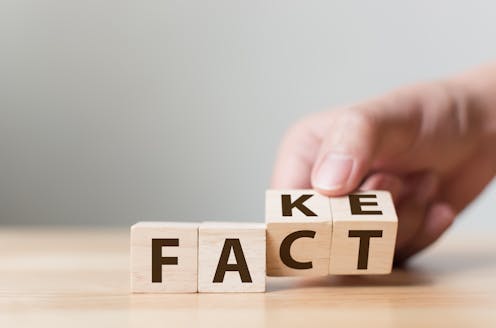
It’s widely believed that this is the age of misinformation, of alternative facts, and of conspiracy theories gone mainstream, from QAnon to anti-vaccine and anti-lockdown movements.
In this telling, claims spread by internet crackpots are amplified by partisan news networks and social media to the point that wild myths can now influence or even change governments.
But is this really the case, or are we inflating the problem of misinformation? Ironically, many of our common beliefs about the issue are, well, myths.
Conspiratorial beliefs are held by a small minority
How many people actually believe misinformation-fed conspiracy theories? It turns out, not many. Wild conspiracy theories like QAnon draw headlines, especially given their believers were amongst the rioters who stormed the US Capitol a year ago. But these beliefs are still rare.
Read more: Misinformation, disinformation and hoaxes: What’s the difference?
While surveys estimate the number of QAnon believers in the US to be as high as 15%, this is likely due to “acquiescence bias”. This is the tendency for people to agree with whatever they’re asked in a survey, even statements like “the government, media, and financial worlds in the US are controlled by a group of Satan-worshipping pedophiles who run a global child sex trafficking operation.” As political scientists Seth Hill and Molly Roberts have demonstrated, phrasing survey questions differently can slash the numbers who agree by half.
Of course, even if only a small percentage of us believe false or deliberately misleading information, there may be real consequences. In America, around 15% of adults refuse to get a COVID vaccine. That, in turn, is leading to what’s been dubbed the pandemic of the unvaccinated.
Why do people fall for false information, even when it’s against their own direct interest, such as keeping themselves and their families alive?
Are we really too gullible?
A common answer is that people are easily duped. The ability of populists like Donald Trump to ride to power on the back of a series of false or misleading claims would seem to be compelling evidence of such widespread credulity. Trump drove the “Birther myth” that Barack Obama was not born in the United States and pedalled wildly inaccurate statistics on crime rates, unemployment throughout his campaign.
But the idea that only a few of us can resist the deluge of falsehoods is another myth. If people were so easily gulled, we’d all be the willing slaves of a manipulative elite! Rather, as French social and cognitive psychologist Hugo Mercier has argued, people have “open vigilance” cognitive mechanisms that prevent this from happening. While we are open to letting in new information, our standard response is to treat that information sceptically.
Are we just irrational?
So how does misinformation slip through? First, our ability to critically evaluate information is far from perfect. While it was once common belief humans would always rationally act in our own best interests, research by Nobel Prize-winning economist Daniel Kahneman and many others has shown we all have systematic cognitive errors such as the “availability heuristic” and the “omission bias”.
Both errors are involved in vaccine hesitancy. If rare vaccine side effects draw media attention, many people will fixate on this risk, despite how low it is. That’s the availability heuristic at work.
At the same time, people discount the risks associated with not taking an action (being unvaccinated), while overestimating the risks of taking an action (getting vaccinated). That’s the omission bias.
There is a link between susceptibility to misinformation and lower levels of cognitive reasoning. But irrationality is not the whole story. When it comes to explaining support for conspiracy theories like QAnon, we need to look beyond people’s numeracy skills.
We’re team players
As Mercier has pointed out, we’re more likely to believe a lie if it comes from a source we already trust. Ours is a deeply social species. We evolved to use culture – shared beliefs and practices – as a kind of societal glue. In practice, this means we sometimes suspend our disbelief just to to get along.
Take, for example, the well-studied effect of political partisanship on American acceptance of the Birther myth: by 2016, while 80% of Democrats believed that Barack Obama was born in the United States, only 25% of Republicans did. People accept misinformation like Birtherism and QAnon to fit in with their group.
How can we help people taken in by misinformation?
For some of us, the pandemic has brought with it an unwelcome challenge: trying to change the mind of a loved one swayed by misinformation about vaccination.
According to an influential theory known as the “backfire effect”, not only do people resist information running contrary to their prior beliefs, but confronting them with this information only increases their commitment to their prior belief.
If this theory was true, there would be no point in arguing. Luckily, the backfire or backlash effect is yet another popular myth. “Out of the hundreds of opportunities to document backlash in my own experimental work on persuasion, I’ve never seen it.” That’s Yale persuasion expert Alexander Coppock, who I corresponded with by email.
Read more: Radicalization pipelines: How targeted advertising on social media drives people to extremes
Why does the myth persist? Coppock believes it’s because disagreement is unpleasant on a personal level. “When we try to persuade others, they don’t like it and they like us less for having tried,” Coppock said. What happens next? After we seemingly fail in our efforts at persuasion, we reassure ourselves the person holding the belief is simply wrong, if not stupid.
Our failed efforts at persuasion shouldn’t stop us trying. The experimental evidence clearly shows us that everyone, even strongly partisan people, can update their views when given accurate information. While some of us have further to go before we are fully convinced, clear, accurate information usually moves us in the right direction.
The key is to avoid making it a partisan right/wrong issue. The more you can make someone else feel included and on the same team, the more empathy and trust you generate.
The more the other person feels understood, the better your chances are of bringing them back in from the wilds of misinformation.
Authors: Paul Kenny, Professor of Political Science, Australian Catholic University
Read more https://theconversation.com/heres-why-misinformation-is-a-smaller-problem-than-you-think-172968


 Daily Bulletin


