

Don't look Up! has a surprising amount to tell us about economics, much of it useful
- Written by: Steven Hail, Adjunct Associate Professor, Torrens University Australia

In the new Netflix sensation Don’t Look Up, two astronomers, played by Jennifer Lawrence and Leonardo Di Caprio, discover a massive comet heading towards Earth, and desperately try to warn the US president, played by Meryl Streep.
Their hope is the government will take action to avert catastrophe while there is time. Their efforts are subverted by a combination of self-serving political cynicism, billionaire business interests, a media that sees its job as respecting those interests and that cynicism, and a population conditioned not to look up.
It is an obvious metaphor for the threat of climate breakdown, where warnings and pleadings from climatologists and scientists and from a growing number of campaigners, ecological economists and others, are being ignored, trivialised and sometimes even ridiculed by political insiders.
But after 40 years marked by the dominance of neoliberal pro-market economic policies, the metaphor can be extended to almost any challenge requiring a serious response, particularly where it involves standing up to vested interests.
There’s more amiss than vision and courage. Public services no longer have the capacity they did to respond to problems like long-term climate change and short-term pandemics.
Their administrative and decision-making capacity has been stripped away, as has the surge capacity in health systems and in many countries the ability to react to disruptions to supply chains – all in the name of efficiency, but with the effect of creating fragility while contributing to inequality and extremism.
Hayek, Friedman and Buchanan got us here
Neoliberalism is rooted in the work of three Chicago School economists: Friedrich Hayek, Milton Friedman and James Buchanan.
Hayek, though a famous name, was probably the least influential of the three. He saw mixed economies, market-based but regulated by governments, as inevitable steps on the road to totalitarianism.
Friedman espoused a naïve and outdated theory of money, which was no sooner adopted than abandoned in the early 1980s, but like Hayek saw freedom in low taxes and championed privatisation and deregulation. It was Friedman who argued that many people had to remain unemployed in order to suppress wages.
Buchanan, like Friedman, argued that politicians and public servants could be trusted to act in in their own interests at a cost to society, and that almost anything that could be done by public servants could be done better by the private sector.
In the 1980s the trio effectively took over the conservative side of politics in high-income countries. Their ideas also helped intimidate those on the other side, including the Hawke-Keating Labor government in Australia, and every Labor front bench that succeeded them. That influence persists to this day.
Mazzucato, Kelton and Raworth want to get us out
In her book Mission Economy, the University College London economist Marianna Mazzucato imagines a different relationship between the public and private sectors: a proactive, problem-solving government cooperating with the private sector to address, among other things, climate change and the problems and opportunities associated with a rapid transition to sustainability.
This would require rebuilding public capacity and an approach to government experimentation and risk-taking not seen for 40 years.
Aligned with her are modern monetary theorist Stephanie Kelton and ecological economist Kate Raworth.

Kelton’s The Deficit Myth describes how modern monetary systems work and demolishes the metaphor of the government as a household used by neoliberals to push for balanced budgets and minimalist governments.
Kelton points out it is normal for governments to run deficits (Australia’s Commonwealth government nearly always has) and that these deficits allow the private sector to avoid building up debt.
Governments that create their own currencies such as America’s or Australia’s are well-placed to guide the private sector to serve a public purpose.
While both Mazzucato and Kelton discuss what this means, and give examples, it is Raworth’s book that most clearly identifies the goal governments should aspire to.
That book is called Doughnut Economics. It sets out a framework for providing everyone with an opportunity to enjoy a secure, dignified and connected life, while respecting nine environmental planetary boundaries that are prerequisites for the maintenance of the planet.
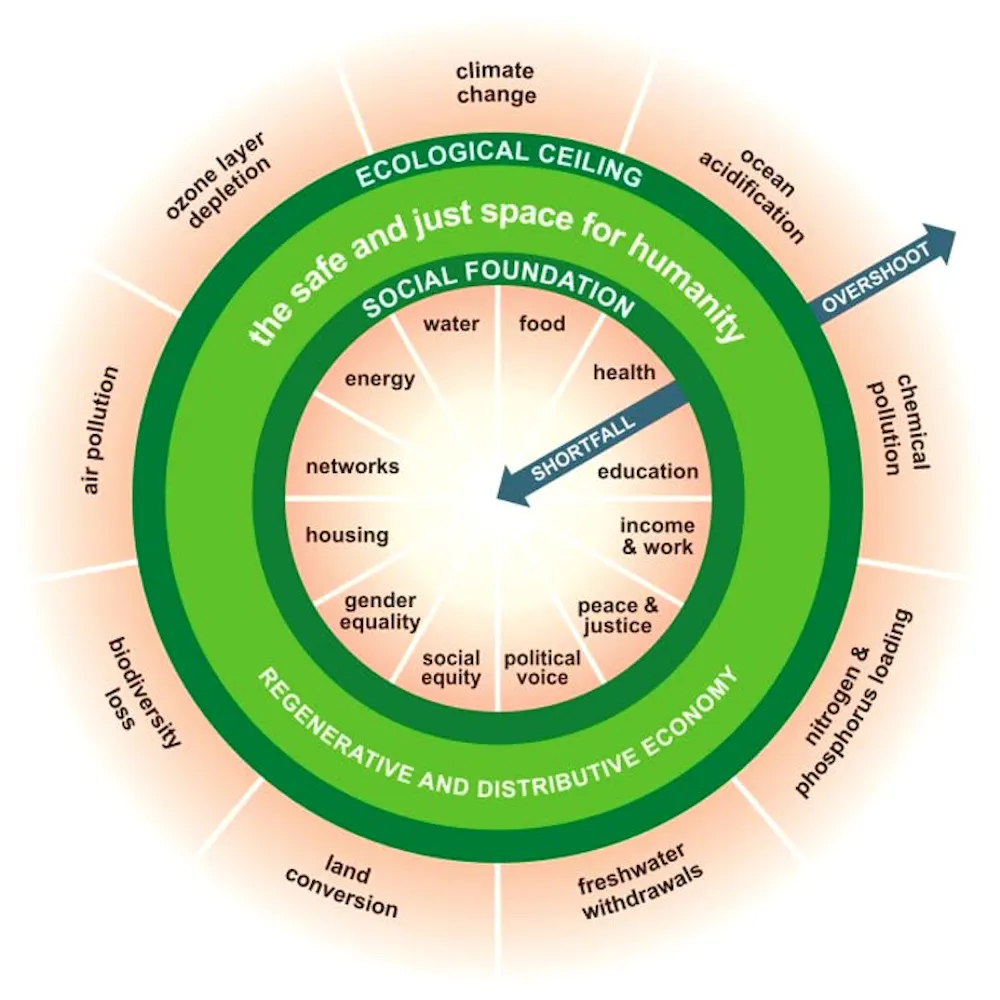 doughnuteconomics.org
The framework requires a shift of focus away from the goal of economic growth as defined by gross domestic product towards a set of indicators of a successful society. The indicators are similar to the UN sustainable development goals.
Both Kelton and Raworth are members of the World Health Organization’s Council on the Economics of Health for All, chaired by Mazzucato. Its guiding principle is that health should be seen not only as a human right but also as an investment in continued prosperity. It is an approach that would have led, among much else, to better preparations for the long-predicted pandemic.
Deficit-funded spending pays dividends
With Kelton and others, including leading medical researcher Steve Robson and health economist Martin Hensher, I have discussed the implications of modern monetary theory for health in an article for the Insight magazine of the Medical Journal of Australia, and in a position paper for the Institute for Health Transformation at Deakin University.
As a nation, we should not have been worried by the prospect of health spending climbing above 10% of gross domestic product as it did in 2015-16, nor by the prospect of it climbing higher in future decades. We should be investing in resources including the skills, health infrastructure and technology we will need to deal with future pandemics and the consequences of climate change.
Read more:
'Don’t Look Up': Hollywood's primer on climate denial illustrates 5 myths that fuel rejection of science
On climate change, it is gradually dawning on people that the outcome of COP26 in Glasgow was not up to the challenge we face and that many countries will not even achieve what they committed themselves to at Glasgow.
To a greater or lesser extent, every leader of a high-income country is failing to articulate a mission in regard to climate change, to drive that mission with the right public investments, and to locate the problems of climate change within the broader context of the planetary boundaries identified by Raworth – the most obvious of which is biodiversity.
The attitude is “Don’t Look Up!”, we have got this. Or “technology will save us”, as President Orlean (Meryl Streep) believed in the movie.
Few leaders any better than Streep
doughnuteconomics.org
The framework requires a shift of focus away from the goal of economic growth as defined by gross domestic product towards a set of indicators of a successful society. The indicators are similar to the UN sustainable development goals.
Both Kelton and Raworth are members of the World Health Organization’s Council on the Economics of Health for All, chaired by Mazzucato. Its guiding principle is that health should be seen not only as a human right but also as an investment in continued prosperity. It is an approach that would have led, among much else, to better preparations for the long-predicted pandemic.
Deficit-funded spending pays dividends
With Kelton and others, including leading medical researcher Steve Robson and health economist Martin Hensher, I have discussed the implications of modern monetary theory for health in an article for the Insight magazine of the Medical Journal of Australia, and in a position paper for the Institute for Health Transformation at Deakin University.
As a nation, we should not have been worried by the prospect of health spending climbing above 10% of gross domestic product as it did in 2015-16, nor by the prospect of it climbing higher in future decades. We should be investing in resources including the skills, health infrastructure and technology we will need to deal with future pandemics and the consequences of climate change.
Read more:
'Don’t Look Up': Hollywood's primer on climate denial illustrates 5 myths that fuel rejection of science
On climate change, it is gradually dawning on people that the outcome of COP26 in Glasgow was not up to the challenge we face and that many countries will not even achieve what they committed themselves to at Glasgow.
To a greater or lesser extent, every leader of a high-income country is failing to articulate a mission in regard to climate change, to drive that mission with the right public investments, and to locate the problems of climate change within the broader context of the planetary boundaries identified by Raworth – the most obvious of which is biodiversity.
The attitude is “Don’t Look Up!”, we have got this. Or “technology will save us”, as President Orlean (Meryl Streep) believed in the movie.
Few leaders any better than Streep
 Meryl Streep as President Orlean.
Tavernise/Netflix
A search by Raworth’s colleagues at the University of Leeds has failed to identify any country anywhere in the world that is providing its citizens with the social foundations for a good life while remaining inside planetary boundaries.
If that was to be the definition of a developed economy, none of our economies are developed.
We are either not meeting the needs of our people or exceeding the carrying capacity of our planet, or (in the case of about a third of countries) doing both at once.
Therein lies both a warning and a challenge; a threat and an opportunity.
Our mission ought to be to meet social foundations everywhere without destroying the environment of which we are a part and on which we depend.
We have an opportunity to govern differently
Governments, and especially monetary sovereign governments in high income countries such as Australia, will have to lead the way.
They will have to throw off the neoliberalism of Friedman, Hayek and Buchanan, and the baggage which goes with it and buy into the new economics of Kelton, Raworth, Mazzucato and their colleagues.
Then we can look up, with some confidence that we can deflect the metaphorical comets that threaten the lives of millions and the quality of life for us all.
The resources and the technology to do what’s needed already exist. But until now we have been trapped in an outmoded way of thinking about both the role of government and the purpose of economic activity that has held us back to the point where the comet is bearing down upon us.
Authors: Steven Hail, Adjunct Associate Professor, Torrens University Australia
Meryl Streep as President Orlean.
Tavernise/Netflix
A search by Raworth’s colleagues at the University of Leeds has failed to identify any country anywhere in the world that is providing its citizens with the social foundations for a good life while remaining inside planetary boundaries.
If that was to be the definition of a developed economy, none of our economies are developed.
We are either not meeting the needs of our people or exceeding the carrying capacity of our planet, or (in the case of about a third of countries) doing both at once.
Therein lies both a warning and a challenge; a threat and an opportunity.
Our mission ought to be to meet social foundations everywhere without destroying the environment of which we are a part and on which we depend.
We have an opportunity to govern differently
Governments, and especially monetary sovereign governments in high income countries such as Australia, will have to lead the way.
They will have to throw off the neoliberalism of Friedman, Hayek and Buchanan, and the baggage which goes with it and buy into the new economics of Kelton, Raworth, Mazzucato and their colleagues.
Then we can look up, with some confidence that we can deflect the metaphorical comets that threaten the lives of millions and the quality of life for us all.
The resources and the technology to do what’s needed already exist. But until now we have been trapped in an outmoded way of thinking about both the role of government and the purpose of economic activity that has held us back to the point where the comet is bearing down upon us.
Authors: Steven Hail, Adjunct Associate Professor, Torrens University Australia


 Daily Bulletin


