

How COVID-19 changed the way we shop – and what to expect in 2022 and beyond
- Written by: Adrian R. Camilleri, Senior Lecturer in Marketing, University of Technology Sydney
COVID-19 has dramatically changed how businesses and consumers behave. We’ve seen panic buying, the rise of the “homebody economy” and a strong shift towards contactless shopping.
As we emerge from the worst of the pandemic, it seems the right time to reflect on the most important changes in consumer behaviour we’ve seen, and to make some predictions about COVID-19’s lasting and pervasive effects on how we shop.
Pandemic purchasing
One of the first impacts of COVID-19 was supermarket shelves being repeatedly stripped of toilet paper and other products ahead of lockdowns.
One debate this behaviour sparked was about how much it could be considered irrational panic buying – or if it was rational to stockpile in response to the irrational behaviour of others.
It was a real-life lesson in game theory. Decisions that make perfect sense for individuals can add up to a bad outcome for the community.
Read more: A toilet paper run is like a bank run. The economic fixes are about the same
Spending less, spending more
Spending more money at the supermarket was at least possible.
Consumption patterns changed significantly due to closed borders, restricted shopping, stay-at-home orders and general uncertainty.
Data from the Australian Bureau of Statistics shows large drops in spending on transport, accommodation, recreation and entertainment services, and catering.
Individual services consumption, 2020
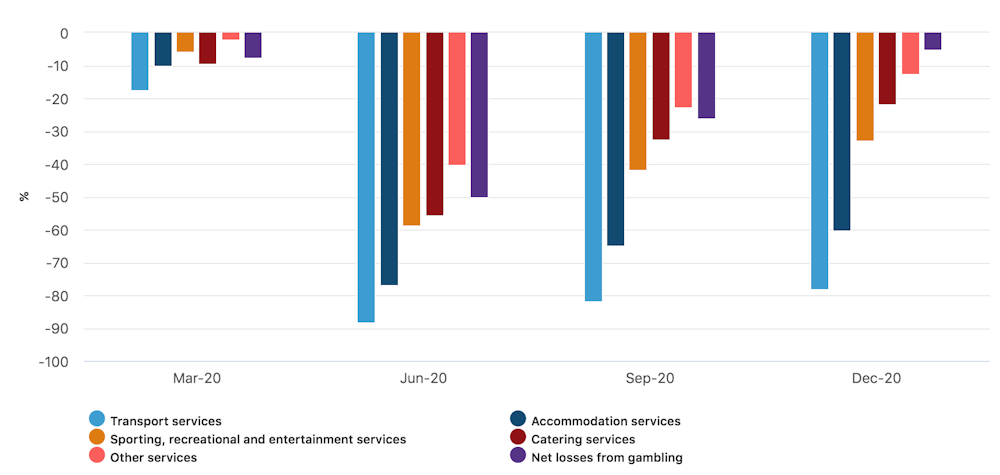
Spending on food increased marginally, and on alcohol even more. The main reasons cited for increased drinking, according to one study, were stress (45.7%), increased alcohol availability (34.4%) and boredom (30.1%).
Individual goods consumption, 2020
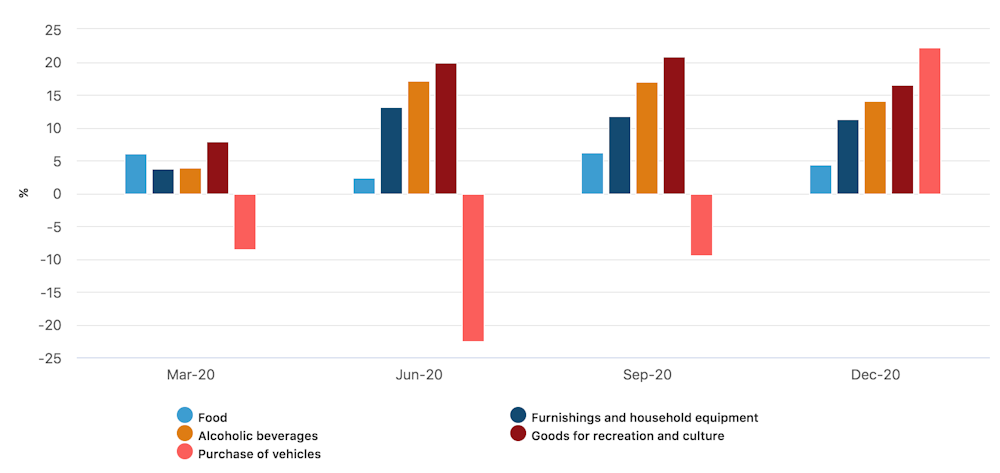 Percentage change in household goods consumption by select categories per quarter 2020.
ABS, Insights into household consumption, December quarter 2020
Percentage change in household goods consumption by select categories per quarter 2020.
ABS, Insights into household consumption, December quarter 2020
Spending also increased on home-related electronics, streaming services, furnishings, hardware and pet-related items.
Interest increased in traditional activities such as cooking, reading and gardening.
It is too early to tell to what extent these pandemic-driven shifts will translate into permanent behavioural change. However, research published last month, based on surveying 7,500 households in France, Germany, Italy, the Netherlands and Spain, supports the likelihood of at least some long-term sectoral shifts in consumer behaviour.
Predictions of a shopping splurge
As restrictions relax, some marketing experts are predicting “revenge spending” – shopping sprees with abandon.
Certainly many higher-income households have the money to splash out on a holiday, or new car, or home renovation, with Australians banking an estimated A$140 billion in extra savings during the pandemic.
Other research, such as the National Australia Bank’s quarterly Consumer Sentiment Survey, suggests the pandemic has engendered greater caution. In its most recent survey, 37% said they were mindful or careful of where they spent their money (42% of women and 33% of men). In terms of purchasing influences, 43% nominated supporting local businesses, compared with 15% environmental issues and 14% social concerns such as labour practices.
Some have wondered if, in the wake of COVID-19, we are about to experience another “Roaring Twenties” – emulating that period of economic prosperity and cultural dynamism in the 1920s following the deprivations of the first world war and the “Spanish flu” epidemic.
The circumstances are not exactly analogous. But new technologies and changes in habits are likely to drive several long-term changes in the way we shop.
Going contactless
Our desire to reduce physical contact accelerated contactless payment methods. Research (from the Netherlands) suggests this will, for most, be a permanent change, accelerating a steady decline in the use of cash for shopping.
ATM cash withdrawals using debit cards
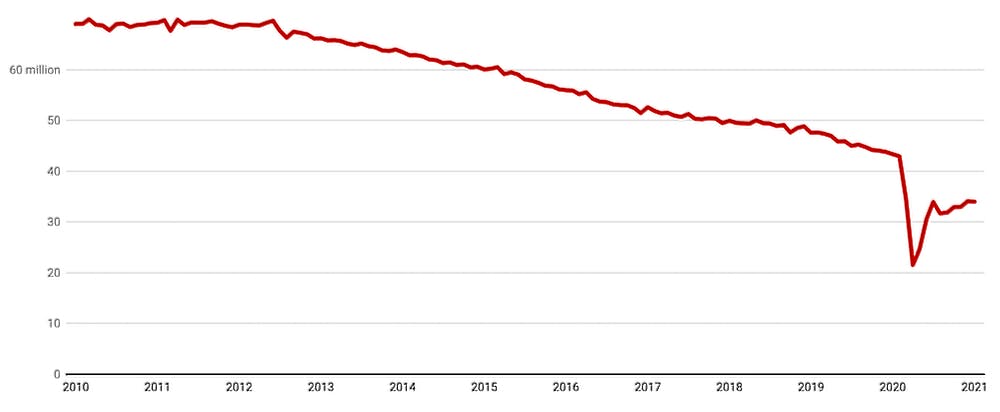 Monthly, seasonally adjusted.
Reserve Bank of Australia
Monthly, seasonally adjusted.
Reserve Bank of Australia
Technology enabling payments using smartphones, such as supermarkets introducing a way to pay by scanning a QR code, will contribute to this shift.
Read more: The paradox of going contactless is we're more in love with cash than ever
Ways to buy things without ever having to step inside a shop – such as curbside pick-up and home delivery – should also continue. In 2021 we’ve seen a number of startup businesses promising grocery deliveries in 15 minutes.
“Omni” experiences
Increasingly our buying behaviour will be shaped by what marketing experts call omnichannel shopping – a fancy word meaning using a variety of experiences to make a purchase.
You might, for instance, go into a store to try out headphones, then go online to read third-party reviews and compare prices from different retailers.
Technologies such as augmented reality will facilitate this trend. For example, IKEA’s Place app allows you to see how furnishing will into your space.
More and more what were once physical experiences will have their digital variants, from attending university to having an appointment with a health professional to taking a tour of the British Museum or exploring the Grand Canyon. Though these cannot replicate the real experience, they will be an increasingly common way to “try before you buy”.
The future of shopping will gradually merge the digital and physical. But whatever changes, some things will remain constant: the human desire to make experiences convenient, fun and meaningful.
Authors: Adrian R. Camilleri, Senior Lecturer in Marketing, University of Technology Sydney


 Daily Bulletin


