

Volunteer on a dig for the thrill of digging up the past (you'll also learn to hate buckets)
- Written by: Gil Davis, Associate Professor and Director, Ancient Israel Program, Australian Catholic University
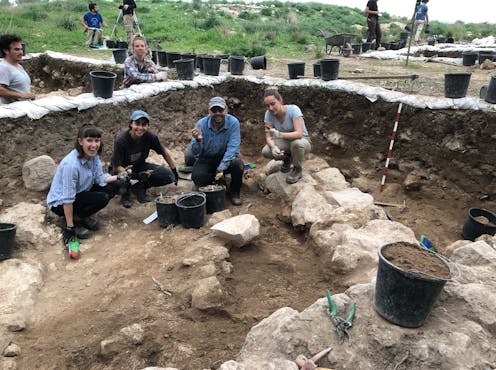
This article is part of a series explaining how readers can learn the skills to take part in activities that academics love doing as part of their work.
A few more brushstrokes and the student gasped with excitement. There in the dirt was a small, bronze statue of a calf, revealed for the first time in 3,000 years. The discovery could have been yours! In this article, I dip into the many opportunities for you to take part in an archaeological dig both locally and abroad.
Places on these digs are not confined to university students. There are opportunities for you to become involved in the fascinating world of archaeology both locally and abroad. You can make a useful contribution in many ways and have enormous fun doing it.
What is archaeology?
Archaeologists in popular imagination are like Indiana Jones and Lara Croft seeking powerful lost artefacts and unimaginable wealth. You don’t need me to tell you this is the stuff of fantasy. Gone too are the days (hopefully!) when real archaeologists just wanted to find palaces and temples and significant objects to stuff in museums.
The reality is more absorbing and less dangerous. The questions that interest us nowadays involve understanding how people lived and interacted with their landscape. What did they eat, drink, wear and believe, and what tools and technologies did they use? This comes under the rubric of “material culture”.
Read more: Why archaeology is so much more than just digging
Excavation is the essential part, but it is destructive. We excavate the minimum area possible to answer specific research questions. We leave the remainder for future archaeologists with different questions and even better technologies.
Uncovering architectural remains and artefacts is vital, but only if we can interpret the finds. To do so, we need to employ a wide range of specialisations, many of them scientific.
To take a case in point, a team in Israel was excavating the site of Ramat Rachel, which was the administrative centre of the Persians just outside Jerusalem. It was complete with a palace and pleasure gardens traditionally kept by Eastern potentates – think the Garden of Eden full of exotic species. No plants have survived from 2,500 years ago, of course, but the walls in the garden were plastered annually, and in the plaster was microscopic evidence of pollens and phytoliths (the mineralised remains). Bingo!
How does a dig work?
A typical dig in the Middle East, Europe and the United Kingdom will start with a survey to identify what is likely to be found and the most promising areas to excavate. This includes plotting surface finds.
Just as sultanas in a cake mix will come to the surface, ubiquitous broken sherds of pottery litter the ground. Diagnostic elements can be identified, giving a snapshot of what lies beneath. Geophysical surveying reveals the outline of subterranean structures.
The dig director(s) then decides where to dig in 5m-by-5m squares. Each square has a supervisor and a few people to help dig and record the finds.
What you can do (and why you will learn to hate buckets)
Those squares don’t dig themselves. First you get down to the levels of interest by removing all the topsoil. It’s usually filled with tree roots and rocks. Mattocks, spades and an endless supply of buckets are the go.
This is where (your?) labour comes in. Most digs need volunteers to do the hard yakka. The dig supplies the equipment, training and supervision; the volunteers do the work.
Soon the team reaches the levels of interest. The work becomes more careful, turning to trowels and brushes. The volunteers become adept at identifying and recording finds and levels.
Fit people don’t need a gym on a dig. Others less physically able will contribute to light duties, logistics, recording and preparing meals.
A dig draws on a wide range of expertise including geophysics, surveying, photography, computing, pottery, lithics, biology, zoology, archaeometallurgy, chemistry and isotopic analysis. There is always call for volunteers able to offer specialised skills. People with medical and allied health training are especially welcome, as are people who can speak a local language.
Australian sites are handled differently as they mostly deal with understanding Aboriginal and Torres Strait Islander use of land and historical (post-European settlement) sites. Research questions are usually linked to cultural heritage management.
The way the sites present does not lend itself to excavating in squares and is more to do with plotting surface finds such as campsites spread out over a wide area. Nonetheless, volunteers are usually welcome and specialised skills and knowledge are prized.
Read more: Cave dig shows the earliest Australians enjoyed a coastal lifestyle
How to volunteer
Be mentally prepared. It’s tough work in the dirt with long hours and very basic, shared accommodation. Hats and sunscreen are essential – but not whips. Usually, you pay for the privilege of participating, though the dig will supply your accommodation, food and transport.
There are endless opportunities to volunteer but finding them takes a bit of sleuthing on the net. Some countries provide a contact point.
For digs in Israel, which is where we dig at Australian Catholic University, contact the Israel Antiquities Authority. Field schools are ideal, such as these ones in Menorca (Spain), Ireland and Bulgaria. The Archaeological Institute of America lists many opportunities.
For digs in Australia, it is best to inquire at the universities that offer archaeology to find out which digs they are doing and whether they accept volunteers.
Finally, if you’re serious about becoming an archaeologist, especially if you are studying it, many organisations place volunteers. Here’s a guide courtesy of the Australian Archaeological Association.
Read more: Down and dirty: what volunteers bring to archaeological digs
Why do it?
A dig offers a unique experience. Volunteer archaeologists know they’re doing something worthwhile. You challenge yourself in many ways, work in a team and create amazing friendships with like-minded people.
As you gain experience, you become more valuable. You could then be employed as a supervisor and not have to pay.
Many volunteers become archaeology junkies who can’t wait to spend their next holiday digging up the dirt.
You can read other articles in this series here.
Authors: Gil Davis, Associate Professor and Director, Ancient Israel Program, Australian Catholic University
&media=https://dailybulletin.com.au/https://images.theconversation.com/files/433044/original/file-20211122-23-l5ld24.jpeg?ixlib=rb-1.1.0&rect=0%2C0%2C4031%2C3011&q=45&auto=format&w=496&fit=clip&description=Volunteer%20on%20a%20dig%20for%20the%20thrill%20of%20digging%20up%20the%20past%20(you'll%20also%20learn%20to%20hate%20buckets) "Pin It")

 Daily Bulletin


