

5 questions to ask yourself before you dob — advice for adults and kids, from an ethicist
- Written by: Hugh Breakey, Deputy Director, Institute for Ethics, Governance & Law. President, Australian Association for Professional & Applied Ethics., Griffith University
COVID lockdown rules have thrust “dobbing” into the spotlight, with some asking whether Australia is a nation of dobbers.
But when is dobbing ethical and when is it wrong? This is a tricky question for adults and kids alike.
There is clearly a place for reporting wrongdoing — it can halt bad behaviour, see wrongdoers punished, help set societal expectations and prevent harm.
Still, there are reasons to be cautious about dobbing. It isn’t always the right thing to do.
A lot of our ideas about dobbing are formed in childhood — and as any parent, carer or teacher knows, not all dobbing is warranted.
Here are five questions worth thinking about before blowing the whistle — and how to talk to kids about dobbing.
1. Is it a clear violation?
Think carefully about exactly what behaviour you’re dobbing on, what rule it breaks and be sure you haven’t made assumptions.
There is no point calling authorities if the behaviour you’re dobbing on has a reasonable explanation.
For example, there may be ambiguity in the rules that you’ve failed to consider.
Or perhaps what you assumed was a violation wasn’t ever one at all, because the person had a valid exemption (such as a medical reasons for not wearing a mask).
Think before you dob.
2. Is there a risk of genuine harm?
There are plenty of rule violations we typically don’t report. You probably don’t call the police when you see someone jaywalking, or a car parked improperly. You might even think it’s “none of my business”.
When someone reports us to the authorities, they essentially take a position of authority. They aren’t the police, but they are policing our behaviour. Widespread dobbing can also make us feel like we are continually being watched. So it’s perhaps no surprise many of us find dobbing for low-level breaches somewhat affronting.
However, these reasons shouldn’t stop us reporting if there is a real risk of harm.
In a pandemic, rule breaking can have grave or even deadly consequences, especially for vulnerable populations.
On this basis, repeated and flagrant violations are especially worth reporting. Such violations are also unfair; it is frustrating to see a person refuse to be bound by the rules the rest of us must accept.
For example, if a neighbour who is self-quarantining because they have tested positive to COVID seems to be having friends over, the authorities should be contacted. The risk of harm to others is very high.
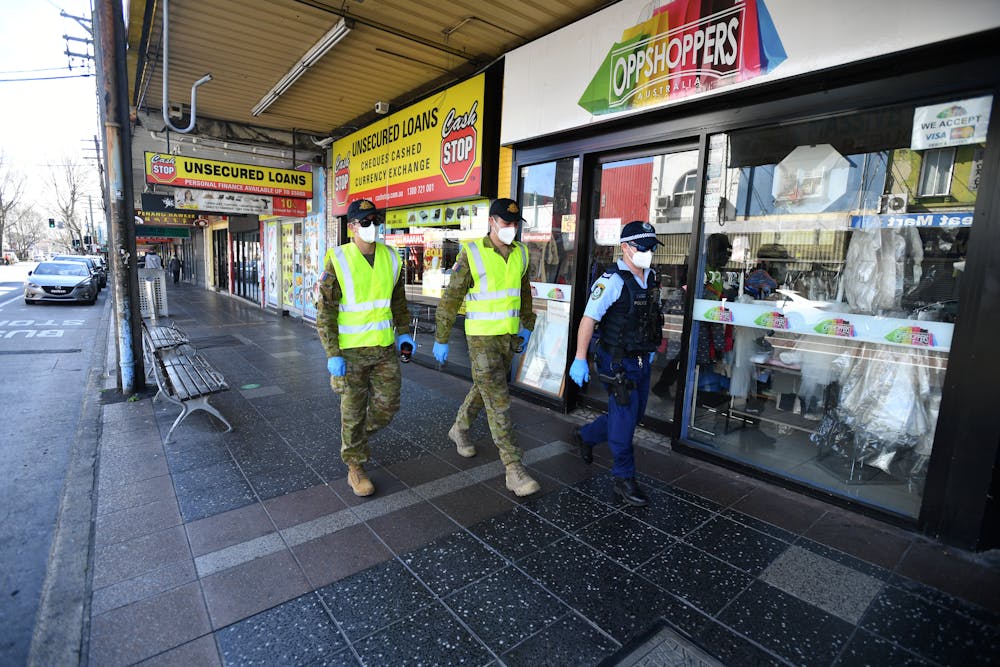 Police and defence force personnel patrol a Sydney street on a COVID lockdown compliance check.
JOEL CARRETT/AAP
Police and defence force personnel patrol a Sydney street on a COVID lockdown compliance check.
JOEL CARRETT/AAP
3. What’s my relationship to the person I am dobbing on?
If you have an important relationship with the rule-breaker, that could be a reason to be cautious about reporting. For example, you might think carefully about poisoning an otherwise good relationship with a neighbour over a one-off or minor infraction.
But it’s also worth reflecting on whether you have a bad relationship with the person, or dislike them. If you’re dobbing on someone primarily because you don’t like them, or want them to get in trouble, you should examine your motivations closely.
This factor may play a role in public reporting on politicians’ mask wearing.
If the community is taking on a reporting role, it needs to be done fairly.
4. Can I resolve this informally?
Most of us have, at least once, forgotten to grab a mask, or to put it on.
Sometimes, a gentle reminder might be all that’s required. If you think an informal approach is likely to work, that may be a better option.
Just as children should learn to try to resolve their differences before seeking out an adult adjudicator, many of us could do more to find informal resolutions before involving authorities.
Of course, people can respond unpredictably and aggressively, even to good-natured approaches. An obligation to report doesn’t require putting yourself in harm’s way.
If you’re unsure about your safety, I think it’s ethically defensible to go straight to a higher authority.
(And if you’re the person being dobbed on and you think “Why couldn’t they have just said something to my face? I would have been fine about it,” just remember: it may have been impossible for your accuser to know that.)
5. What are my motivations?
There is a little bit of the self-righteous busybody in most of us. Dobbing can deliver a sense of authority and power (especially to those, like kids who are younger siblings, who may crave a fleeting sense of power because they have relatively little of it in their day to day life).
While it’s not easy to objectively survey your own motivations, it’s worth trying to make sure your heart’s in the right place.
Talk to children about the difference between dobbing and whistleblowing
We all learned about “dobbing” in the schoolyard. Children might encourage a social norm against dobbing because they think the rules are unfair, or because since they all break some rules, everyone is better off if nobody dobs.
But parents too can be frustrated by dobbing, such as when children seem to delight in getting a sibling into trouble.
 Talk to your children about the difference between dobbing and whistleblowing.
Shutterstock
Talk to your children about the difference between dobbing and whistleblowing.
Shutterstock
Talk to your children about the difference between dobbing and whistleblowing. If the rule-breaking is clear and someone could be harmed, it’s important children know they should come forward. It’s always right to tell someone if you feel unsafe, or if someone is making you feel scared.
Equally though, not everything in life requires reporting to authorities. We all need to learn how to manage relationships with friends and siblings, and to resist the thrill of getting others into trouble.
When you’re the one getting dobbed on
An article on dobbing wouldn’t be complete without mentioning human beings are enormously clever about justifying rule-breaking.
We tell ourselves elaborate stories about how our “special” circumstances mean the rules shouldn’t apply to us.
When someone reports us, it can be tempting to feel outraged. But in doing so, we may avoid facing up to our own culpability.
Just as there is an ethics of dobbing, there is also an ethics of accepting responsibility.
Read more: Troublemakers and traitors - it's no fun being a whistleblower
Authors: Hugh Breakey, Deputy Director, Institute for Ethics, Governance & Law. President, Australian Association for Professional & Applied Ethics., Griffith University


 Daily Bulletin


