

WATCH: Our mobile phones are covered in bacteria and viruses... and we never wash them
- Written by: Wes Mountain, Multimedia Editor
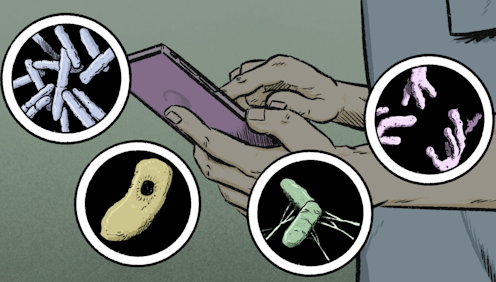
COVID-19 has seen the world embrace sanitisers and formal hand washing procedures in our private lives like never before. But even as we’ve thought more and more about surfaces and the hands that touch them as vectors for disease, mobile phones have largely escaped scrutiny.
We carry them everywhere (including the toilet) but they’re rarely cleaned or sanitised, and we touch them with our hands many, many times per day.
Lotti Tajouri explains what his research team found when they surveyed hospital staff about their phone use, the bacteria, viruses and parasites they found on swabbed phones, and the very personal reason he began this research.
Transcript:
My name is Dr Lotti Tajouri, associate professor in molecular biology and genomics in health science medicine at Bond University. I’m also a member of the Dubai Future Council for Community Security and the Dubai Police Scientist Research Committee.
The first time I actually got an interest in mobile phones as contaminated platforms was associated with my wife’s pregnancy. We came up to a situation where there was an emergency: my little girl was in breech while my wife was pregnant.
And we had to go very quickly to the theatre.
And what happened is when there was this preparation for the caesarean, I actually saw that there were some health care workers walking around with their mobile phones.
And really with the stress of the situation and knowing that I’m actually understanding clearly what is microbiology. I was really saying, “oh, there is a red flag here with some individuals, right there in the theatre, where there was my little girl about to be born”. Something was kind of wrong.
And of course, it’s nothing to blame the health care workers for, or how they do their job. The issue was that they don’t really know that mobile phones are actually contaminated with microbes.
So that was the very first time where I said to myself, “oh, I think I really need to do something about it”.
We did a survey within the hospital and we actually surveyed 165 health care workers, including doctors and nurses.
And we found something very interesting.
First of all, 98% of all those health care workers admitted that probably, indeed, their mobile phones are contaminated.
They are aware of that.
The other thing which was very interesting is their behaviour around mobile phones.
52% of them, out of 165 individuals used mobile phones in the bathroom and they used that for different reasons for media, social media, etc.
And the other very interesting statistic is that 57% of them never, ever washed their mobile phones.
We have also undertaken a massive amount of swabs of mobile phones.
And then what we wanted to do is, first of all, demonstrate that the microbes that are on the surface of mobile phones coming from health care workers, and if those microbes were viable or not.
After swabbing the mobile phones, we took around 30 mobile phones and we cultured them in different types of petri dishes.
It was very impressive.
If you look at the pictures that come up from those particular petri dishes, you see a huge amount of colonies coming out of it.
We found all sorts of types of bacteria: we found e.coli, demonstrating faecal contamination, we found pseudomonas aeruginosa (which is extremely resistant to different types of antibiotics), we found salmonella. We found listeria.
Even very, very interestingly, we found parasites, protozoa. One of them was, for example, entamoeba histolytica.
So those mobile phones are platforms that accommodate a huge panel, a huge spectrum of microorganisms that interact with each other and they are viable.
We started the video with me, for example, working in my office and holding the mobile phone and simulating a cough.
And with that cough, obviously, we deposited droplets on the surface of the mobile phone.
And then because we tend to text or touch our mobile phones, what would happen is that I would then obviously touch my keyboard, and do my whereabouts for my work, take a phone call or take a glass of water, etc.
And then after that, I decided, of course, to get out of my office and go, for example, to a kitchen.
And you will understand that because I touched my filthy mobile phone, I had actually the microbes on my hands.
And then when I went to the kitchen, and eat, and use whatever device I wanted to use, for example, the coffee machine. Well, the same again, you could see that spread going on again and again and disseminating itself in different areas.
Now, it will be natural for me once in a while to use the toilet. So then I decided to go to the bathroom. And same thing.
So in the bathroom, you’d touch different surfaces: the doors, the lid of the toilet.
So when you wash your hands, yes, your hands are clean. However, when you touch your filthy mobile phone, what happens is you contaminate yourself all over again.
The mobile phones are our third hand. Those ‘third hands’ needs to be ‘hand-washed or sanitised the same way as we ought to do with our two normal hands.
If we don’t decontaminate our mobile phones, it means that we negate the hand washing.
The solution is very simple.
At least, wipe off your mobile phone with a clean felt cloth, put a little bit of 70% isopropyl alcohol [on it]. But you have to be very careful when you wipe off your mobile phone with this type of material.
If you really want to clean your phone, never clean your phone when it is switched on, switch it off first. And the other advice I would tell you is probably to go back to your phone manufacturer recommendations, on how best you can clean your phone.
Our research, at Bond, is very clear. And this is also backed up by the literature. The best way forward [for public sector and industrial settings is] to sanitise your phone is by Ultraviolet C.
And there are some great technologies out there that do the job within 10 seconds, that will really be the solution for our community, for our health care workers and for any type of professional sector.
And my dream is to get the World Health Organisation, the CDC, etc. to embrace this technology.
To, first of all, understand that those mobile phones are actually probably transmitting diseases because those mobile phones are Trojan horses for the enemies that we carry with us all the time: all those germs.
Authors: Wes Mountain, Multimedia Editor


 Daily Bulletin


