

Remote learning is even harder when English isn't students' first language. Schools told us their priorities for supporting them
- Written by: Gary Bonar, Lecturer, School of Curriculum Teaching & Inclusive Education, Monash University
The COVID-19 pandemic has left large numbers of students, teachers and families grappling with the challenges of remote learning. Remote learning can be particularly challenging for students who are learning English as an additional language or dialect (EAL/D students).
We wanted to find out about schools’ experiences of teaching and supporting these students during the 2020 and 2021 lockdowns in Victoria. We interviewed ten classroom teachers and EAL/D curriculum leaders across primary and secondary levels in urban, regional and rural schools. We identified three key areas of concern for these students:
well-being – issues such as language barriers compounded their feelings of isolation and disconnection
access to resources such as digital devices, the internet and learning materials
loss of in-school structural supports.
These issues affect large numbers of students. About one in four primary and secondary school students in Victoria are from language backgrounds other than English. The proportion is similar in NSW.
We know from a range of studies that, even in the most favourable conditions, the reality of remote learning has often had a negative impact on students’ learning and well-being. Although the information about what works for online teaching is expanding, EAL/D-specific information is lacking.
Early findings from our ongoing research show that for many EAL/D educators complex social, emotional, material and geographic factors compounded the challenges of engaging EAL/D learners during remote learning. The following three points illustrate these challenges and how educators adapted.
Making well-being the priority
Student well-being was the most important consideration for these educators. It’s a prerequisite for real engagement in remote learning.
Schools are often a space of identity validation and belonging for new arrivals. The remote learning experience left many students feeling isolated and disconnected. This was sometimes compounded when issues such as low digital literacy and language barriers affected students’ support at home.
To overcome these issues, the role of teachers often expanded into areas such as supporting families by connecting with social services, mothers’ groups and foodbanks. This trend was even clearer in rural and regional areas where the school often became the central point of support for EAL/D students and their families.
Read more: Students’ well-being must always be the priority. Here are 5 tips to help them through lockdown
Well-being was also an issue for EAL/D educators and multicultural education aides (MEAs). Supporting students and families to navigate the new remote learning platforms and procedures was extremely difficult when resources and time were limited. EAL/D teachers often work part-time or across more than one school. As one participant said:
“We worked harder in remote learning than I’ve ever worked in my life in those early stages, and so I guess the learning curve was to sit back and say, ‘Hey, it’s okay. We can’t fix the world. We need to actually look after ourselves.’ ”
 The work that went into supporting students and families to navigate remote learning was exhausting for teachers and aides.
Shutterstock
The work that went into supporting students and families to navigate remote learning was exhausting for teachers and aides.
Shutterstock
Ensuring access to resources
Access to devices and the internet caused some issues in the initial remote learning phase. This gradually became less of a barrier as resources were distributed to families. All participants stressed the important role of education aides and interpreters in supporting teachers and students to use these devices effectively.
“They [students] struggle […] particularly at the secondary level. They struggle because the platforms that the secondary schools use are foreign to these students. So, in lockdown, it takes an enormous amount of time to upskill these students.”
Read more: Schools are moving online, but not all children start out digitally equal
Teachers and aides invested large amounts of time in developing resources in students’ first languages that were suitable for remote learning. This task of creating resources was even more challenging in areas with fewer multicultural education aides and interpreters due to relatively lower numbers of EAL/D students.
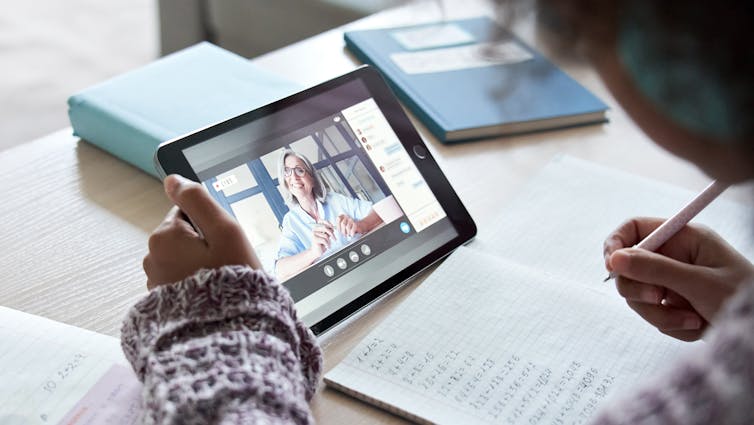 Early on, access to devices and the internet was a problem, but creating suitable learning resources took even longer.
Shutterstock
Early on, access to devices and the internet was a problem, but creating suitable learning resources took even longer.
Shutterstock
Overcoming loss of in-school support
How EAL/D students are integrated in mainstream classes also presented many challenges. In regular face-to-face teaching, these students may get support from peers or education aides to help them in classes such as humanities, science and mathematics. Providing this support in the online learning space often proved difficult.
If teachers of other subjects were not aware of strategies to support EAL/D students in their classes, this left some students feeling excluded, isolated and overwhelmed. Strategies can range from differentiating learning sequences to meet the learner’s needs, to providing structured opportunities for them to use their knowledge in and of other languages.
Participants also commented on how teaching strategies that help EAL/D learners in mainstream classes often greatly benefit all learners, including monolingual English speakers. Empowering all teachers with the knowledge and strategies to support EAL/D learners in both face-to-face and remote classes was a way to create inclusive environments for all students. As one participant said:
“So, they’ve got to understand – the teachers have to – instead of watching content, content, content and I’ve got to get this much done in five weeks, let’s relook and let’s have another think about this and see what we can do. What can we do differently so that they can access something in this curriculum? That they [the students] can bring something to it.”
Building on students’ strengths
A final key message is the importance of viewing EAL/D learners through an asset rather than a deficit lens. A deficit lens tends to frame students for what is “lacking” (English proficiency) and overlooks the rich linguistic and cultural repertoires of these students.
The notion of plurilingual competencies, where students are supported to use all their language knowledge to engage in learning, is a recent addition to the EAL curriculum in Victoria. This requires all teachers, not just EAL/D teachers, to develop an awareness of students’ plurilingual resources and encourage them to use this knowledge to enhance their learning.
School leadership can play a vital role here by supporting a whole-school approach to inclusive EAL/D practices.
Authors: Gary Bonar, Lecturer, School of Curriculum Teaching & Inclusive Education, Monash University


 Daily Bulletin


