

India’s 'love jihad' anti-conversion laws aim to further oppress minorities, and it's working
- Written by: Ghazala Jamil, Assistant Professor, Jawaharlal Nehru University
A new anti-conversion law passed in India’s most populous state, Uttar Pradesh, is being used to prevent inter-faith couples from getting married. Media reports suggest right wing groups are preventing interfaith marriages by claiming it involves “forced conversion”, or what they call “love jihad”.
“Love jihad” is a term used by these groups to suggest Muslim men seek to deceive Hindu women through marriage and convert them to Islam.
Under the new anti-conversion law, passed on November 28, interfaith couples must now give two months’ notice to a district official before getting married. Currently, under the Special Marriages Act, 1954, that governs interfaith marriages in India, couples must give a notice of 30 days.
The new law has criminal aspects, too, including a jail term of up to ten years if convicted of using marriage to force a spouse to change their faith. Parents, siblings and “any relatives” by marriage and adoption can complain against a conversion. Such marriages can also be nullified. The burden of proof lies on the persons converting, or those counselling the persons to convert, to prove the conversion isn’t forced.
Women’s rights advocates are pointing out this amounts to curtailment of the right to choose one’s partner by the state.
Under the Bhartiya Janata Party, also the ruling party at the federal level, eight of 29 states of India now have anti-conversion laws, including these interfaith marriage clauses. These laws seek to regulate religious conversions through “forcible or fraudulent means”, or through “allurement” or “inducement”. In practice, they restrain the citizens’ constitutional right to convert.
Read more: Holy cow: as Hindu nationalism surges in India, cows are protected but minorities not so much
A history of religious conversion in India
According to the Indian Constitution, citizens have the freedom to “profess, practice and propagate” religion. The word propagate must include the citizen’s right to convert.
However, the right to propagate and convert has come into contradiction with laws that restrict a citizen to do so. Anti-conversion laws have roots in India’s colonial history and the deep caste and communal fractures in its society.
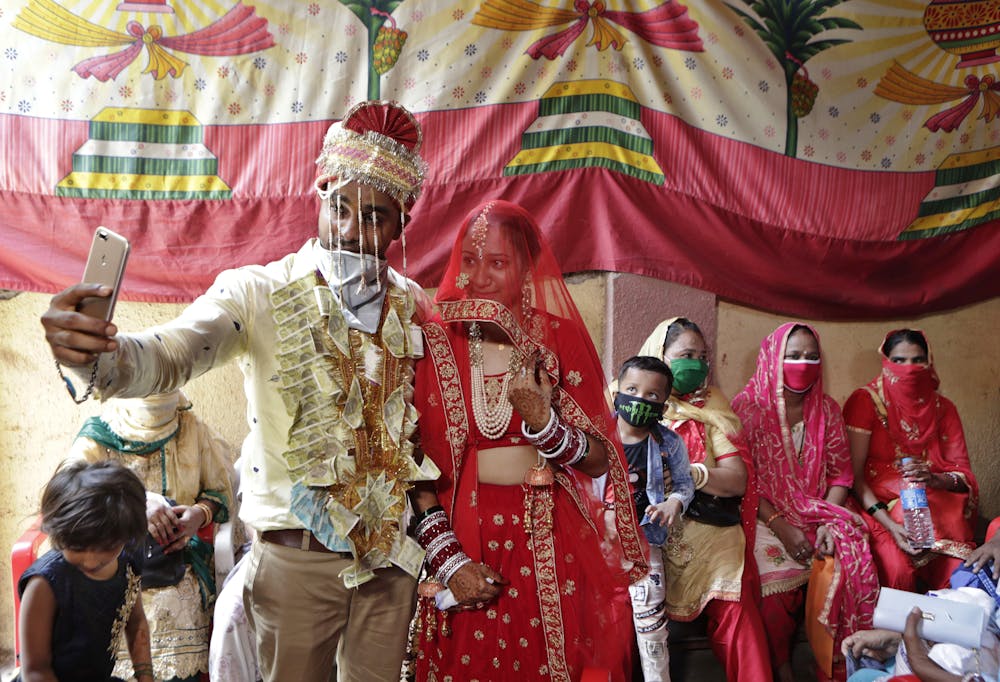 Interfaith marriages are already somewhat rare in India.
Rajanish Kakade/AAP
Interfaith marriages are already somewhat rare in India.
Rajanish Kakade/AAP
As in other parts of the world, the British and other European colonisers were accompanied by cultural missions to “civilize” natives in India.
Proselytizing Christian missionaries have traditionally focused their efforts on better living standards and education among the tribal (Indigenous) people of India.
In the 1950s, Indian social reformer Dr Bhim Rao Ambedkar promoted mass conversion to Buddhism as a way for the lower castes, who were considered “untouchable”, to escape the Hindu religious order and attain a more dignified life.
Ambedkar was a jurist and chairman of the committee that drafted the Constitution of India. He took up the cause of the “untouchables” within the anti-colonial movement in India, and made a crucial contribution in ensuring freedom of religious conversion was included in the constitution.
The first generation of anti-conversion laws, euphemistically called “Freedom of Religion” Acts, were passed in the late 60s and early 70s. They were enacted in states with higher tribal populations. However a few princely states in India (those governed by a local ruler or king, unlike other states that were ruled by the British before India’s independence) had similar laws in place even before the country became independent in 1947.
Read more: The problem with India's 'love jihad' laws
These laws were enacted to allay anxiety among the caste Hindus around conversion to Christianity and Islam, and later to stop the lower castes converting to Buddhism, in order to maintain the caste hierarchy.
Recent laws, though, are more forthright in their intent, and include “conversion for marriages”.
 The caste system in India designates the lowest caste as ‘untouchable’.
Altaf Qadri/AAP
The caste system in India designates the lowest caste as ‘untouchable’.
Altaf Qadri/AAP
How are the new laws being used?
The new laws have been passed in states where the Bhartiya Janata Party (the ruling party) has strong support. Through these laws, the ruling party’s agenda is to mobilise anti-Muslim sentiment in these states.
The case of the latest law in Uttar Pradesh shows the intensification of these tendencies due to upcoming state elections. As the most populous state, Uttar Pradesh sends the largest contingent of representatives to the Parliament of India. With the highest concentration of Muslims in the country, the state also had the highest number of Muslim MPs until 2014, when the ruling party swept the parliamentary elections by consolidating Hindu voters across caste divides.
The new anti-conversion laws, including the one in Uttar Pradesh, are being debated with the backdrop of a fake news campaign alleging Muslim men ensnare Hindu women with fraudulent marriages with the sole aim of overtaking the Hindu population to attain demographic majority status in India.
Read more: Indian Matchmaking: a show about arranged marriages can't ignore the political reality in India
However, what is being missed in the social commentary on these laws is the criminal penalty for mass conversions (defined as two or more) among lower castes and tribal people. Converting for the purpose of attaining a better education, job and lifestyle is being called “allurement”.
Through such discriminatory law-making, right wing forces in power are seeking to achieve their core agendas.
First, they seek to mobilise anti-minority sentiments by fanning the insecurities of the Hindu majority, polarising people and explicitly disenfranchising Muslim minorities.
Second, they wish to mount a backlash against the gains made by the feminist movement in achieving increased autonomy for women in a patriarchal society.
And last, but not least, they wish to covertly undermine the social mobility of the lower castes and tribal populations.
A repeal of these laws may not be enough to bring about social justice in India, but it is a necessary step.
Authors: Ghazala Jamil, Assistant Professor, Jawaharlal Nehru University


 Daily Bulletin


