

Could a France-style vaccine mandate for public spaces work in Australia? Legally, yes, but it's complicated
- Written by: Katie Attwell, Senior Lecturer, The University of Western Australia
Several jurisdictions overseas have introduced vaccine requirements for entry into public and private spaces such as schools, restaurants, public venues, and for domestic travel. Attention is turning to whether these policies would work in Australia and at what point they might be introduced.
An important consideration is whether the mandates are seeking to protect people against COVID transmission in key sectors or spaces, or whether governments are using them as a lever to push up vaccine rates in the population at large. While both can be legitimate, they are different policy goals and governments need to be transparent about which one they are pursuing.
Israel, the first jurisdiction to introduce a vaccine passport, has utilised this measure intermittently, depending on the transmission risk and coverage rates. This suggests the government has used it as a strategy to increase vaccine coverage overall.
EU countries are also utilising vaccine passports, but they have had design and implementation issues.
Despite ongoing protests to the measures in France, and to a lesser extent Italy, surveys show the majority of people in both countries approve of the measures. They have also led to a rapid increase in bookings for vaccinations.
New York City has also mandated vaccination for certain public spaces — the first government in the US to do so. There is a legal basis to do so: the Supreme Court ruled in 1905 that states could require residents to be vaccinated against small pox or be fined.
Can it be done here legally?
There is scope for Australian governments to impose a similar “vaccine passport”.
It’s important to bear in mind this kind of mandate is very different from forced vaccination (where an individual is forcibly inoculated). Rather, mandates create a set of negative consequences in cases of noncompliance.
The most obvious example in Australia is the “No Jab No Play” policies that restrict access to childcare in most states for children who are not fully immunised.
In the same vein, COVID-19 vaccination could be made mandatory for specific purposes, such as access to certain public or private spaces, travel, or certain types of employment, such as the pending vaccine requirement for aged care workers.
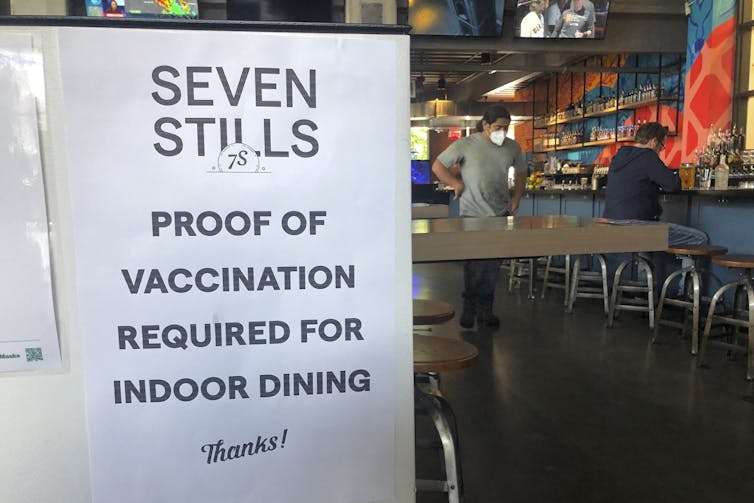 A proof of vaccination sign is posted at a bar in San Francisco.
Haven Daley/AP
A proof of vaccination sign is posted at a bar in San Francisco.
Haven Daley/AP
From a legal perspective, the key limitation for government mandates pertains to discrimination. The mandate must not discriminate, and therefore exemptions must be available for those who cannot be vaccinated for medical reasons.
There is no protection under Australian law, however, for “discrimination” against people who are opposed to vaccination because of their personal beliefs.
Countries like France and Italy have dealt with vaccine refusal by enabling people to show proof of a recent negative COVID test as an “opt-out” measure to the vaccine mandate. This is good behavioural science, since it makes the option available — albeit more burdensome — than the default of vaccination.
Read more: Can Australian employers make you get a COVID-19 vaccine? Mostly not — but here's when they can
Private sector vaccine mandates are also feasible in Australia for COVID-19 and other diseases. These mandates can apply to workers, clients, or both, provided they align with existing employment and consumer laws.
Unlike in the US, where many major companies are mandating COVID vaccines for employees, the measure is still framed in Australia as a possible exception to the general rule.
However, this could become more widespread in Australia after the Fair Work Commission ruled in several cases this year that it was reasonable for employers in the aged care and child care sectors to insist on flu vaccinations for staff.
Unsurprisingly, it looks like the Fair Work Ombudsman may be open to a tiered system of employment mandates.
How public and private mandates differ
Mandates may be easier to establish and implement in the private sector because companies are generally subject to less scrutiny and accountability than governments. They can also rely on arguments about their duty of care to workers and clients.
International research also shows the private sector is highly trusted, and this can provide a useful anchor if companies ask their workers or clients to vaccinate. (There is a difference, of course, between providing vaccinations at a workplace or requesting it of employees, and demanding it!)
Moreover, private companies lack some of the constraints that governments face. Government vaccine mandates must be linked to other conditions for which governments are responsible and accountable, such as the available supply of vaccines. A broad-based government mandate in the absence of adequate supply could be subject to court challenge and risk being political suicide.
By contrast, private entities do not share the same level of responsibility for providing vaccines when enacting such mandates on clients. In the case of vaccine mandates for employees, however, the duty to provide vaccines is much higher.
Accordingly, it is heartening that companies introducing employee mandates are taking steps to ensure their workers have easy and funded vaccine access. It would be great to see more companies doing this without introducing mandates first.
Despite the fact that private sector mandates may be easier to introduce, the complexity of exemptions and enforcement leads us to prefer government mandates.
Would Australians support vaccine mandates?
Our research shows Australians are broadly supportive of vaccine mandates, and our recent unpublished work indicates they prefer vaccine passports to other kinds of mandates (such as punishments or financial incentives).
Read more: Would Australians support mandates for the COVID-19 vaccine? Our research suggests most would
However, the high levels of support for government mandates we saw in our survey last year may not be the same now, given public perceptions of the government’s vaccine rollout failure. Australians may be less trusting of government, and therefore, less supportive of government-mandated vaccinations.
This demonstrates that the obstacles to the introduction of vaccine passports are not only legal, but highly political.
To appear legitimate, a mandate needs to serve clearly articulated public health goals and be proportionate. (In particular, it has to be effective, reasonable and without a less invasive alternative available.)
Mandates can be good public policy when they are appropriately designed and defensible from ethical and epidemiological perspectives. These attributes are largely within government control.
However, when governments do not take sufficient action to address hesitancy in the community, this can create the conditions that make mandates appear attractive or necessary. Our research shows this was the case in Italy with childhood vaccines.
The danger here is that all roads automatically lead to mandates, without governments first exhausting other important strategies to encourage vaccinations. Excellent public communications targeted to specific groups, and making access to vaccines as easy as possible, are two no-brainers.
Authors: Katie Attwell, Senior Lecturer, The University of Western Australia


 Daily Bulletin


