

Should the University of Melbourne host the Menzies Institute? The answer hinges on academic freedom
- Written by: Katharine Gelber, Professor of Politics and Public Policy, The University of Queensland
The University of Melbourne will open the Robert Menzies Institute, in honour of Australia’s longest-serving prime minister, in September this year. The presence of board members with close ties to the Liberal Party and the Menzies Research Centre has prompted protests from some students and academics. They question the appropriateness of the university hosting a platform, set up with A$7 million in federal government funding, that lauds Menzies’ achievements but overlooks negative aspects of his legacy.
The institute is a partnership between the university and the Menzies Research Centre, a self-described “think-tank that champions Liberal principles” that “is affiliated with the Liberal Party of Australia”. The institute’s board includes: Sky News commentator Peta Credlin, a former chief of staff to PM Tony Abbott; Geoffrey Hone, chair of the right-wing think-tank, the Institute of Public Affairs; and David Kemp, a former Howard government cabinet minister. A former chair of Qantas and a University of Melbourne pro vice-chancellor and dean also sit on the board.
Debates over the legacy of a former head of government and the governance of the institute are legitimate. However, would these concerns justify the exclusion of the institute from the university?
Read more: Universities and government need to rethink their relationship with each other before it's too late
Institutes named after PMs aren’t unusual
Australia has other institutes that honour former prime ministers.
The Whitlam Institute at Western Sydney University was established in 2000 under an agreement between the university and Gough Whitlam himself. Most of its funding has come from the university. The institute provides access to books and materials donated by its namesake, and hosts public lectures and events.
At Curtin University in Western Australia, the John Curtin Institute of Public Policy was established in 2004 for research, teaching and public engagement on public policy issues. It is named after Australia’s 14th prime minister, as is the university.
The University of South Australia hosts the Bob Hawke Prime Ministerial Library. It provides access to research materials and hosts public events and presentations.
In other countries, it’s normal to honour former heads of government in this way. In the United States, presidential libraries preserve historical materials and support research. Others set up their own, such as the Tony Blair Institute for Global Change.
As for the Menzies Institute, there are reasons why it might logically be located at the University of Melbourne. Menzies studied law there. After retiring from parliament he became its chancellor (1967-1972).
Being named after a former prime minister, then, does not appear to be a decisive negative against the institute.
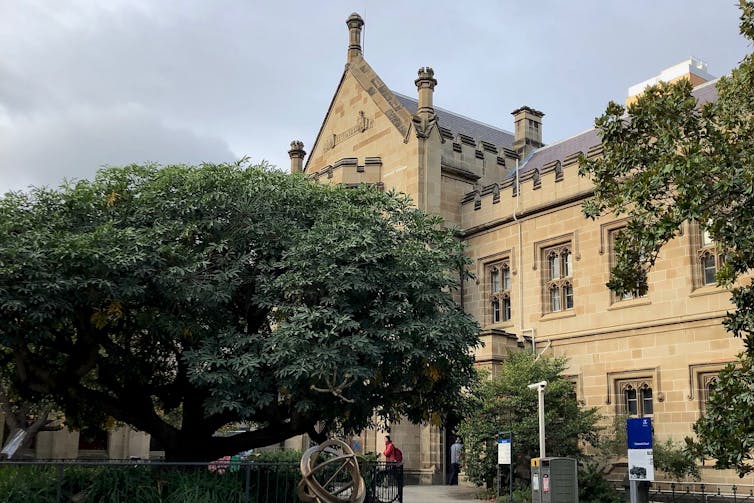 The Old Quad building, where Robert Menzies studied law at the University of Melbourne, will house the institute named after him.
Gracchus250/Wikimedia Commons, CC BY-SA
The Old Quad building, where Robert Menzies studied law at the University of Melbourne, will house the institute named after him.
Gracchus250/Wikimedia Commons, CC BY-SA
Governance and academic freedom
A key issue in locating an institute at a university is whether or not it preserves academic freedom. When industry and political figures from outside academia enter into partnerships with universities, they must do so in a manner that preserves academic freedom, regardless of political viewpoints.
This was the key point of dispute over proposals to establish programs in Western Civilisation, funded by the Ramsay Centre, in Australian universities. Its board includes former Liberal prime ministers John Howard as chair and Tony Abbott.
The Australian National University rejected such a program on the ground that it infringed academic freedom. The centre later established programs at other Australian universities, under conditions that appeared to preserve academic freedom.
Read more: ANU stood up for academic freedom in rejecting Western Civilisation degree
Academic freedom is a robust protection for activities of academics and students that are central to the mission of the university – the creation and dissemination of knowledge. These activities include:
- lecturing and choice of course content
- deciding what research to pursue
- publishing research findings
- classroom discussions and academic debates.
In turn, those whose activities are protected have responsibilities that include:
- providing evidence to back up claims
- conducting research with integrity using recognised and robust methods
- not engaging in unlawful or discriminatory conduct.
Read more: Book review: Open Minds explores how academic freedom and the public university are at risk
What does this mean for the Menzies Institute?
In practice, the principles of academic freedom will mean any Menzies Institute board members should have no structural means of determining the content of curriculums and research priorities – or publication of findings – of any academics or students at the university.
Details of the contract between the centre and the university are not public. But the institute’s website says it will curate papers, books and other artefacts in its collection. This represents no threat to academic freedom. In fact, it’s likely to improve access to these archival records.
The institute wants to create a hub for researchers. The key question here is whether it will do so in a manner that preserves academic freedom. With several academic staff members on the board, it appears the governance arrangements recognise this.
The institute also intends to host school visits and “develop curricula”. If that includes university curriculums, then of course while board members could make suggestions, they must not be given the ability to determine, or develop, the curriculum. Academic freedom demands that the academics responsible for learning and teaching decide all the detail on curriculum content, readings, questions, methods and approaches.
Finally, the institute wishes to organise public lectures and exhibitions, and host visiting professors. Again, these activities must be subject to the protections of academic freedom.
Funding can be a source of pressure
Funding is one obvious way in which pressure can be brought to bear on academic freedom. Some funding for the institute is coming from the University of Melbourne and the Menzies Research Centre, but its most generous benefactor is the federal Coalition government, which has provided A$7 million. No other comparable institute has received such a large sum.
In 2012, the Whitlam Institute received $7 million from the then federal Labor government. However, this funding was primarily for a historic building restoration, which included providing a permanent home for the institute 12 years after its founding.
 The historic Female Orphan School, which now houses the Whitlam Institute, in 2012 shortly before the federal government funded its restoration.
Gareth Edwards/Wikimedia Commons, CC BY-SA
The historic Female Orphan School, which now houses the Whitlam Institute, in 2012 shortly before the federal government funded its restoration.
Gareth Edwards/Wikimedia Commons, CC BY-SA
The Morrison government’s generosity seems slightly odd, given its reluctance to help a sector struggling with the loss of international student fee revenue. In 2020 it amended JobKeeper three times to ensure public universities were unable to claim it. The Job-Ready Graduates Package cut total funding for teaching in universities. Research is losing the cross-subsidy from teaching revenue.
Read more: Big-spending 'recovery budget' leaves universities out in the cold
The federal government has often been highly critical of universities. Critics would regard its institute funding as a ploy to influence research and engagement in a way that favours its preferred points of view. This is a reasonable suspicion, and the university needs to be alive to it.
Nevertheless, government funding is not a ground for rejecting the institute as long as it is “hands-off” and doesn’t require the institute or the university to violate academic freedom to receive it.
Finally, there is much room in Australian political discourse for a debate over the legacy of Robert Menzies. His time as prime minister (1939-41, 1949-66) spanned the second World War, the Cold War, the Vietnam war, the failed attempt to ban the Communist Party, and the civil rights movement. While the institute honours Menzies’ achievements, his critics point to his support for the White Australia policy, his agreement to test nuclear weapons with no regard for Indigenous owners or their Country, and his refusal to take a position against apartheid.
Universities are the right place for rigorous debates about this legacy. The key issue is whether the Menzies Institute’s funding and governance, which underpin the public debates it wishes to engage in, respect or infringe academic freedom. Time will tell.
Authors: Katharine Gelber, Professor of Politics and Public Policy, The University of Queensland


 Daily Bulletin


