

Fiji’s other crisis: away from the COVID emergency, political dissent can still get you arrested
- Written by: Dominic O'Sullivan, Adjunct Professor, Faculty of Health and Environmental Sciences, Auckland University of Technology and Professor of Political Science, Charles Sturt University
The arrest of nine Fijian opposition politicians, including party leaders and two former prime ministers, once again exposes Fijian democracy’s fragility. The intimidation doesn’t bode well for the parliamentary elections due next year (or early 2023).
The political crisis has been overshadowed by Fiji’s COVID-19 crisis, which has seen more than 25,000 infections and over 100 deaths since April. Prime Minister Frank Bainimarama even used a COVID analogy when he called those arrested “super-spreaders of lies”.
While no charges have been laid, the nine are accused of inciting unrest by opposing a government bill to change the management of iTaukei (indigenous) land rights.
The original iTaukei Land Trust Act 1940 allows for long-term land leases to private interests. The idea is to maximise the economic return on land, while protecting it against permanent alienation.
The act aims to protect indigenous interests by prohibiting the sub-lease or raising of mortgages on leased land without the consent of the iTaukei Land Trust Board.
The proposed amendment would remove the requirement to obtain the board’s consent, and prevent land owners going to court to dispute land use.
Arresting the opposition
Bainimarama, who also chairs the board, says the bill’s purpose is to remove bureaucratic obstacles to minor activities such as arranging electricity or water supply. He says the board takes too long to provide consent and this is a constraint on economic development.
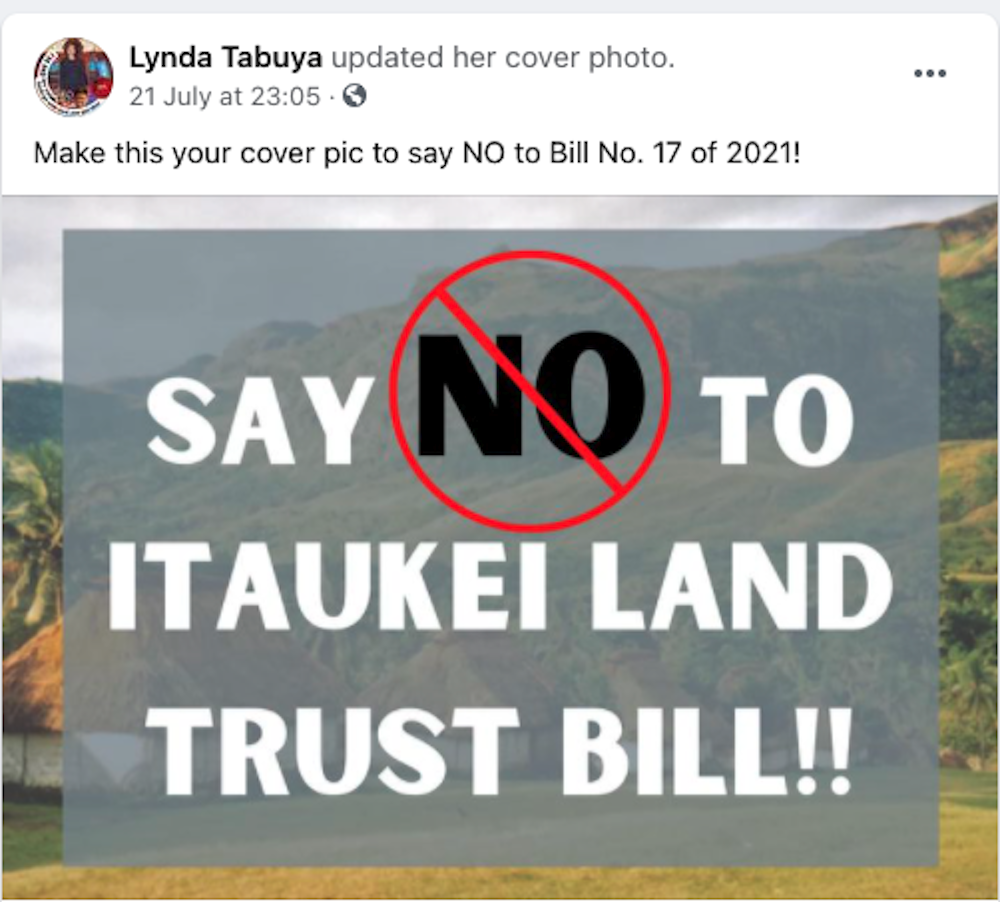 But critics of the bill, including some of those arrested, argue it will weaken iTaukei land rights. Opposition MP Lynda Tabuya was accused of a “malicious act” after she posted a “Say no to iTaukei Land Trust Bill” cover picture on Facebook last week.
In a separate post, demonstrating the low threshold for “malice” in modern Fiji, she asked:
What protection is left for landowners? This is absolutely illegal and a breach of human rights of landowners. This is not a race issue, this is a human rights issue and breaches Section 29 of the Fijian Constitution.
Tabuya is not alone. The National Federation Party has said the government has not properly consulted on the bill, and party leader Biman Prasad was among those arrested, along with former prime ministers Mahendra Chaudhry and Sitivini Rabuka.
Read more:
Two past coup leaders face off in Fiji election as Australia sharpens its focus on Pacific
Limited media scrutiny
Media coverage, too, has felt the effects of the arrests. For example, the Fiji Sun’s one story on the issue in its July 28 edition cited only supporters of the bill and offered no insight into why it was controversial.
This isn’t surprising, given Fijian journalism operates under a constitutional provision limiting its rights and freedoms “in the interests of national security, public safety, public order, public morality, public health or the orderly conduct of elections”.
Read more:
NZ journalists arrested in Fiji have been released but a new era of press freedom is yet to arrive
The Fiji Times took a risk last week by publishing an opinion column arguing poor drafting and failure to consult meant the bill goes further than its purported aims of administrative simplicity and efficiency.
Beyond the legal complexities of the land bill, however, the real problem is political. As the article asks, “What’s the issue?”.
As I discuss in my book Indigeneity: a politics of potential — Australia, Fiji and New Zealand, the issue is that Fiji is a fragile, reluctant and conditional democracy.
But critics of the bill, including some of those arrested, argue it will weaken iTaukei land rights. Opposition MP Lynda Tabuya was accused of a “malicious act” after she posted a “Say no to iTaukei Land Trust Bill” cover picture on Facebook last week.
In a separate post, demonstrating the low threshold for “malice” in modern Fiji, she asked:
What protection is left for landowners? This is absolutely illegal and a breach of human rights of landowners. This is not a race issue, this is a human rights issue and breaches Section 29 of the Fijian Constitution.
Tabuya is not alone. The National Federation Party has said the government has not properly consulted on the bill, and party leader Biman Prasad was among those arrested, along with former prime ministers Mahendra Chaudhry and Sitivini Rabuka.
Read more:
Two past coup leaders face off in Fiji election as Australia sharpens its focus on Pacific
Limited media scrutiny
Media coverage, too, has felt the effects of the arrests. For example, the Fiji Sun’s one story on the issue in its July 28 edition cited only supporters of the bill and offered no insight into why it was controversial.
This isn’t surprising, given Fijian journalism operates under a constitutional provision limiting its rights and freedoms “in the interests of national security, public safety, public order, public morality, public health or the orderly conduct of elections”.
Read more:
NZ journalists arrested in Fiji have been released but a new era of press freedom is yet to arrive
The Fiji Times took a risk last week by publishing an opinion column arguing poor drafting and failure to consult meant the bill goes further than its purported aims of administrative simplicity and efficiency.
Beyond the legal complexities of the land bill, however, the real problem is political. As the article asks, “What’s the issue?”.
As I discuss in my book Indigeneity: a politics of potential — Australia, Fiji and New Zealand, the issue is that Fiji is a fragile, reluctant and conditional democracy.
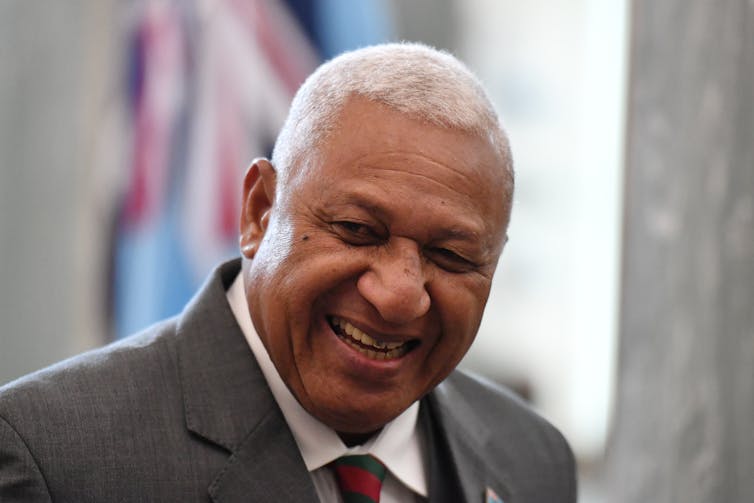 A military grip on power: Prime Minister Frank Bainimarama.
GettyImages
Military interference
Coups in 1987 and 2006, and a putsch in 2000, happened because democracy failed to provide the perpetrators with the “right” answers to complex political questions at the intersection of class, military power and personal interest.
The rights of indigenous Fijians were always a side issue, as the present conflict shows.
The 2013 constitution established that “it shall be the overall responsibility of the Republic of Fiji Military Forces to ensure at all times the security, defence and well-being of Fiji and all Fijians”.
Read more:
Bainimarama wins again in Fiji, helped by muzzling the media, unions and the church
Military oversight of the workings of government is intentional and explicit. When
Bainimarama (then head of the military forces) led the 2006 coup, he was dismissive of accusations of political interference. If the military didn’t act against the government, he said, “this country is going to go to the dogs”.
He also claimed then-prime minister Laisenia Qarase was trying to weaken the army by attempting to remove him: “If he succeeds there will be no one to monitor them, and imagine how corrupt it is going to be.”
No room to move
Intimidation is political strategy in Fiji. The proposed amendments to the iTaukei Land Trust Act are not what is at stake — a functioning parliamentary process could identify and resolve any substantive disagreements.
The bigger issue is that autocratic leadership, and the national constitution itself, leave little room for Fijian citizens to work out for themselves the kind of society they want.
This also leaves little room for Fijians to demand more effective policy responses to their country’s COVID-19 crisis.
A military grip on power: Prime Minister Frank Bainimarama.
GettyImages
Military interference
Coups in 1987 and 2006, and a putsch in 2000, happened because democracy failed to provide the perpetrators with the “right” answers to complex political questions at the intersection of class, military power and personal interest.
The rights of indigenous Fijians were always a side issue, as the present conflict shows.
The 2013 constitution established that “it shall be the overall responsibility of the Republic of Fiji Military Forces to ensure at all times the security, defence and well-being of Fiji and all Fijians”.
Read more:
Bainimarama wins again in Fiji, helped by muzzling the media, unions and the church
Military oversight of the workings of government is intentional and explicit. When
Bainimarama (then head of the military forces) led the 2006 coup, he was dismissive of accusations of political interference. If the military didn’t act against the government, he said, “this country is going to go to the dogs”.
He also claimed then-prime minister Laisenia Qarase was trying to weaken the army by attempting to remove him: “If he succeeds there will be no one to monitor them, and imagine how corrupt it is going to be.”
No room to move
Intimidation is political strategy in Fiji. The proposed amendments to the iTaukei Land Trust Act are not what is at stake — a functioning parliamentary process could identify and resolve any substantive disagreements.
The bigger issue is that autocratic leadership, and the national constitution itself, leave little room for Fijian citizens to work out for themselves the kind of society they want.
This also leaves little room for Fijians to demand more effective policy responses to their country’s COVID-19 crisis.
Authors: Dominic O'Sullivan, Adjunct Professor, Faculty of Health and Environmental Sciences, Auckland University of Technology and Professor of Political Science, Charles Sturt University


 Daily Bulletin


