

AstraZeneca advice has just changed (again). Here's what you need to know if you're in lockdown
- Written by: Nicholas Wood, Associate Professor, Discipline of Childhood and Adolescent Health, University of Sydney
Sydney’s COVID outbreak has just prompted official advice on the AstraZeneca vaccine to change to encourage more people to get fully vaccinated sooner.
Now, the Australian Technical Advisory Group on Immunisation (ATAGI) recommends people in outbreak areas have their booster shot at 4-8 weeks after their initial dose rather than wait for 12 weeks. ATAGI now also advises people in outbreak areas under 60 to “re-assess the benefits to them and their contacts” from getting an AstraZeneca vaccine now if the Pfizer vaccine is not available.
Advice for people outside outbreak areas remains unchanged.
Here’s how to make sense of the latest advice if you’re in an outbreak area.
The situation has changed
Getting vaccinated, like taking any medication, is a case of balancing the risks against the benefits. And clearly, when there’s a COVID outbreak such as Sydney’s, the potential benefit of vaccination just increased.
We know two doses of AstraZeneca vaccine (or the Pfizer vaccine) are really good at preventing you from serious disease and hospitalisation. There’s growing evidence COVID vaccines also reduce your chance of infecting others. And we know two doses are needed to improve your protection from the Delta variant, which is currently circulating in NSW.
Read more: Should I get my second AstraZeneca dose? Yes, it almost doubles your protection against Delta
Now let’s turn to the AstraZeneca vaccine. In parts of Australia with low rates of (or no) community transmission, the advice remains to wait 12 weeks after your initial dose for your booster shot. This is the time needed for your body to mount the best immune response.
However, as case numbers in Sydney have climbed, we’ve had calls from Prime Minister Scott Morrison, NSW Chief Health Officer Kerry Chant and Australia’s Chief Medical Officer Paul Kelly for people in outbreak areas to bring forward their AstraZeneca booster shots. Now ATAGI joins them.
Will I be protected if I go early?
Leaving less than 12 weeks between your first and second doses of AstraZeneca is a trade-off. There is slightly lower vaccine effectiveness against serious disease compared to if you’d waited for the full 12 weeks, but you will have some protection. In an outbreak, some reasonable protection now may be better than remaining unprotected while hanging out for greater immunity later.
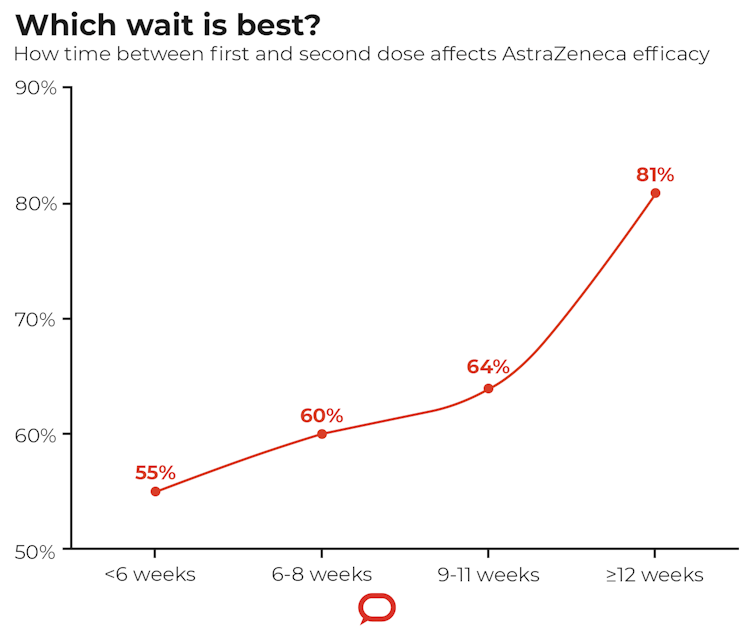
The difficulty is pinning down exactly how much the vaccine’s efficacy drops by going early. The only figures we have that chart the different lengths of time between AstraZeneca shots and the corresponding levels of vaccine efficacy come from earlier variants of the virus (before Delta). We don’t actually have the figures as they relate to the Delta variant, circulating in NSW right now.
With that caveat in mind, here’s the best data we have about how different gaps between first and second dose of AstraZeneca affect its efficacy. It’s the same data ATAGI has cited to explain its latest advice.
 The Lancet, CC BY-ND
If you’ve decided to go early with your booster shot, don’t worry if you can’t book an earlier appointment than 12 weeks. Your first shot has already started you on the protective road.
Read more:
Should I have my AstraZeneca booster shot at 8 weeks rather than 12? Here's the evidence so you can decide
What if I’m under 60?
Earlier advice was for Pfizer to be the preferred vaccine for people under 60. This was due to an increased risk of the rare blood clot syndrome known as TTS (thrombosis with thrombocytopenia syndrome) associated with the AstraZenenca vaccine in this age group. This advice is still current for most parts of Australia.
But in outbreak areas, ATAGI now advises people under 60 to consider having the AstraZeneca shot now, if the Pfizer vaccine is not available. Again, in an outbreak, starting on your road to becoming fully vaccinated may be better than hanging on for a Pfizer shot, which may not arrive for a few months.
Yes, people under 60 are at increased risk of those rare clots compared to older age groups. But the risks are still small, and you should balance that with the potential benefits of vaccination during an outbreak.
Risk estimates of TTS are updated regularly as new cases are reported. The latest figures show if you’re under 60, your risk of TTS is 2.6 per 100,000 doses. If you’re aged 60 or over, the risk is 1.6 per 100,000 doses.
Read more:
Concerned about the latest AstraZeneca news? These 3 graphics help you make sense of the risk
Your GP or vaccine provider will also discuss what to look out for should you experience these rare blood clots. If you have symptoms including: a new severe and persistent headache (appearing a few days after the vaccine or one that does not improve after simple painkillers, and which may be accompanied by nausea and vomiting), abdominal pain, pin-prick bruising or bleeding, chest pain, leg swelling or trouble breathing in the few days to few weeks after the AstraZeneca vaccine, you will need to seek medical advice.
This could be due to the rare clotting syndrome and the earlier it is recognised the earlier it can be treated.
Common side-effects from the AstraZeneca vaccine include headache, muscle aches, fatigue, fever and pain or redness at the injection site. These usually start in the first 24-48 hours after vaccination and may last a few days. You can manage these with over-the-counter medicines for fever and pain, such as paracetamol.
Read more:
A history of blood clots is not usually any reason to avoid the AstraZeneca vaccine
One last thing to think about
If you are having trouble booking in at your local GP clinic, you can attend one of the NSW mass vaccination hubs, which may be out of your local government area.
Although you are permitted to leave the home for medical care (including vaccination), please only do so if you have no COVID symptoms, however mild.
The Lancet, CC BY-ND
If you’ve decided to go early with your booster shot, don’t worry if you can’t book an earlier appointment than 12 weeks. Your first shot has already started you on the protective road.
Read more:
Should I have my AstraZeneca booster shot at 8 weeks rather than 12? Here's the evidence so you can decide
What if I’m under 60?
Earlier advice was for Pfizer to be the preferred vaccine for people under 60. This was due to an increased risk of the rare blood clot syndrome known as TTS (thrombosis with thrombocytopenia syndrome) associated with the AstraZenenca vaccine in this age group. This advice is still current for most parts of Australia.
But in outbreak areas, ATAGI now advises people under 60 to consider having the AstraZeneca shot now, if the Pfizer vaccine is not available. Again, in an outbreak, starting on your road to becoming fully vaccinated may be better than hanging on for a Pfizer shot, which may not arrive for a few months.
Yes, people under 60 are at increased risk of those rare clots compared to older age groups. But the risks are still small, and you should balance that with the potential benefits of vaccination during an outbreak.
Risk estimates of TTS are updated regularly as new cases are reported. The latest figures show if you’re under 60, your risk of TTS is 2.6 per 100,000 doses. If you’re aged 60 or over, the risk is 1.6 per 100,000 doses.
Read more:
Concerned about the latest AstraZeneca news? These 3 graphics help you make sense of the risk
Your GP or vaccine provider will also discuss what to look out for should you experience these rare blood clots. If you have symptoms including: a new severe and persistent headache (appearing a few days after the vaccine or one that does not improve after simple painkillers, and which may be accompanied by nausea and vomiting), abdominal pain, pin-prick bruising or bleeding, chest pain, leg swelling or trouble breathing in the few days to few weeks after the AstraZeneca vaccine, you will need to seek medical advice.
This could be due to the rare clotting syndrome and the earlier it is recognised the earlier it can be treated.
Common side-effects from the AstraZeneca vaccine include headache, muscle aches, fatigue, fever and pain or redness at the injection site. These usually start in the first 24-48 hours after vaccination and may last a few days. You can manage these with over-the-counter medicines for fever and pain, such as paracetamol.
Read more:
A history of blood clots is not usually any reason to avoid the AstraZeneca vaccine
One last thing to think about
If you are having trouble booking in at your local GP clinic, you can attend one of the NSW mass vaccination hubs, which may be out of your local government area.
Although you are permitted to leave the home for medical care (including vaccination), please only do so if you have no COVID symptoms, however mild.
 The Conversation, CC BY-ND
The last thing we want to see is people spreading COVID while trying to get vaccinated, with the potentially devastating impact on health-care workers, clinics and the wider community.
Read more:
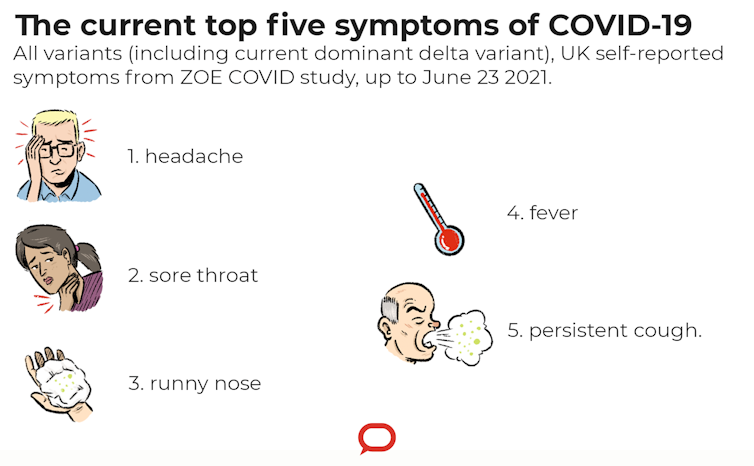
The symptoms of the Delta variant appear to differ from traditional COVID symptoms. Here's what to look out for
The Conversation, CC BY-ND
The last thing we want to see is people spreading COVID while trying to get vaccinated, with the potentially devastating impact on health-care workers, clinics and the wider community.
Read more:
The symptoms of the Delta variant appear to differ from traditional COVID symptoms. Here's what to look out for
Authors: Nicholas Wood, Associate Professor, Discipline of Childhood and Adolescent Health, University of Sydney
-here-s-what-you-need-to-know-if-you-re-in-lockdown&media=https://dailybulletin.com.au/https://images.theconversation.com/files/411183/original/file-20210714-25-13xx8xw.png?ixlib=rb-1.1.0&q=45&auto=format&w=754&fit=clip&description=AstraZeneca%20advice%20has%20just%20changed%20(again).%20Here's%20what%20you%20need%20to%20know%20if%20you're%20in%20lockdown "Pin It")

 Daily Bulletin


