

With Aung San Suu Kyi facing prison, Myanmar's opposition is leaderless, desperate and ready to fight
- Written by: Adam Simpson, Senior Lecturer, University of South Australia
As Aung San Suu Kyi finally faced court last week to defend herself against a litany of politically motivated charges, Myanmar is continuing its downward spiral into state failure.
Suu Kyi was arrested following the February 1 coup by the military and charged with alleged corruption, inciting public unrest and other offences. If she is found guilty, which is a near certainty, she may well be imprisoned for the rest of her life.
The popularity of Suu Kyi and her National League for Democracy (NLD) party have been consistently underestimated by a range of domestic and international analysts, and even by the Myanmar military itself. But her role will now change as her case takes a stop-start journey through the tightly held and persistently manipulated judicial process.
With Suu Kyi facing another lengthy detention, Myanmar’s diverse democracy movement is now operating independently of the NLD and its ageing leadership. Nearly five months after the coup, opposition to the junta is growing, but it is effectively leaderless and has been de-linked from Suu Kyi’s fate.
Most troubling, the evolving crises facing the long-suffering people of Myanmar are not just framed by political repression and violence. They include the heavy burdens of poverty, food shortages and unemployment, along with the collapse of the healthcare and education systems.
The coup-makers have put their own narrow interests — eliminating the NLD and retaining absolute power — in front of everything else. Even the COVID-19 pandemic receives almost no attention under the current conditions.
It is no wonder millions of Myanmar people are so angry and fed up — and why some are looking for more violent solutions. There is now potential for the country’s smouldering civil wars in its mountainous borderlands to spread into its major cities.
Increasing violence on both sides
The ongoing reign of terror by the military junta includes the recent burning of more than 200 homes in a village in central Myanmar and the tortures and deaths of at least 21 detainees.
Altogether since the start of the coup, some 900 people have been killed during protests or other activities and almost 5,000 others are currently detained.
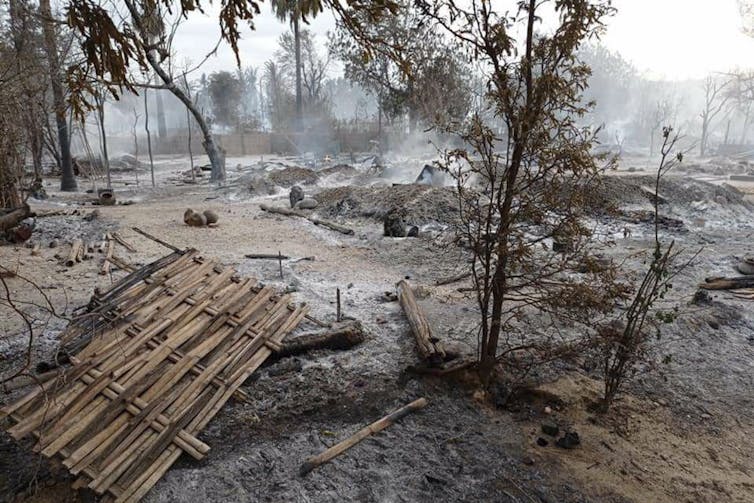 Smouldering houses in Kinma village after military troops burned it the night before.
AP
Smouldering houses in Kinma village after military troops burned it the night before.
AP
In response, there is a growing militancy among some civilians, with the establishment of people’s defence forces across Myanmar.
In addition, ethnic armed groups in Myanmar’s periphery, some of which have been at war with the military since the 1940s, have joined forces with the protest movement. For the first time since the 1988 uprising against the military, civilians from the Bamar (Burman) ethnic majority are now being trained by these groups or have enlisted with them.
Attacks on government forces include bombings, targeted assassinations of village administrators and those seen to support the junta, and the killing of 25 alleged “undercover soldiers” by an ethnic armed group in Kayin (Karen) State.
The United Nations has expressed alarm at the “recent acts of violence that illustrate a sharp deterioration of the human rights environment across Myanmar”.
Some seasoned analysts have argued the increasing militancy of the military’s opponents may cause problems for the protest movement, with the junta better able to paint them as terrorists and the international community becoming uncomfortable supporting a violent “terrorist” movement.
A pragmatic response is for the political wings of the opposition, including the exiled national unity government, formed by the NLD and ethnic minority representatives, to ensure there is adequate distance between themselves and any violent operations.
This is a standard model in Myanmar’s long decades of conflict, as seen with the separation of the civilian and military wings of various ethnic minority organisations such as the Karen National Union and Karen National Liberation Army.
The model obviously presents risks, however, as civilian leaders can expect to be held to account for the activities of their militant peers.
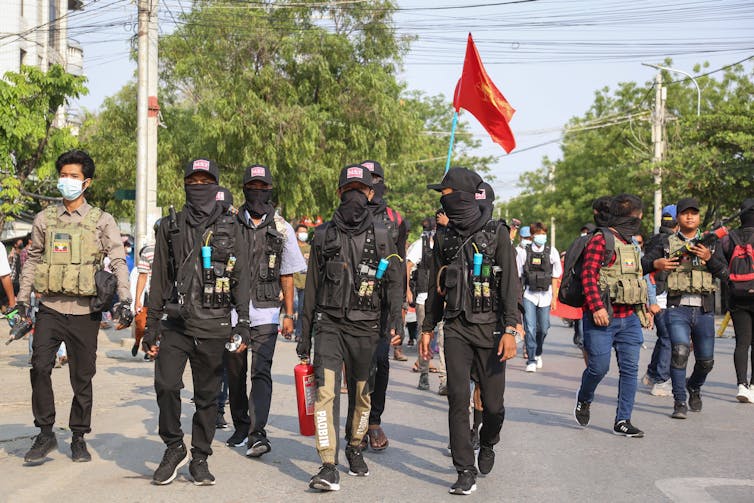 Demonstrators carrying homemade weapons march during an anti-military protest in Mandalay in April.
Stringer/EPA
Demonstrators carrying homemade weapons march during an anti-military protest in Mandalay in April.
Stringer/EPA
Some faint hopes of reconciliation
In the hope of rehabilitating the patchy reputation of Myanmar’s democrats as a force for human rights, the national unity government announced a seismic shift in official policy toward the Muslim Rohingya community in early June.
The government pledged to implement a new citizenship act that bases “citizenship on birth in Myanmar or birth anywhere as a child of Myanmar citizens”. This should effectively offer Rohingya and some other ethnic minorities full citizenship for the first time.
This statement is part of a broader shift in public sentiment regarding the Rohingya across most of Myanmar. Until recently, they have been largely friendless in the country, enduring decades of discrimination and repression. This included the brutal clearance operations in 2017 that led to 740,000 refugees fleeing into Bangladesh in a matter of months.
The coup has resulted in a reassessment of the treatment of the Rohingya. A recent social media campaign, for instance, featured people wearing black and adopting the three-fingered salute of the opposition under the “Black4Rohingya” hashtag.
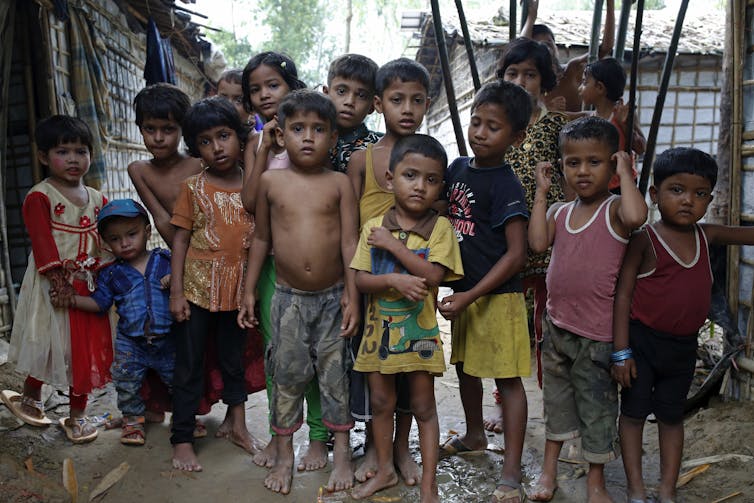 Rohingya refugee children at a makeshift camp in Bangladesh in 2018.
MONIRUL ALAM/EPA
Rohingya refugee children at a makeshift camp in Bangladesh in 2018.
MONIRUL ALAM/EPA
International response must be stronger
These positive developments come at a time when the international community appears increasingly powerless to effect positive change in Myanmar.
Calls to ban arms exports and economic engagement with the military are growing much louder. But direct material support for the Myanmar’s democrats will be just as important, as will the creation of a viable model of regional diplomacy.
The Association of Southeast Asian Nations (ASEAN) has again proved too slow and inept when faced with a serious test of its mandate.
An important UN General Assembly resolution on June 18 calling on “all member states to prevent the flow of arms into Myanmar”, meanwhile, passed with an overwhelming majority. However, several ASEAN members, along with Russia and China (Myanmar’s major arms suppliers), abstained.
The courage and creativity of the protesters and the civil disobedience movement have already won them much credit with Myanmar’s desperate population. But in the months ahead, this alone will not be enough to succeed.
A genuinely pan-ethnic, society-wide coalition is needed, along with well-timed and properly targeted support internationally, to have any chance of ending military dominance in Myanmar once and for all.
Authors: Adam Simpson, Senior Lecturer, University of South Australia


 Daily Bulletin


