

Our research shows COVID has made Australians more conservative and care less about others
- Written by: Julie Anne Lee, Professor in Marketing, Founding Director of the Centre for Human and Cultural Values, and Director of Research at the UWA Business School, The University of Western Australia
The COVID-19 pandemic has already changed so many things about our society and our lives. While some of the impacts can be seen clearly and straight away, others take more digging.
Our new research, based on surveys with Australians before and during the pandemic, suggests COVID also shifted our values. This is surprising because values in adulthood rarely change.
It is also concerning as it showed as a society, we have become less caring and less open to new ideas.
Our research
As part of a larger project at the Centre for Human and Cultural Values, we asked Australian adults aged 18-75 how important different values are in their life.
We asked the same questions to the same group in 2017, 2018, and 2019. When the pandemic started, we were able to ask them the questions early on (April, 2020) and again in November-December 2020. During the pandemic, we also asked how worried respondents were about getting the virus.
 Values in adulthood rarely change, but can be shifted by major events.
Erik Anderson/AAP
Values in adulthood rarely change, but can be shifted by major events.
Erik Anderson/AAP
We began with a near nationally representative sample of more than 2,300 people, who answered our survey from 2017 onwards. More than half (1,440 people) also responded in the last round in November-December 2020.
This gave us a rare opportunity to look at what impact the pandemic may have had on Australians’ values.
What are values?
Values are broad goals relating to things we think are desirable or worthy, like kindness, safety, adventure or success. There are no “bad” values, but our values can lead us to prioritise very different things.
We may not think about our values all the time, but they direct our way of thinking, and even our behaviour. They direct everyday decisions, such as whether to help a friend in need, or throw an item in the recycling bin. They also guide major decisions, such as which party to vote for, and which profession to choose.
Based on the work of psychologist Shalom Schwartz, our research grouped values into four categories.
- Self-transcendence — seeking to care for the welfare of others and nature
- Self-enhancement — seeking self-interest through ambition, success, and control
- Conservatism — seeking to preserve the status quo through traditions, compliance, and security
- Openness to change — seeking creativity, independence, novelty, and excitement
We care less about others
Our research found the values that motivate us to care for people and for nature (“self-transcendence”) were stable before 2020 and very early in the pandemic. But they decreased significantly in importance by late 2020.
One possible explanation is people who worried about what COVID might mean for them became especially less caring about the people around them. After suffering months of worry, lockdowns, border closures, and social distancing, people were less likely to prioritise others over themselves.
We are more conservative
We also found values that prioritise maintaining the status quo (“conservation”) were stable prior to COVID, but increased in importance early in 2020.
When the pandemic started, Australians immediately started prioritising safety and security, and traditions around one’s family, culture and religion. The increased importance of conservative values may have helped to motivate compliance with the new pandemic health and safety rules.
Again, this trend happened more in people who were worried about getting COVID early in the pandemic.
Read more: How the pandemic has brought out the worst — and the best — in Australians and their governments
While the increase in importance of these more conservative values lingered later in the pandemic, this increase was no longer associated with worry over getting COVID.
In fact, it was somewhat surprising that the increase in more conservative values lingered throughout 2020, given that the pandemic situation in Australia was largely under control. This shows the pervasiveness of subtle changes taking place as a consequence of the pandemic.
Reassessing our priorities
Early in the pandemic, as more conservative values increased in importance, opposing values like adventure, excitement and enjoyment (“openness to change”) became less important for Australians.
Later in 2020, in contrast to the more conservative values that remained more important than before the pandemic, the importance of “openness to change” values began to change.
While people continued to disregard values that promote pleasure and enjoyment, values that prioritise independence and intellectual pursuits increased in importance. This suggests the pandemic restrictions may have led people to critically examine what’s important in life, and to seek out interesting things they can do independently of others.
COVID has changed us — and done it quickly
Our study shows major events such as the COVID pandemic can change values in society in a relatively short period of time.
Central to these value changes appear to be worries about getting infected, which was linked to more conservative values, less openness values, and decreased importance of values related to caring about others and the environment.
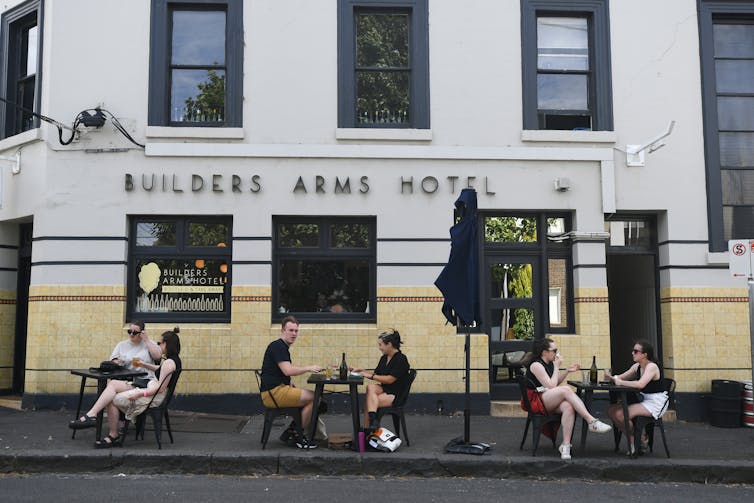
 The pandemic saw people less likely to prioritise others over themselves.
Darren England/AAP
The pandemic saw people less likely to prioritise others over themselves.
Darren England/AAP
As values have been linked with social and political opinions and voting, these changes have important implications for Australian society.
Australians may vote more conservatively as a result. It’s noted that pandemic elections have seen Australians back incumbents (whether they be Coalition or Labor). Although interestingly, both the successful Queensland and West Australian ALP governments have had very tough state border regimes.
If these value changes linger on, we might see people objecting more to immigration, caring less about human rights, and being less likely to enact random acts of kindness. Indeed, separate survey results have already shown many Australians back the strict international border controls during COVID.
We may also see less volunteering and donations to a wide range of causes. We know volunteering rates have dropped since COVID hit Australia, and are yet to recover.
Our findings suggest the pandemic has significantly affected our values. Follow up surveys will be critical to understand our values as we emerge from the pandemic.
Authors: Julie Anne Lee, Professor in Marketing, Founding Director of the Centre for Human and Cultural Values, and Director of Research at the UWA Business School, The University of Western Australia


 Daily Bulletin


