

Australia needs construction waste recycling plants — but locals first need to be won over
- Written by: Salman Shooshtarian, Research Fellow, RMIT University
Strong community opposition to a proposed waste facility in regional New South Wales made headlines earlier this year. The A$3.9 million facility would occupy 2.7 hectares of Gunnedah’s industrial estate. It’s intended to process up to 250,000 tonnes a year of waste materials from Sydney.
Much of this is construction waste that can be used in road building after processing. Construction of the plant will employ 62 people and its operation will create 30 jobs. Yet every one of the 86 public submissions to the planning review objected to the project.
Residents raised various concerns, which received widespread local media coverage. They were concerned about water management, air quality, noise, the impact of hazardous waste, traffic and transport, fire safety and soil and water. For instance, a submission by a local businessman and veterinary surgeon stated:
“The proposed facility is too close to town, residences and other businesses […] Gunnedah is growing and this proposed development will be uncomfortably close to town in years to come.”
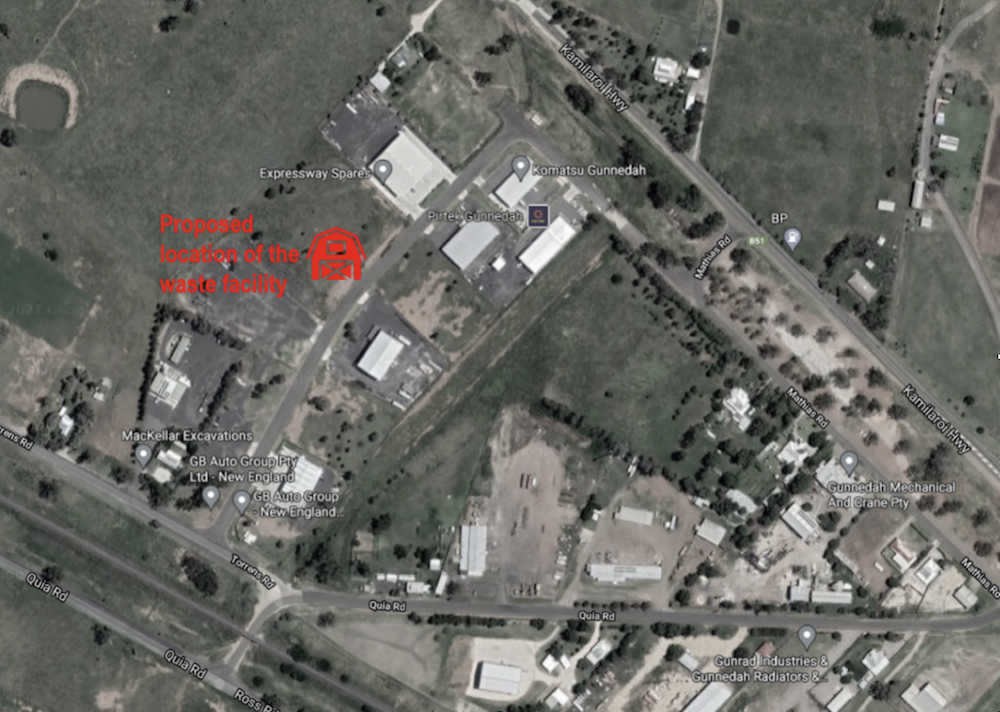 The location of the proposed waste recycling facility in Gunnedah.
Source: Google Maps (2021), Author provided
The location of the proposed waste recycling facility in Gunnedah.
Source: Google Maps (2021), Author provided
The general manager of the applicant said descriptions such as “toxic waste dump” were far from accurate.
“It’s not a dump […] Its prime focus is to reclaim, reuse and recycle.”
He added: “[At present] the majority of this stuff goes to landfill. What we’re proposing is very beneficial to the environment, which is taking these resources and putting them back into recirculation. The reality is the population is growing, more waste is going to get generated and the upside is we’re much better processing and claiming out of it than sending it to landfill.”
Read more: We create 20m tons of construction industry waste each year. Here's how to stop it going to landfill
Why are these facilities needed?
According to the latest data in the National Waste Report 2020, Australia generated 27 million tonnes of waste (44% of all waste) from the construction and demolition (C&D) sector in 2018-19. That’s a 61% increase since 2006-07. This waste stream is the largest source of managed waste in Australia and 76% of it is recycled.
However, recycling rates and processing capacities still need to increase massively. The environmental impact statement for the Gunnedah project notes Sydney “is already facing pressure” to dispose of its growing construction waste. Most state and national policies – including the NSW Waste Avoidance and Resource Recovery Strategy 2014-2021, NSW Waste and Resource Recovery Infrastructure Strategy and 2018 National Waste Policy – highlight the need to develop infrastructure to effectively manage this waste.
Read more: The 20th century saw a 23-fold increase in natural resources used for building
Why, then, do people oppose these facilities?
Public opposition to new infrastructure in local neighbourhoods, the Not-in-My-Back-Yard (NIMBY) attitude, is a global phenomenon. Australia is no exception. We have seen previous public protests against waste facilities being established in local areas.
The academic literature reports the root causes of this resistance are stench and other air pollution, and concerns about impacts on property values and health. Factors that influence individuals’ perceptions include education level, past experience of stench and proximity to housing.
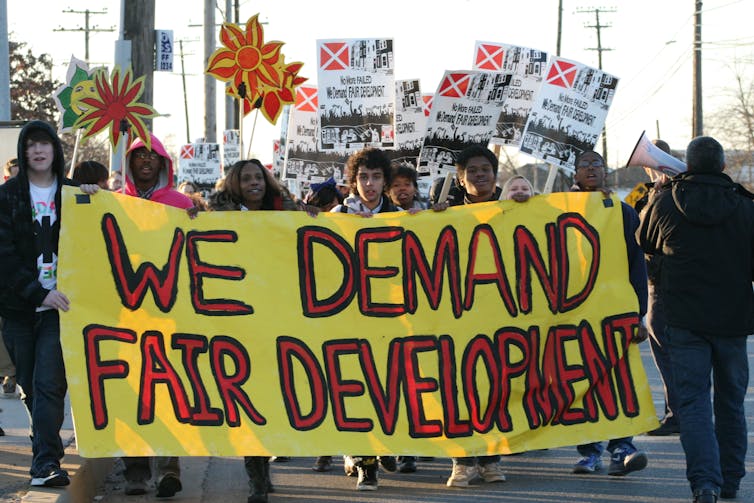 Local communities around the world have protested against local waste management plants that they see as a threat to their health.
United Workers/Flickr, CC BY
Local communities around the world have protested against local waste management plants that they see as a threat to their health.
United Workers/Flickr, CC BY
What are the other challenges of recycling?
Our research team at RMIT University explore ways to effectively manage construction and demolition waste, with a focus on developing a circular economy. Our research shows this goal depends heavily on the development of end markets for recycled products. Operators then have the confidence to invest in recycling construction and demolition waste, knowing it will produce a reasonable return.
Read more: The planned national waste policy won't deliver a truly circular economy
A consistent supply of recycled material is needed too. We believe more recycling infrastructure needs to be developed all around Australia. Regional areas are the most suitable for this purpose because they have the space and a need for local job creation.
To achieve nationwide waste recycling, however, everyone must play their part. By everyone, we mean suppliers, waste producers, waste operators, governments and the community.
Today we are facing new challenges such as massive urbanisation, shortage of virgin materials, increasing greenhouse gas emissions and bans on the export of waste. These challenges warrant new solutions, which include sharing responsibility for the waste we all generate.
Read more: A crisis too big to waste: China's recycling ban calls for a long-term rethink in Australia
What can be done to resolve public concerns?
Government has a key role to play in educating the public about the many benefits of recycling construction and demolition waste. These benefits include environmental protection, more efficient resource use, reduced construction costs, and job creation.
Government must also ensure communities are adequately consulted. A local news report reflected Gunnedah residents’ concern that the recycling facility’s proponent had not contacted them. They initiated the contact. One local said:
“I do understand the short-term financial gains a development like this will bring to the community, but also know the financial and environmental burden they will cause.”
Feedback from residents triggered a series of consultation sessions involving all parties.
A robust framework for consulting the community, engaging stakeholders and providing information should be developed to accompany any such development. Community education programs should be based on research.
For instance, research indicates that, unlike municipal waste recycling facilities, construction and demolition waste management facilities have negligible to manageable impact on the environment and residents’ health and well-being. This is due to the non-combustible nature of most construction materials, such as masonrt.
Such evidence needs to be communicated effectively to change negative community attitudes towards construction and demolition waste recycling facilities. At RMIT, through our National Construction & Demolition Waste Research and Industry Portal, we continue to play our part in increasing public awareness of the benefits.
Read more: With the right tools, we can mine cities
Authors: Salman Shooshtarian, Research Fellow, RMIT University


 Daily Bulletin


