

Where is Australia at with the COVID vaccine rollout? Our interactive shows how we compare with the rest of the world
- Written by: Sunanda Creagh, Head of Digital Storytelling
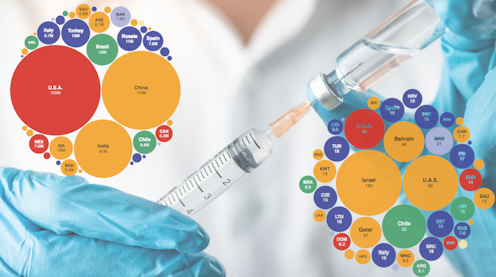
As COVID vaccination programs roll out around the world, our new interactive tool allows you to see where each country is at with its immunisation program. Using data from Our World in Data, you can see how each country is performing when it comes to:
Due to some limitations with the source data, not all countries are shown. Our World in Data explains how they collect their data, which is being used by the WHO, over here. We’ve shown data as of March 28 below because that’s the latest data set available that’s relatively complete for a good range of countries.
Australia has administered about 600,000 doses at the time of writing (although, as shown on the interactive, it was 510,000 on March 28). That is a long way short of the target set by the prime minister to administer 4 million doses by the end of March.
Data visualisation: Kaho Cheung. Data source: Our World in Data https://ourworldindata.org. Australian data via https://covidlive.com.au/.The Conversation asked Hassan Vally, an epidemiologist and infectious diseases expert, to reflect on what the data reveal at date of this article’s publication.
Here’s what he told us:
This visualisation provides a useful and easy way to track where countries are at in their COVID vaccine rollouts.
We are in the midst of one of the largest logistical exercises in world history and it’s easy to drown in the sheer magnitude of the numbers.
The numbers are astounding even though we have only just begun. As of March 31, we have delivered about 574 million doses of the vaccine across 141 countries across the globe, reaching 3.7% of the population.
Total doses administered
The United States has done extremely well in terms of the total number of doses given. It has clearly administered the most doses so far in total.
President Joe Biden promised to deliver 100 million doses of vaccine by his 100th day in office, which was achieved by March 19, approximately six weeks ahead of schedule. Regardless of how hard a marker you are, given the obstacles in the US, this is an impressive achievement.
China comes in second, having recently passed a significant milestone of delivering more than 100 million doses of the vaccine. The numbers of people currently being vaccinated each day are extraordinary, with goals to increase delivery to more than 10 million doses per day and immunise 40% of the population by June.
India comes in next at around 61 million doses, which is impressive given the unique challenges it faces.
The United Kingdom is also doing well on total number of doses given. After these countries, you have Brazil a fair way back at about 18 million doses at the time of writing, and then a pack of countries further back.
Read more: Vital Signs: Israel shows how to do vaccinations right. It's a race, and we're behind
Total doses given per 100 people
A different picture emerges when you adjust the data for the population sizes of countries by looking at the number of doses given per 100 people.
As has been well publicised, Israel leads the pack by a fair margin.
United Arab Emirates is doing really, as is Chile, the UK, Bahrain and the US.
Interestingly, the large countries such as China, India and the US that have delivered large total amounts of vaccine fall back from the lead when you adjust for population size.
Taking into account the size of countries to better assess the progress of the vaccination programs highlights the benefit of having a smaller population size and small geographical size.
Wealthier countries are ahead
This interactive tool also highlights that wealthier countries are generally ahead of poorer countries when it comes to the vaccination rollout. Unless addressed, that’s going to be a significant problem. Until the pandemic is stamped out everywhere, huge risks remain for all countries.
Global equitable access to vaccines is the right thing to do. But it’s also in the interests of rich nations, too. As the WHO says:
With a fast-moving pandemic, no one is safe, unless everyone is safe.
It’s fantastic to see Australia playing its role as a good regional citizen by providing vaccines and assistance to PNG to help deal with their serious COVID situation. One could argue however, that we could and should be doing more.
How’s Australia doing compared with the rest of the world?
At first glance, Australia looks to be tracking poorly compared to the rest of the world.
However, context is really important. We need to remember Australia is virtually COVID-free, making it the envy of the world.
We have access to two good vaccines suitable for all age groups, and the immunisation program has begun.
Although things have started slowly and we are behind where we would like to be, our slow start will likely ramp up significantly in the coming weeks.
It is significant that we have now entered phase 1b of the rollout, which means many millions more are now eligible to get the vaccine. We have also now started onshore vaccine production, which ensures vaccine supplies into the future.
Yes, there have been frustrations. But unlike many places, Australia has the luxury of time to carefully and safely deliver the vaccines due to our excellent performance so far in containing the spread of COVID-19.
Authors: Sunanda Creagh, Head of Digital Storytelling


 Daily Bulletin


