

After Oprah: what will it take to revive an Australian republic?
- Written by: Jenny Hocking, Emeritus Professor, Monash University
Oprah Winfrey’s brilliantly stage-managed “tell-all” interview with Meghan Markle and Prince Harry was for viewers, advertisers and the three participants, a tremendous success.
For the royal family, not so much. Globally, the interview’s audience was “gargantuan”. It was watched by nearly 50 million people as it went to air and in Australia, was Network Ten’s highest rating special in a decade. This remarkable reach continues to climb with millions of viewers on demand and, of course, generating its own hashtag — #OprahMeghanHarry.
Royalty as American celebrity had truly arrived.
Although it is easy to dismiss this interview as a cynical marketing exercise, it raises important questions about the contemporary role and relevance of the royal family in a modern liberal democracy, and Australia’s place in the arcane system of constitutional monarchy.
In doing so, it has added to the momentum for an Australian republic, highlighting the incongruity of the British monarch as the Australian head of state through the right of monarchical succession and not as the choice of the Australian people.
Palace secrecy
Above all, this interview broke through the armour of secrecy, the carefully constructed royal image, which is the monarchy’s great protector. This is #OprahMeghanHarry’s most important contribution beyond the celebrity circuit — the breach of royal secrecy that has given us a window onto the inner workings of “The Firm”.
What we saw there was not at all pleasant.
Among the litany of damaging claims aired are that Markle had faced the repeated leaking of false claims about her to select royal watchers in the media. This ranges from the petty — “Meghan made Kate cry!” — to more serious claims of bullying.
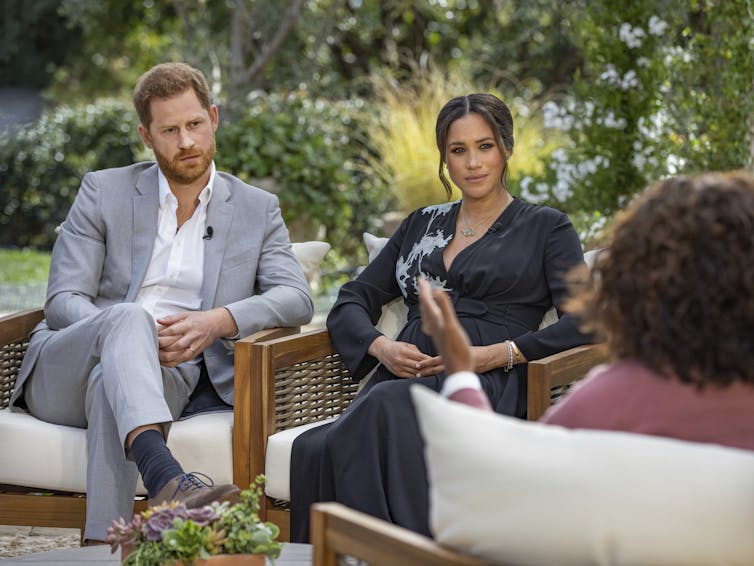 Almost 50 million people worldwide watched the Sussexes’ tell-all with Oprah Winfrey as it went to air.
Jo Pugliese/AP/AAP
Almost 50 million people worldwide watched the Sussexes’ tell-all with Oprah Winfrey as it went to air.
Jo Pugliese/AP/AAP
More disturbing, however, is Meghan’s description of isolation, powerlessness and depression, culminating in suicidal thoughts during her pregnancy. When she sought help from Buckingham Palace officials, she was told it would look bad for the monarchy if it were known she was having treatment for mental health issues. “Suck it up, princess”, literally.
Then came the claim by both Harry and Meghan that there had been “concerns and conversations” with a senior member of the royal family about the colour of their child while Meghan was pregnant.
Whaaatttt?
Oprah’s perfectly timed response hung in the air just long enough to hook us all back in, after the (very long) ad break.
Race and royalty
Race had been a peculiar fascination in the relentless media focus on Markle, escalating dramatically when she was first linked with Harry. One of the most overt, and it was just one of thousands, was the Daily Mail’s depiction of the fairy-tale “upward mobility” of Meghan’s family: from “cotton slaves to royalty” in just 150 years, with an accompanying family tree pointing to the “mulatto” antecedents of her “dirt poor” forebears.
That there would be “shocks” from the renegade royals’ interview was widely anticipated, but what was actually revealed during these coruscating two hours was never imagined. This was devastating, brutal and highly damaging.
Read more: The royal family can't keep ignoring its colonialist past and racist present
Just two weeks before the interview aired, an early blow to Meghan’s reputation was struck with claims she had “bullied” staff at Buckingham Palace and “undermined their confidence”. These were leaked to preferred royal watchers in the British media. The palace immediately instituted a full investigation into these anonymous claims, stating it was “very concerned”.
It is notable no such investigation has been called into the relationship between Prince Andrew and Jeffrey Epstein, the late disgraced financier and convicted paedophile. Nor was any undertaken into Markle’s own claims of racial comments about her child. Those would be dealt with “privately”, the queen announced.
As Birmingham City University professor of Black Studies Kehinde Andrews writes, none of this would be of a surprise
to any Black person who spends their time navigating White institutions. The constant feeling of being out of place, undermined and misunderstood take a daily toll. The term we use in academia is ‘microaggressions’ — the paper cuts of racism that have the cumulative effect of damaging our mental health.
Unleashing on Harry and Meghan
In line with these micro-aggressions, and apparently determined to confirm everything Markle had said about them, the British media duly unleashed on #OprahMeghanHarry for their temerity in speaking out and doing this interview.
They reserved special contempt for Markle. A woman of colour, a commoner, a divorcee, an American, and an actress. On all counts an outsider. And she had dared to break the bounds of royal secrecy and reveal the monarchy for what it is, or at least what she perceived it to be: a monument to dynastic privilege and stupendous inherited wealth on the one hand, and a dysfunctional, emotionally damaged family, irreparably torn apart on the other.
The visceral response was almost as remarkable as the interview itself. The vaudevillian excess of the British media was encapsulated in ITV host Piers Morgan’s diatribe against Markle for well, everything.
I don’t believe a word she says. I wouldn’t believe it if she read me a weather report.
He then stormed off the set, never to return.
Racism and royalty
More difficult to sustain were the denials and denunciation of any suggestion of racism from within the royal family (and it’s difficult to write that with a straight face). This is an impossible line to run for even the most sympathetic monarchist.
When asked, Prince William said “we’re very much not a racist family”. The reality however, is very different, as historian Benjamin T Jones has discussed.
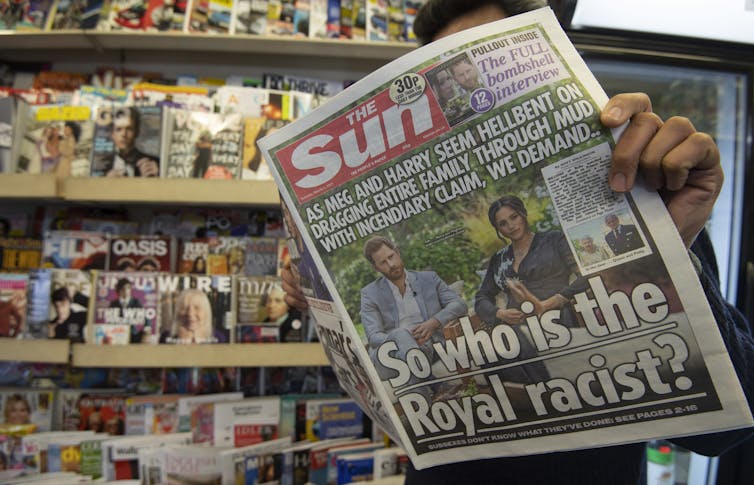 Harry and Meghan would not say who had raised concerns about the colour of their unborn child’s skin, other than specify it it was not the queen or Prince Philip.
Facundo Arrizabalaga/EPA/AAP
Harry and Meghan would not say who had raised concerns about the colour of their unborn child’s skin, other than specify it it was not the queen or Prince Philip.
Facundo Arrizabalaga/EPA/AAP
It’s impossible to ignore the structural racism of monarchy and empire, the historic support for and profit from slavery, King Edward’s overt racism and well-documented Nazi sympathies, and Prince Philip’s repeated racist comments – always politely and inappropriately dismissed as “gaffes”.
The inconvenient fact is that race is the logic of empire and the driver of imperial expansion. It lies at the heart of notions of dynastic monarchy and of a hereditary title of the blood. “Blue blood” is a thing.
Nor is it any coincidence there has been a lack of racial diversity in the queen’s body guard and royal household. Despite the existence of a diversity policy, Buckingham Palace acknowledges “more needs to be done” and is set to appoint a “diversity tsar”.
Until Markle, there was also no diversity in the royal family. Little wonder her arrival caused consternation over the prospect of colour entering the family — and even how much colour — as she related.
A palace above politics?
These unsettling revelations are the latest of several instances where the veil of royal secrecy has been lifted. None has been welcomed by the palace.
The 2015 release of the “black spider memos” from Prince Charles to members of Tony Blair’s government, revealed our future king’s personal input into government policy. In February, The Guardian showed the queen’s interference in legislation through the process of royal assent in order to advance and protect the financial interests of herself and Prince Charles.
Read more: The queen's gambit — new evidence shows how Her Majesty wields influence on legislation
My own palace letters legal case revealed the queen’s embargo over a vast array of historic documents held in our National Archives, including her extensive correspondence with Governor-General Sir John Kerr, about Kerr’s prospective dismissal of Gough Whitlam’s government.
Soon to be released letters between Kerr’s predecessor, Governor-General Sir Paul Hasluck, and the queen are likely to further highlight the queen’s involvement in political matters during the Whitlam government.
The very real and much denied political power of the queen and the monarchy is now beyond dispute, thanks to the breakdown in royal secrecy to which this interview has contributed.
Institution vs family
In this display of royal family breakdown, one thing that stood out is the impossible duality of the monarchy as both institution and family. It succeeds as the former only by destroying the latter.
This is The Firm, the institutional family made up of the senior royals, staff, a clique of aristocratic courtiers, centuries of ritual and a fixed institutional memory, and yet bigger than them all. It speaks as one, follows protocol as one, and everyone knows their place.
In the process, the usual human interactions even within the family are stripped back to a callous and unresponsive dynastic dysfunction.
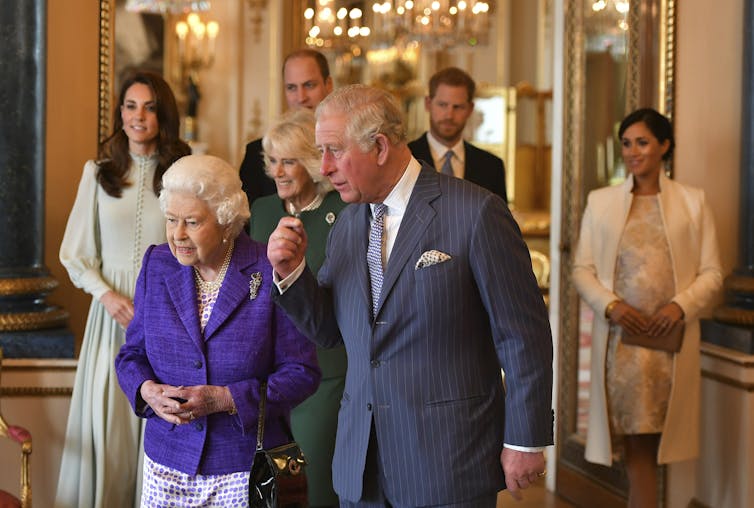 The royal family still has rules and protocols when interacting in private.
Dominic Lipinski/AP/AAP
The royal family still has rules and protocols when interacting in private.
Dominic Lipinski/AP/AAP
Markle’s professed shock at having to curtsy and Harry having to bow to the queen in private — “but she’s your grandmother!” — illustrates the surreal formality and artifice that governs their every move.
It is difficult not to feel sympathy for Harry after his public revelation his father stopped taking his calls and that after initially inviting him to dinner, the queen was “too busy” to see him before he and Meghan left for Canada. The royal courtiers, in his view, had stepped into this “family” matter and put the interests of the monarchy first.
It is a rare and unpalatable window onto a strangely Victorian mindset that remains unchanged in its settled imperial form and uncertain of its contemporary role. The palace has shown itself unable and unwilling to adapt to the expectations of a modern liberal democracy in which we should make our own choices and fully govern ourselves.
What now for the Australian Republic Movement?
The Australian Republic Movement has certainly felt the impact of the Meghan and Harry interview, despite claims to the contrary.
It saw a marked increase in members in the week after this deeply damaging interview aired, reflecting broader concerns about the dynastic dysfunction it revealed and the growing incongruity of our residual monarchical ties.
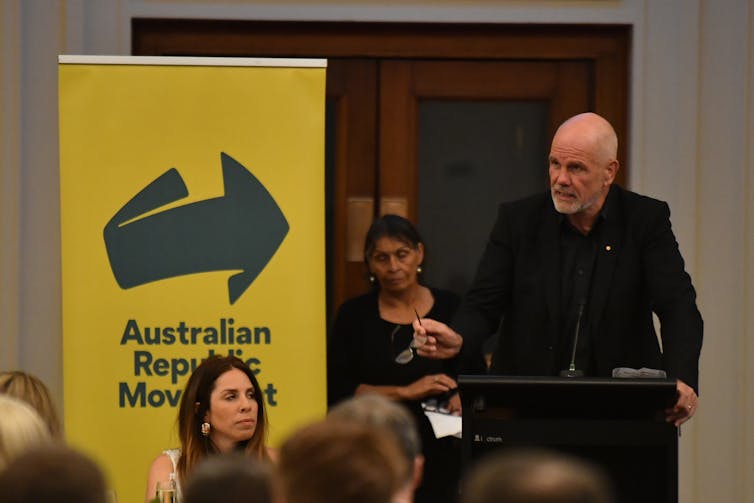 Peter FitzSimons is chair of the Australian Republic Movement.
Mick Tsikas/AAP
Peter FitzSimons is chair of the Australian Republic Movement.
Mick Tsikas/AAP
This comes on top of a 19% increase in members over the last year — despite the difficulties of COVID and lockdowns.
Opinion polls consistently show that a significant number of Australians support a republic – so why aren’t we one?
A new model
For some time, the Australian Republic Movement has been working towards a new model for a republic with an Australian head of state, with major input from public submissions, discussions with expert groups and all political parties to develop a consensus position.
The proposed model will be released by the end of this year.
The core requirements of any successful model are
it has enough bipartisan political support to pass through parliament as the formal referendum question
it needs to reflect the lessons of the unsuccessful 1999 referendum and bridge the artificial divide between an “elected or appointed” model, which drove a wedge between republicans last time
most critically, it must be able to win the support of the Australian public.
Read more: Is Australia ready for another republic referendum? These consensus models could work
If we can do those three things, then an Australian republic is not far off.
It has been more than a generation since the 1999 republic referendum and one of the strongest sentiments for retaining the monarchy — that a republic would be seen as “ditching the queen” — is fast losing relevance.
We are getting closer to the day when the queen will be succeeded by King Charles of Australia and the choice then will be stark. Do we embrace a post-colonial future of independence and autonomy in all matters of governance? Or retain this residual connection with a monarch and a monarchy out-of-step with expectations of democratic practice?
‘If you can see it, you can be it’
In a very different context in the Oprah interview, Markle spoke of the importance of representation for all peoples. She talked of a line from one of her son’s books,
if you can see it, you can be it.
This resonates with questions about our own head of state, which is neither representative of us, nor something we can aspire to. It is and can only be the British monarch - we can see it, but we can never be it nor have a say in who it is. This is the defining familial privilege at the heart of monarchy itself, based on notions of superiority and heredity which are completely at odds with a modern democracy in which representation, accountability, and transparency are central.
Our head of state should be one of us, not one of them.
Authors: Jenny Hocking, Emeritus Professor, Monash University
Read more https://theconversation.com/after-oprah-what-will-it-take-to-revive-an-australian-republic-156958


 Daily Bulletin


